

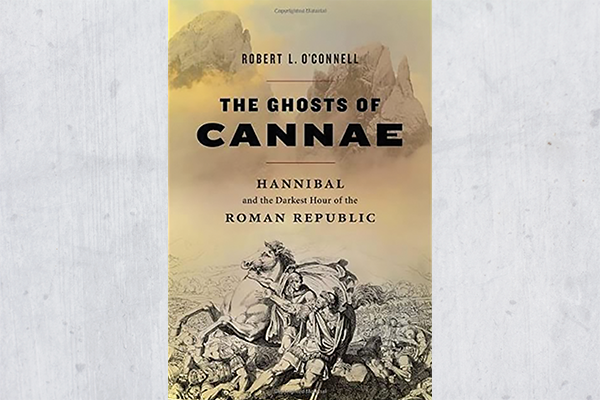
Two massive armies estimated at about 120,000 men met on the plains of southeastern Italy 2,200 years ago and engaged in “what amounted to a mass knife fight” that claimed the lives of an estimated 50,000 Roman soldiers – in one day.
The Battle of Cannae remains “the costliest day of combat for any army in history,” author Robert L. O’Connell writes in The Ghosts of Cannae: Hannibal and the Darkest Hour of the Roman Republic (310 pages; Random House). Rome lost more soldiers on 2 August 216 B.C. “than any other army on any single day of combat in the entire course of Western military history.”
The massacre occurred during the Second Punic War between Rome and Carthage, which, like World War II, “followed … from the unfinished business of the first.”
At its core, Rome “was a place made by war,” O’Connell writes; warfare “was in essence the local industry.” In contrast, Carthage, in modern-day Tunisia, North Africa, was the commercial center of Phoenician trade. The written language of Carthage was devoid of vowels and really was “best at recording transactions, not thoughts,” the author relates.
Rome defeated Carthage in the First Punic War, when Hannibal’s father commanded the Carthaginian army. Thus Hannibal learned to hate Rome. And after he besieged and conquered Rome’s ally Saguntum, in Spain, Rome declared war.
Hannibal set out to invade Italy, crossing the Alps with elephants and a full baggage train. He launched his assault on Rome with perhaps 90,000 infantry and 12,000 cavalry, along with 37 elephants, O’Connell reports.
An army that size would have consumed at least 120 tons of food each day and would have required forage for thousands of horses and mules plus the elephants.
During the treacherous march, some of his troops turned back, some deserted, many died, and many were killed in battles with native Gauls of western Europe. Consequently, Hannibal arrived in Italy with approximately 26,000 members of his original force.
The Carthaginian army rested and recuperated from its harrowing journey, and was joined by many Gauls who also hated the Romans (the enemy of my enemy is my friend). In time, Hannibal’s army grew substantially.
In late 218 B.C., Hannibal’s troops defeated a Roman army at the Battle of the Trebia, the first major battle of the Second Punic War. Next, Hannibal crossed the Apennine Mountain range that extends along the length of the Italian peninsula, and at Lake Trasimene he destroyed another Roman army in the summer of 217 B.C.
The Romans mounted a force of approximately 70,000 infantry and cavalry to engage Hannibal’s army of about 40,000 infantry and 10,000 cavalry at Cannae. Hannibal positioned his lines toward the north, forcing the Romans to face mostly to the south, where the hot wind blew dust and grit into their eyes. In addition, Hannibal confined the Roman legions in a narrow valley.
He also allowed the Romans to punch through the center of the Carthaginian lines but enveloped them on the flanks and then slaughtered them. The Romans were “burdened with between 50 and 80 pounds of arms and armor” that included a shield, a double-edged sword a little over 2 feet long, a helmet and chest protection, and it was a scorching hot summer day.
In an area not much bigger than a square mile, approximately 50,000 legionnaires and Roman cavalrymen lay dead and dying; the Carthaginian army captured about 10,000 prisoners, and about 14,000 Romans somehow escaped.
Hannibal’s troops suffered approximately 6,000 combat deaths and 10,000 wounded.
Thus, in two years Hannibal’s army had slain or captured at least 100,000 Roman soldiers.
(Also, as 216 B.C. came to a close, word reached Rome that a magistrate of the Roman republic who was sent to Cisalpine Gaul with two legions plus allies to break the rebellious Celts was ambushed and his entire army of 25,000 soldiers was annihilated. The victors decapitated the fallen Roman consul, hollowed out his skull, and used it as a drinking cup.)
Many of the Roman captives from Cannae were sold into slavery; as many as 1,200 of them were finally repatriated in Greece, and 28 years after the battle a “substantial number” of the captives were found in Crete and sent home, O’Connell reports. The Roman Senate, which dominated the state, banished the survivors of Cannae to Sicily for more than a decade, considering them to be essentially deserters; they were joined “by refugees of other armies similarly pulverized” by Hannibal.
Ironically, despite winning the battles Hannibal ultimately lost the war; the Romans gradually restricted his freedom of movement. “One triumph simply led to another triumph and another, until he found himself confined to a rut in the toe of the boot of Italy and eventually back in Africa” after 13 years of waging war in Italy, the author writes.
Hannibal lived for almost two more decades, “occupying a place … on the fringes of high politics” but little else, and Carthage sued for peace. Hannibal was elected a senior executive of the Carthaginian government in 196 B.C. The Roman Senate sent three of its members to Carthage to indict Hannibal, but he “discreetly left town” and wandered. Eventually he ended up in what today is Turkey, where he was employed as a city planner. The Romans pursued him again; he attempted to escape but was trapped, and at the age of 63 he committed suicide by consuming poison.
Hannibal “died much as he had lived, as a paladin and warlord,” O’Connell says.
And the “lethal brilliance” of his maneuvers at Cannae “was of such an order that the encounter became one of the most studied and emulated battles, casting a long shadow over military history and the profession of arms even to this day.”