

In the American South of the early 20th century, it was not uncommon for a black man to be accused of raping a white woman and subsequently convicted by an all-white male jury in a sham trial. Nor was it unusual in the South for a black man to be summarily executed by a bloodthirsty mob of white men never held accountable for their actions.
But in an extraordinary case from 1906, the Supreme Court of the United States brought criminal charges against nine Tennessee law-enforcement officers and 18 private citizens suspected of ignoring a stay of execution granted to an unjustly convicted black laborer and participating in his lynching.
To this day, it remains the only criminal trial the Supreme Court has ever conducted in its 232-year history.
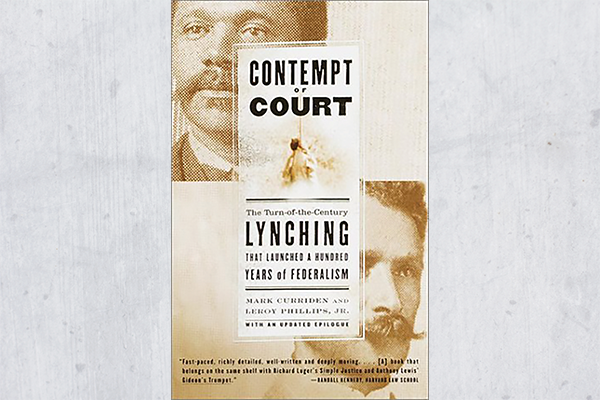
The obscure event is reviewed in “Contempt of Court: The Turn-of-the-Century Lynching That Launched a Hundred Years of Federalism,” by Mark Curriden, a Dallas legal affairs journalist, and the late Leroy Phillips Jr., a Tennessee trial attorney (Anchor Books, 394 pages).
The case revolved around one Ed Johnson, a young black man who dropped out of school in the fourth grade and performed odd jobs.
On the evening of Jan. 23, 1906, a 21-year-old white woman was attacked, choked with a strap and raped while en route home after work as a bookkeeper for a downtown Chattanooga, Tennessee, grocery store.
In less than two days, Johnson was arrested and charged with the crime. He was convicted by an all-white jury on Feb. 11 and sentenced to hang a month later, on March 13, 1906.
Soon after the verdict, Johnson’s father asked Noah Parden, a prominent local black attorney, to appeal his son’s conviction. Reluctantly, Parden – who has an Oklahoma connection – agreed.
Parden and an associate – neither of whom was part of the original defense – quickly appealed to the Tennessee Supreme Court but were denied. Then Parden appealed to a federal district court in Knoxville.
In 1906, the U.S. Supreme Court had previously said that the Bill of Rights was not binding on the state court system in criminal cases, and the Justices did not recognize a criminal defendant’s right to effective counsel nor a constitutional right to a fair trial. Consequently, the federal judge denied Parden’s petition, but the jurist extended the execution date 10 days to allow the defense enough time to petition the nation’s highest court.
Parden traveled to Washington, D.C., and made a personal appeal to Supreme Court Associate Justice John Marshall Harlan on March 17, which was a Saturday. Only once before had a black lawyer from the old Confederacy taken a petition to the nation’s highest court, and Parden’s appointment was the first time a black man had ever argued a case before a U.S. Supreme Court Justice.
In a brief he submitted to the jurist, and during his oral presentation, Parden asserted that Johnson was almost certainly innocent and was not afforded a fair trial. (The wrongs heaped upon his client were lengthy and despicable.)
Nevertheless, the deck was stacked against Parden. It had been years since the nation’s highest court had stayed an execution or reversed a murder conviction, the authors write. “And no one could remember a single black man the justices had ever saved from the gallows.” Federal courts “had never been a friend to the black man in America.”
To achieve his goal of saving Johnson’s life, Parden “needed to convince the Supreme Court to make the right to a fair trial, as guaranteed in the Sixth Amendment to the U.S. Constitution, binding on state courts.” Parden was asking the Court to intervene directly in a state court criminal trial for the first time in the nation’s history. He argued that under the 14th Amendment Johnson was entitled to “due process” under the law.
Justice Harlan granted a temporary stay of execution on March 18, 1906, believing the condemned man “deserved a full and impartial hearing” on Parden’s claims of a rigged trial.
Instead, the next day an enraged lynch mob broke down the jail door, dragged Johnson out to a bridge, hanged him from a metal girder and shot him multiple times for good measure.
The district attorney who prosecuted Johnson, and the trial judge, a Civil War veteran who served in the Confederate Army, passively watched the entire raid on the detention center from a courthouse window.
“From the time the assault on the jail began, to the moment Ed Johnson’s body was lifted into the air, more than three hours had passed,” Curriden and Phillips write. Yet during that time, “not one sheriff’s deputy, city police officer, state militia member, or local leader appeared at the jail to attempt to prevent the lynching.” No police reports were ever filed.
Fifty-three days after he was arrested for and charged with a crime he probably didn’t commit, Ed Johnson was dead.
News of the lynching reached the U.S. Supreme Court the morning after it happened. The Justices were stunned and infuriated by the blatant defiance. Less than 48 hours after the lynching, the U.S. Attorney General sent two Secret Service agents to Chattanooga to begin collecting evidence.
On May 28, 1906, the U.S. Justice Department filed official papers at the Supreme Court against Sheriff Joseph Shipp, eight of his deputies, and 18 Chattanooga merchants and private citizens, charging them all with criminal contempt of court.
The Supreme Court appointed a commissioner to preside over the evidentiary hearings, listen to witnesses and make an official record, which the Justices reviewed.
Ultimately the Supreme Court convicted Sheriff Shipp, Chief Jailer Jeremiah Gibson, and four members of the lynch mob: Nick Nolan, Luther Williams, Henry Padgett and William Mayes. The other 21 defendants were either exonerated or the charge against them were dropped for lack of sufficient evidence.
In 1909 the high court imposed 90-day prison sentences on Shipp, Williams and Nolan, and 60-day sentences on Gibson, Padgett and Mayes. All six were confined in the federal jail in Washington, D.C.
Nearly every single federal constitutional issue that Noah Parden raised in his appeal of Johnson’s conviction “became legal precedent in the decades that followed.” Parden never returned to Chattanooga; instead, he toured the North for a while, lectured on events in the Johnson saga, and eventually moved to Oklahoma, where it’s believed he started a small newspaper.