

FARM BANKRUPTCIES
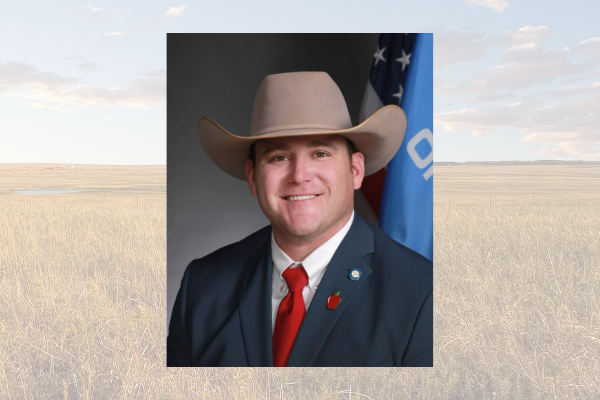
OKLAHOMA CITY – “There is no one single thing you can point to as the cause for the rise in farm bankruptcies," said state Rep. Trey Caldwell, a fifth-generation farmer/rancher in Comanche County. “It’s a multitude of things,” including global climate change, rising interest rates, commodity prices, too much rain or too little, hefty prices for equipment, and a trade war with China.
“Each year, our nation’s farmers, especially those operating small and mid-sized family farms, face numerous challenges in their operations,” echoed Johna- than Hladik, policy director for the non-profit Center for Rural Affairs based in Lyons, Neb. The “biggest reason” for farm bankruptcy today is “the rising cost of inputs,” said Caldwell, R-Lawton, who earned a degree in business administration from Cameron University.
For example, he said, the average cost of a tractor used to be $70,000; now it’s $150,000 to $170,000. A new combine costs “somewhere in the $265,000 to $300,000 range.” A swather (a/k/a windrower) can cost $168,000. A “decent” tractor will cost “in the range of $65,000 to $80,000.” A diesel-powered dually flatbed farm truck can cost $50,000 to $70,000, Caldwell said.
Other costs include fertilizer, insurance and diesel for farm vehicles. “All of that has increased drastically,” he said. The relative value of land in southwest Oklahoma is “below average” because it is “subpar ground” – lots of sandy red clay – Caldwell said.
Nevertheless, that land isn’t cheap. “They aren’t making any more of it,” he quipped. Also, many urban dwellers are moving to the country to taste the rural lifestyle. “Many people want 10 acres in the country” in order to get away from the traffic congestion, the crime and the burgeoning population, Caldwell observed.
Meanwhile, interest rates have “gone up” but commodity prices have “gone down or remained the same.” Farmers are “being squeezed,” Caldwell said. “The relative value of the farmer’s product has dropped or stayed the same, but the cost of the inputs to raise that product have gone up.” Another factor contributing to farm bankruptcies is the weather. “We don’t have irrigation” in southwest Oklahoma, with the exception of the Lugert-Altus Irrigation District in Jackson County, he said.
Proper soil management, no-till farming, and cover crops (which are planted to manage soil erosion, soil fertility, soil quality, water, weeds, pests, diseases and biodiversity) are essential in southwest Oklahoma because, “At the end of the day, we’re 100% dependent on whether it rains and how much it rains,” Caldwell said. “Our yearly average rainfall is 30 inches, and 20 of those come on six days of the year,” he said. “And our soil doesn’t
The relative value of land in southwest Oklahoma is “below average” because it is “subpar ground” – lots of sandy red clay – Caldwell said. Nevertheless, that land isn’t cheap. “They aren’t making any more of it,” he quipped. Also, many urban dwellers are moving to the country to taste the rural lifestyle. “Many people want 10 acres in the retain much water; most of it runs off into the Red River.”
Caldwell said he planted 242 acres of dryland alfalfa this year, with no irrigation. “We ended up with about a 30% success rate,” he said. “It probably costs about 10 times more to raise alfalfa hay than it does to raise wheat. That’s why we rotate crops.” Hurchel “Trey” Caldwell III owns and leases land in Comanche County on which he grows alfalfa, wheat and cotton. He also has approximately 60 head of cattle and custom cuts/bales about 2,000 acres of hay each year. In addition, Caldwell, 30, is an Oklahoma Farm Bureau insurance agent and for the past year has represented District 63 in the Oklahoma House of Representatives.
Despite the challenges, Caldwell said he’s a farmer/ rancher because of his love for the soil. “If you don’t have a passion for it, it’s really hard to justify doing it,” he said. “It gets harder and harder every day to succeed.” He said he has friends “who knew what they were doing, who have college degrees, who are not lazy, but still they didn’t work out.” Calls fielded by suicide hotlines in “farm country” have risen. Mental health experts report more suicides in farm country as bankruptcies and loan delinquencies increase, weather events destroy crops and profits disappear.
The agriculture industry is “very cyclical,” Caldwell noted. "It’s not so much boom-or-bust," he said. “It’s more like bust or break even. A farmer/rancher needs to turn a good profit one year to be able to weather the next four down years," he said.
Fortunately, the government provides support structures designed to help keep farmers and ranchers solvent. These include the U.S. Department of Agriculture’s Farm Service Agency, which provides myriad types of financial assistance, conservation programs, disaster relief programs and some price support programs.
The federal government also subsidizes crop insurance. “Without the subsidies, farmers couldn’t afford it,” Caldwell said. The United States has “the safest and cheapest food and fiber supply in the history of the world,” he said, “because we have protections against the down markets.”