

By The Editorial Board of Southwest Ledger

On Aug. 27, Oklahoma voters will be asked to make informed decisions that will impact on our lives. They will cast their votes in runoff elections to decide who is going to craft policy and pass legislation that will shape our great state for years to come. They will do so at a time when many Oklahomans contend we are treading water.
In at least one race there are serious questions of privacy, candor and transparency. While many have had errors in judgement in their youth and have gone on to become mature, responsible, contributing members of society, are voters not entitled to the full truth of their candidates so they are able to make informed decisions?
Living in a republic places a great deal of burden on the people. Not having a direct say in governing, it is their duty to elect the correct person for positions of power to make decisions that will ultimately affect not only their lives but the lives of future generations.
When our Founding Fathers considered a republican form of government, they were influenced by several political philosophers such as John Locke (1632-1704) and Charles Louis de Secondat, Baron de La Brède et de Montesquieu (1689-1785), but one who had a great deal of influence on republicanism was Henry St. John, First Viscount Bolingbroke (1678-1751), who in 1738 wrote "The Idea of a Patriot King.”
While Bolingbroke was speaking about monarchs, his ideas were applied to all government leaders—especially elected ones. He argued all political leaders should have moral character and act in the best interests of the people they governed. A key issue for him was that the people needed to be able to trust their leaders, which implied strict transparency. Bolingbroke wrote, "A King who can be suspected of private views, and of governing with a regard to them, is the most dangerous enemy to the whole nation." While he did not discuss transparency specifically, Bolingbroke’s concept of trust suggests candidates in a republic must be open and forthright to allow the people to make informed decisions about whom they elect.
One of Bolingbroke’s disciples was Founding Father and second U.S. President John Adams. Adams (1735-1826) wrote a letter to poet, playwright and historian Mercy Warren in 1776, the same year our Declaration of Independence was created. America was years away of creating our republican government, but as they had begun their fight for freedom, it was clearly on their mind.
Writing about a republican form of government, Adams wrote “The Form of Government, which you admire when its Principles are pure is admirable indeed, it is productive of every Thing, which is great and excellent among Men. But its Principles are as easily destroyed, as human Nature is corrupted. Such a Government is only to be supported by pure Religion or Austere Morals.
“There must be a positive Passion for the public good, the public Interest, Honour, Power and Glory, established in the Minds of the People, or there can be no Republican Government, nor any real Liberty: and this public Passion must be Superiour to all themselves, and be happy to sacrifice their private Pleasure, passions and Interests, nay their private Friendships and dearest Connections, when they stand in Competition with the Rights of Society.”
When Adams wrote private pleasure must be sacrificed, he singled out privacy.
A candidate seeking election to an office where he would help create laws that affect his family, neighbors and people he doesn’t know, must be willing to place his private life under the lens of the public microscope. Any legislative candidate who asks the public to trust his judgment must be willing to submit to complete transparency. How else can he be trusted?
At the risk of being verbose, let us consider the words of John Stuart Mill, a 19th century English philosopher, politician and civil servant, who wrote, “The best government is that which is most responsible to the people, and where responsibility exists, public opinion will force those who have power to make their conduct public.”
Mill believed that government officials need to be fully accountable to their constituents, which can only be achieved through transparency.
We do not suggest that past transgressions should automatically disqualify any candidate from pursuing their calling to be a public servant, but rather that voters in a republic should expect the full account so they may make an informed decision. As Mill wrote, “An informed electorate is the only way to maintain the integrity of democracy.”
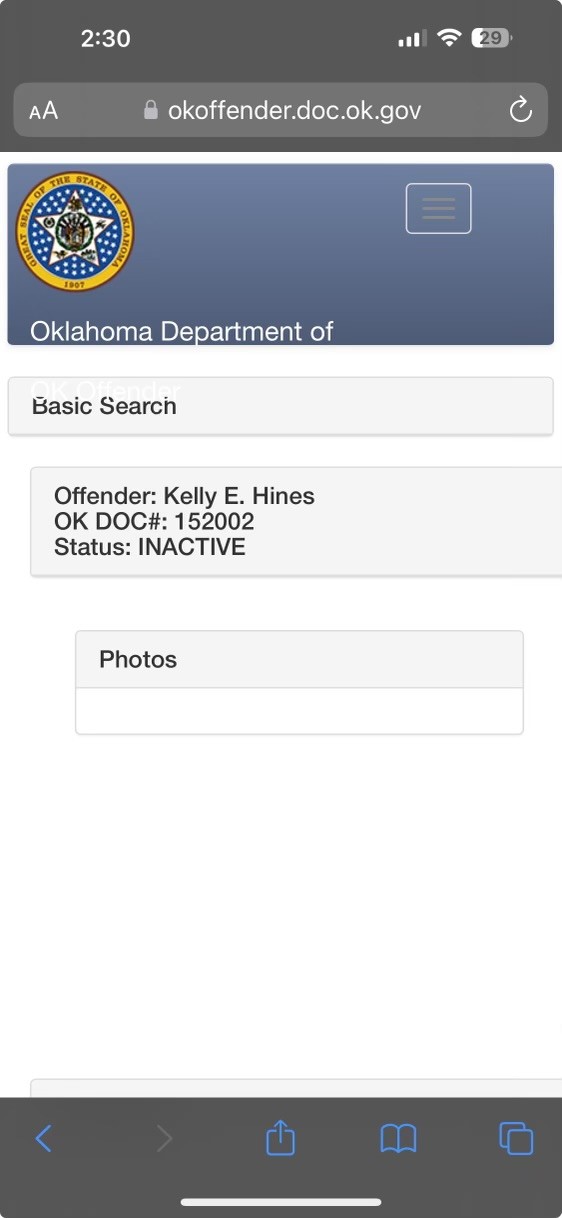
The Editorial Board of Southwest Ledger contends that Kelly Hines, Republican candidate for Oklahoma State Senate District 47, (northwest Oklahoma City, Edmond, Bethany and Deer Creek), should be forthright with voters as to why he has been shackled with Oklahoma Department of Corrections inmate number 152002.
Hines has been flippant with the press about this matter, stating he doesn’t know why he has a DOC inmate number. Surely, he doesn’t expect Oklahoma voters to assume that’s nothing more than a DOC clerical error. If that were so, he would have and should have fought to clear his name long ago.
For the sake of transparency, the Editorial Board of Southwest Ledger respectfully requests that Kelly Hines have an open and honest conversation with the public so voters in state Senate District 47 are able to make a fully informed decision on Aug. 27.