

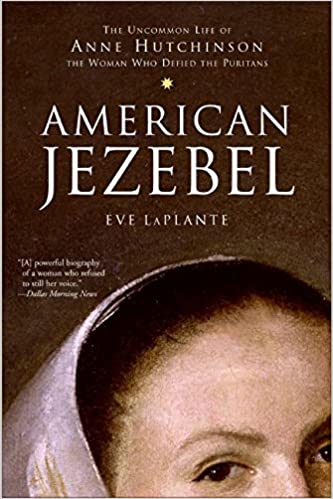
The women’s liberation movement began in the 1960s, but a courageous woman who epitomized feminism appeared in New England 360 years earlier.
In a time when no woman could vote, teach outside the home or hold public office, Anne Hutchinson demonstrated the intellect, courage and will to challenge the judges and pastors who founded and ran the colony of Massachusetts.
Anne Hutchinson has “never been widely understood or her achievements appreciated and recognized,” author Eve LaPlante, a distant relative, laments in “American Jezebel” (HarperSanFrancisco, 312 pages).
Hutchinson was the wife of a wealthy textile merchant and gave birth to 15 children. In the latter half of the 17th century Massachusetts was a British colony of approximately 7,000 settlers.
Hutchinson’s family was a clan of nonconformist rebels. Her father’s repeated challenges to Anglican authorities led to his censure and imprisonment; in 1580, at age 25, he was released from prison for the third time, but he was convicted again and placed under house arrest for three years. Her brother-in-law was censured by the Church of England in 1632, prompting his exile to Massachusetts, where he was convicted in 1637 of sedition and “contempt of the civil authority,” censured and banished from the colony.
Hutchinson’s greatest “crime,” and the source of her power, LaPlante relates, was a series of weekly meetings she held at her house to discuss Scripture and theology. At first, in 1635, the evening meetings had been just for women, but the next year men began to accompany their wives to her events. Her audience often numbered 80 men and women.
The “model” 17th century Englishwoman was “modest, meek, submissive, virtuous, obedient and kind, solely occupied with supervising and maintaining the home, cooking, sometimes brewing and dairying and bearing and rearing children,” LaPlante writes. “She was expected to suffer all these in silence…”
In colonial Massachusetts, women were barred from the ministry, from voting on church membership, from participating in church services, from talking in church, and within the meetinghouse they entered by a different door and sat apart from the men on a separate side of the church.
Hutchinson, though, was well-educated by her father, Francis Marbury, a Cambridge-educated minister of the Church of England, a schoolmaster and Puritan reformer. (Puritans were a group of English Reformed Protestants who sought to “purify” the Church of England from its “Catholic” practices.”) Marbury implanted in his daughter a willingness to question, and even to show contempt for, authority.
Mrs. Hutchinson maintained that salvation could be achieved only by God’s grace; good works were not irrelevant to salvation but were not necessary for it. Her principal detractor, John Winthrop, the first governor of Massachusetts, deemed that doctrine to be blasphemy.
At that time, most homes contained fewer than four books, at least one of which was the Bible. “It is not possible to exaggerate the importance of Scripture to this community,” LaPlante emphasizes. Children learned to read, if they did at all, from the Bible. Families studied it together daily, reading it aloud over several months” from cover to cover, “and then starting again.” The life of a Puritan “was in one sense a continuous act of worship,” historian Patrick Collinson wrote.
In Winthrop’s view, one of Hutchinson’s biggest offenses was “her criticism of the ministers with whom she disagreed,” the author writes. Hutchinson claimed that only two ministers in the colony preached the truth.
Winthrop condemned her as an “instrument of Satan” and called her “this American Jezebel,” equating her to an evil and shameful woman in the Bible. In addition, several ministers considered her a witch. This was a prelude to the infamous Salem, Mass., witch trials of 1692-93.
Hutchinson was summoned to answer to the Great and General Court of Massachusetts, which was then the only court established in the fledgling colony. The judicial, administrative, legislative and executive functions were all intertwined in the General Court, as well as the religious authority, a court archivist in modern-day Boston wrote. “This court’s vast power … limited people’s freedom to a degree that is unimaginable today,” LaPlante writes.
(Hutchinson’s trial reeks from the stench of hypocrisy. In England the Puritans had been “hounded by the Church of England authorities, silenced, and in a few cases imprisoned,” LaPlante reports. In Massachusetts, though, they “ran the state church” with an iron fist.)
Hutchinson, 46, stood trial although no charge had been filed. Winthrop “couldn’t accuse her of contempt against the state nor of sedition, because as a woman she had no public role.” And she could not be silenced or punished with disfranchisement “because as a woman, she had no voice or vote.”
Winthrop served as both chief judge and chief prosecutor, and hastily appointed two new judges to replace three who had expressed support for Hutchinson. By colonial decree she had no right to legal counsel and even her husband could not testify on her behalf. Ministers and deputies of the Massachusetts court were present as witnesses and to advise the prosecution, but the defendant was allowed no legal assistance or advice. (The term “kangaroo court” comes to mind.)
Hutchinson ably held her own – the historical written record of her trial survives to this day – but was nevertheless convicted of heresy and banished from Massachusetts colony in November 1637. Four months later the Church of Boston excommunicated her.
The Hutchinson family moved approximately 40 miles away to Providence Plantation, and 30 other families voluntarily accompanied Anne in her exile. The men created the new settlement of Rhode Island and Anne’s husband, Will, became Rhode Island’s first governor.
One of the first written rules of the new settlement was that no one in the colony “shall be in any [way] molested, punished … or called into question on matters of religion…”
In 1642, after her husband died, Hutchinson took her younger children and moved to the Dutch colony of what became New York. The next year, rampaging Siwanoy Indians responding to a murderous attack by Dutch soldiers on a band of natives camped on Manhattan Island scalped Anne and six of her children, captured her 9-year-old daughter, and burned down their house.
Anne Hutchinson’s great-great-grandson, Thomas Hutchinson, became the royal governor of Massachusetts in 1771-74. And in 1987 Massachusetts then-Gov. Michael Dukakis formally pardoned her, 350 years after John Winthrop ordered her “banished from our jurisdiction as a woman not fit for our society.”
In addition, she was indirectly the “midwife” responsible for Harvard University, LaPlante claims. Because of Anne’s “heresy,” the Massachusetts court decided to build the colony’s first college as a way to minimize her “seditious” brand of religion. The college was later named for newcomer John Harvard, who bequeathed half of his estate and his extensive library to the school.