

LAWTON – A race to be the first bank in the new prairie town of Lawton turned out to be a little tricky.
Although the U.S. government adopted a lottery system to open the Kiowa-Comanche- Apache Reservation on Aug. 6, 1901, instead of the chaotic land runs, anxious homesteaders and entrepreneurs had been lurking and scouting the area for over a year, reported local newspapers at the time.
Among those scrambling to achieve the “first” status were a group of bankers wanting the title in the name of their bank. As the story goes, recorded by early-day local historian Arthur R. Lawrence in his book “Lawton Golden Anniversary, 1901-1951, 50 Years of Progress,” three bankers from Wichita Falls, Texas, made a trip to Fort Sill in February 1901.
They wanted to explore opportunities on the KCA Reservation that would be opened soon to settlers.
They stopped for lunch at the Indian Sub-Agency where three Indian traders had stores. A brother of one of the traders learned the purpose of their trip and told them there was no need to meet with the Fort Sill Post Trader, William H. Quinette, whom the bankers wanted to interest in joining their venture.
The bankers were told to meet with George Paschal, one of the traders, before continuing their trip to Fort Sill.
They were also joined by Emmet Cox, husband of one of Comanche Chief Quanah Parker’s daughters, who had experience dealing with cattlemen.
Since the name of the new town hadn’t been decided yet, the three Wichita Falls bankers took out a charter in the name of First National Bank of Fort Sill. They thought the new town would take the Army post’s name, just like Fort Worth. The charter was issued by the Comptroller of the Currency in this name on March 23, 1901, with George M. Paschal, Emmet Cox, William M.
McGregor, William T.
Huff and William Keller listed as directors.
In an unexpected move, the new townsite was named Lawton in honor of deceased Army Major General Henry Ware Lawton, who was killed in overseas action in the Philippines. He had been laid to rest at Arlington National Cemetery on Feb. 3, 1900.
Once the name of the town was established, another group formed and took out a charter in the name of First National Bank of Lawton. Organizers of this bank were Sterling P. Richardson of Kingfisher, William Grimes, secretary of the Territorial State of Oklahoma, Charles Billingsley of Guthrie, Congressional Delegate Dennis T. Flynn and Walter C. Stevens.
Lawrence continued to explain that City National Bank had taken out its original charter in the name of the First National Bank of Fort Sill. A small frame bank building had been constructed on Fort Sill and was placed on rollers to bring to the new townsite when the former reservation was officially opened. The name First National Bank of Fort Sill could no longer be used since the other group took out their charter with the name First National. That prompted the name change to City National Bank of Lawton.
On Aug. 5, 1901, the new CNB building was rolled in from Fort Sill and placed west of the land office, near the intersection of what became Third and F streets. First National Bank opened in a tent and was located across the street from the land office at what became Third and D streets.
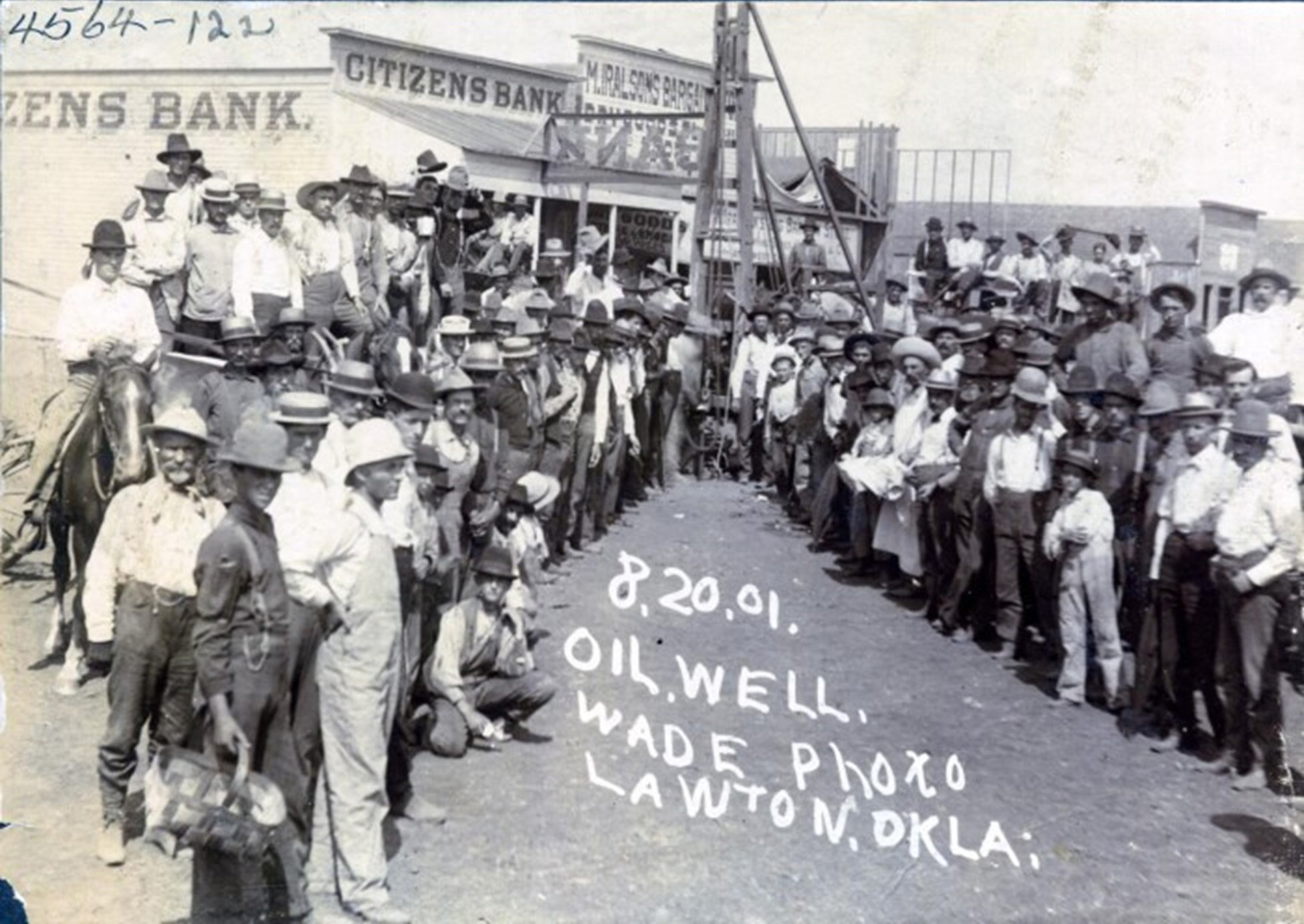
Another bank pictured in an Aug. 20, 1901, photograph was Citizens Bank. The American National Bank of Lawton originally organized on July 22, 1901, as the Citizen’s State Bank of Lawton, Oklahoma Territory, according to “The History of Comanche County Oklahoma, Vol. 1.” The organizers were F.W.
Smith, Jno. H. Porter, R.J. Schofield, all of Enid, and W.W. Dunlap of Newton, Kansas.
This bank opened in a temporary location on Aug. 15, 1901, in a tent while a wooden building was constructed.
Thieves had stolen the bank’s safe before the planned opening on Aug. 6 and the opening was delayed until the safe was recovered from Cache Creek where it had been tossed.