

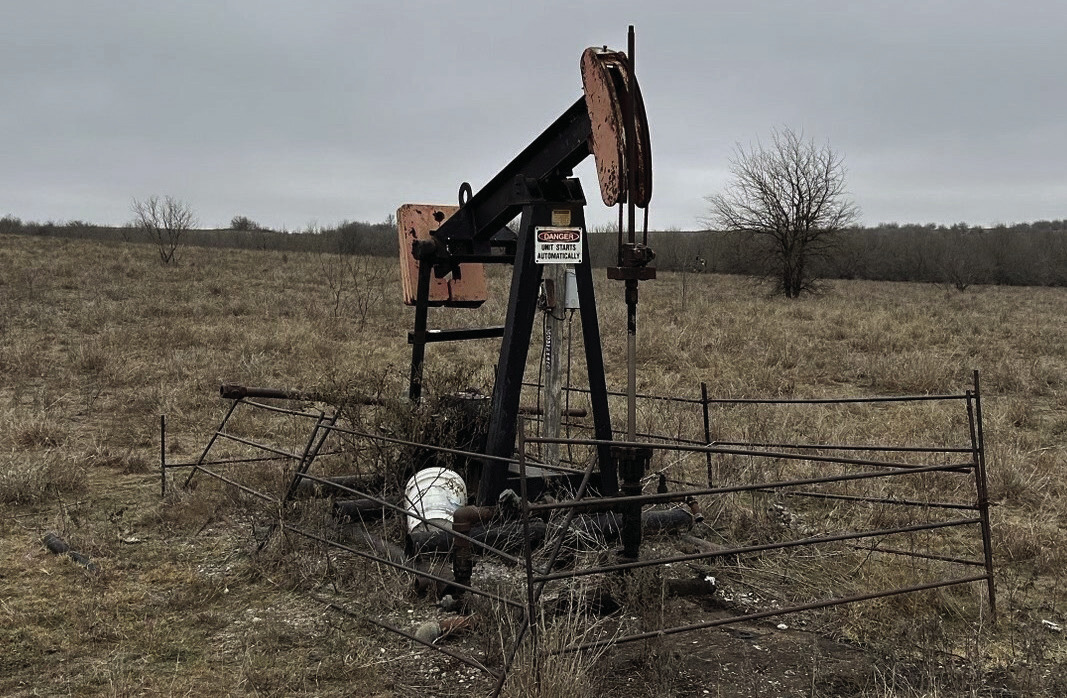
OKLAHOMA CITY –Two pieces of legislation that pertain to funding for plugging oil and gas wells in Oklahoma await floor votes in the state House of Representatives.
The issue is of vital importance across the state, because Oklahoma has more than 20,800 wells that are candidates for plugging, state Corporation Commission ledgers reflect.
House Bill 1369 by Rep. Brad Boles (R-Marlow) would require oil and gas drillers to meet new financial requirements for plugging wells, removing trash and equipment.
The bill decrees that effective Nov. 1, 2025, Category A surety would no longer be accepted as a valid form of surety for new operators. However, current operators who have valid Category A surety “and are in good standing” with the Corporation Commission would be able to retain their Category A surety “for the time they are a valid operator” in Oklahoma.
Category A surety is a financial statement in lieu of a bond.The statement must list the operator’s assets and liabilities and include a general release “that the information may be verified with banks and other financial institutions.” The financial statement “shall prove a net worth of not less than $50,000.”
Instead of Category A, the amount of surety required by a driller would be based on the number of wells the person operates.
• For one to 10 wells, the surety guarantee would remain $25,000.
• For 11 to 50 wells, the surety would double to $50,000.
• For 51 to 100 wells: $100,000; and
• For more than 100 wells: $150,000. Surety could include an irrevocable commercial letter of credit, cash, a cashier's check, a Certificate of Deposit, Bank Joint Custody Receipt, other negotiable instrument, or a blanket surety bond.
Upon certification by any operator that its plugging liability is less than the $25,000 standard amount based on the number of wells it operates, the commission could allow the operator to provide surety in a lesser amount “but at least sufficient to cover the estimated cost of all plugging, closure, and removal operations…” “What this bill is trying to do is help get more funding from industry if companies go out of business, so that we have a higher surety bond that goes back to the state, because the state has to take over these wells to plug them,” Boles told StateImpact Oklahoma.
A companion measure by Boles is House Bill 1370. As amended in committee, it would modify the apportionment structure of the excise taxes on petroleum oil and on natural gas.
Currently, 10.526% of all monies from the excise tax on petroleum oil and 10.5555% of all monies from the excise tax on natural gas are apportioned to the Corporation Commission Plugging Fund.
HB 1370 would modify the apportionment structure of those excise taxes by establishing a $10 million cap on each of them. Thus, the bill would quadruple the commission’s well-plugging fund, from $5 million now to a maximum of $20 million.
The amended bill also would extend the “sunset” date for the well-plugging fund for five years, to July 1, 2031.
Both bills cleared the House’s Energy and Natural Resources Oversight Committee chaired by Boles and whose members include Rep. Trey Caldwell (R-Faxon).
According to the Corporation Commission, Oklahoma has 18,300 abandoned oil and gas wells – many of which leak methane, a greenhouse gas – for which no owner can be found. Those include 1,380 “orphan” wells in southwest Oklahoma: • Caddo County: 98
• Comanche County: 290
• Cotton County: 166
• Grady County: 117
• Greer County: 16
• Jefferson County: 132
• Kiowa County: 57
• Stephens County: 485
• Tillman County: 18
• Washita County: 1 Another 2,520 wells are on the State Funds Well Plugging List. It is comprised of oil and gas wells for which the Corporation Commission has issued plugging orders because the wells were abandoned and the responsible operator went out of business, filed bankruptcy “or was otherwise noncompliant,” said Trey Davis, Corporation Commission communications manager.
Those wells will be plugged with funds derived from the excise taxes paid by oil and gas producers.
That list includes 198 wells in southwest Oklahoma: Caddo County, 4; Comanche County, 21; Cotton County, 13; Grady County, 3; Greer County, 33; Jefferson County, 10; Kiowa County, 89; Stephens County, 33; Tillman County, 1; and Washita County, 4.