

From staff reports Immigration remains a hot-button issue in the United States, with border recidivism, which has risen in recent years, being a key aspect of policy debates at the federal level and in Oklahoma.
Border recidivism is the rate at which people try to reenter the U.S. illegally after previously being caught and sent back to their home country.
The word “recidivism” is often used to describe how likely a formerly incarcerated person is to re-offend. The same concept applies to border recidivism, which U.S. Customs and Border Protection defines as the percentage of people apprehended by the U.S. Border Patrol more than once within a fiscal year (which begins on Oct. 1 and ends on Sept. 30 of the following year) for attempting to enter the U.S. illegally.
An apprehension is not the same as an arrest. Apprehension is when Border Patrol detains someone who is unlawfully in the U.S. It may or may not lead to an arrest, according to the CBP’s definition.
Border apprehensions totaled 1.662 million in Fiscal Year 2021 and climbed to 2.06 million in FY 2023, records reflect.
More than 80% of the people apprehended or denied entry between October 2020 and June 2024 were Latin Americans. More than a quarter of them came from Mexico, 8.9% from Guatemala, 8.5% from Honduras, 8.1% from Venezuela, and 6.2% from Cuba.
The federal government uses the border recidivism rate to measure how effective the Border Patrol is at preventing illegal immigration, according to a report from the U.S. Government Accountability Office. However, the measure has some limitations.
According to the GAO and the U.S. Department of Homeland Security’s Office of Inspector General, the border recidivism rate does not account for a person’s apprehension history over multiple fiscal years, nor does it consider individuals who have been apprehended but have no record of removal, which can lead to an underestimation of recidivism.
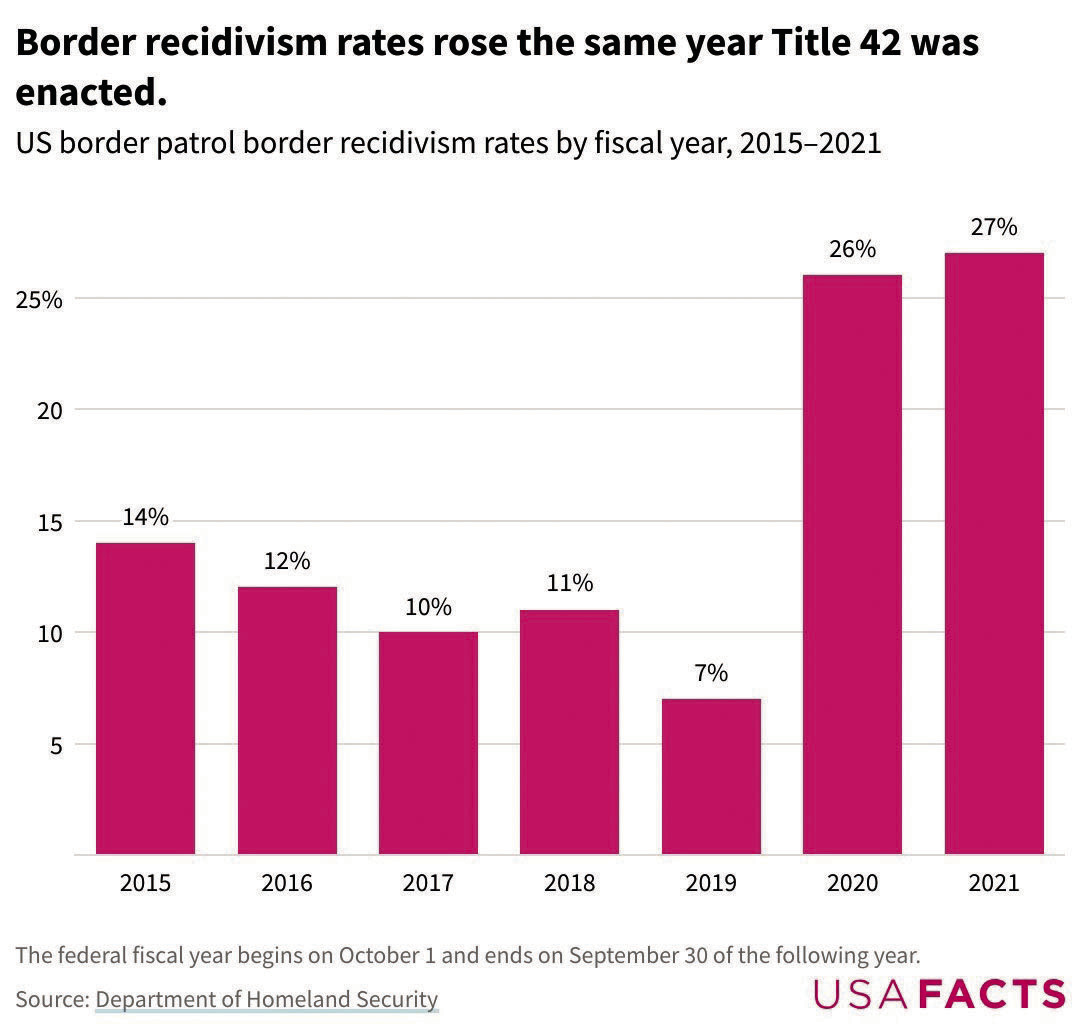
Recidivism rates had generally declined since FY 2015. However, this changed with the passage of Title 42 in March 2020, which made it easier for the government to expel migrants at the border and more difficult for people to seek asylum.
In FY 2015, 14% of expelled migrants attempted to reenter illegally. That rate fell to 12% in FY 2016. In FY 2019, just 7% of migrants were apprehended more than once.
Repeat border crossings increased in FYs 2020 and 2021, reaching 26% and 27%, meaning that more than a quarter of migrants attempted to illegally cross the border at least twice.
Between October 2019 and June 2024, Customs and Border Protection reported just under 11 million border encounters nationwide.
Monthly encounters peaked with more than 370,000 people in December 2023. That month, CBP encountered nearly 12,000 people at the border every day; that’s more than eight people every minute. Border encounters in the month of December 2023 exceeded the 337,000 border encounters in all of FY 2015.
As of June 2024, the last month of available CBP data, there were 1.44 million reported border encounters this year.
From October 2020 to June 2024, 81.3% of encounters occurred along the U.S./Mexico land border; 45.8% of nationwide encounters were along the Texas border.
Because of the staggering number of immigrants seeking to enter the U.S., the number of border patrol agents more than quadrupled in 30 years: from 4,139 in 1992 to 19,357 in 2022, according to the CBP.
How Titles 42 and 8 affect recidivism According to a 2023 Congressional Research Service report, the increase in border recidivism rates under Title 42 was largely due to the lack of penalties for expelled migrants if they attempted to illegally reenter the U.S.
Since the expiration of Title 42 in May 2023, the U.S. has resumed using Title 8 to govern the processing and removal of unlawful immigrants at the border. People who are deported under Title 8 are prohibited from reentering the United States for at least five years. If caught attempting to recross illegally, they could face prosecution and jail time and be presumed ineligible for asylum. Border Patrol data is not yet available to determine if border recidivism trends have reversed under Title 8.