

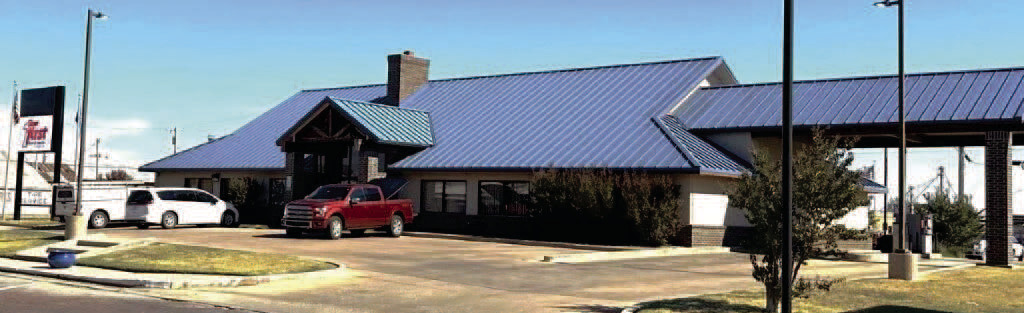

OKLAHOMA CITY — The co-conspirator in a fraud scheme that led to the collapse of a bank in Lindsay pleaded guilty Thursday in federal district court here to two felony counts. Shaun Urrea Christian, 57, of Lindsay, admitted participating in a conspiracy that led to the collapse of First National Bank of Lindsay almost two years ago, and to committing money laundering. He admitted he conspired with Danny Seibel, 55, FNBL’s former president and chief executive officer, to enrich himself and his businesses and to support a gambling habit. Christian “owned, operated, controlled, or was otherwise associated with several automotive businesses in and around the Lindsay area,” and was an FNBL customer, the indictment related. Seibel, who began working at the Lindsay bank in 1993 and became the CEO in 2007, handled all relevant FNBL loans issued to Christian’s businesses, federal investigators discovered. For four and a half years, from Feb. 25, 2020, through Sept. 20, 2024, Christian and Seibel “conspired to commit bank fraud,” the indictment charged. Seibel issued loans to Christian that Christian either never repaid or for which Seibel never recorded any payments, federal investigators discovered. Seibel was accused of manipulating bank records related to Christian’s accounts to conceal overdrafts and past-due balances. At meetings held by FNBL’s board of directors and executive loan committee, Seibel “failed to disclose the true extent of Christian’s overdrafts or pastdue loans, grossly misstating the amount of loans that FNBL issued and failed to collect from Christian — by millions of dollars,” the indictment claimed. Christian signed several loan agreements with FNBL “in which he represented that he (or a business associated with him)” would use the funds “for business purposes, typically to purchase vehicles or other equipment.” Instead, he “spent nearly all of the funds at casinos or withdrew them in cash at casinos,” the indictment alleges. Christian was indicted April 7, 2026, on one count of conspiracy, four counts of bank fraud, and three counts of money laundering; because of his plea agreement, six of those charges will be dismissed at his sentencing. He was released from custody on a $5,000 unsecured bond. Seibel was indicted Dec. 3, 2025, on 18 charges: one count of conspiracy to commit bank fraud, five counts of bank fraud, 10 counts of false bank entries, one count of obstructing the examination of a financial institution, and failure to maintain an anti-money laundering program. He pleaded guilty May 6 to one charge of bank fraud. He was released on an unsecured $15,000 bond. At sentencing, both men face up to 30 years in federal prison and a fine of up to $1 million each, Oklahoma Western District U.S. Attorney Robert J. Troester said. The Office of the Comptroller of the Currency closed FNBL on Oct. 18, 2024, after uncovering “false and deceptive bank records suggesting fraud, which the OCC reported led to depletion of the bank’s capital. The bank failure cost the Federal Deposit Insurance Corp.’s Insurance Fund an estimated $43 million. The FDIC was named receiver of FNBL, and the bank’s insured deposits were transferred to First Bank & Trust Co. in Duncan. According to the FDIC, First Bank & Trust agreed to assume the Lindsay bank’s insured deposits at a premium of 6.67% and purchased approximately $20 million of the failed bank’s assets. The FDIC retained the remaining assets for future disposition. The case was investigated by the Federal Deposit Insurance Corp.’s Office of Inspector General, Federal Housing Finance Agency Office of Inspector General, FBI Oklahoma City Field Office — Norman Resident Agency, and IRS Criminal Investigation.
Borrower at failed Lindsay bank admits fraud, money laundering
Body