

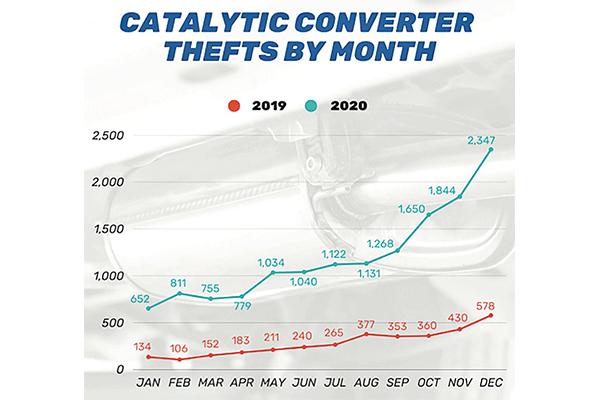
OKLAHOMA CITY – Catalytic converter thefts have been increasing nationally in recent months – because two of the metals from which they are manufactured are worth more per ounce than gold.
A catalytic converter is an exhaust emission control device that encases a honeycomb structure that filters fumes to reduce toxic gases and pollutants in exhaust gas from an internal combustion engine. Catalytic converters are usually used with engines fueled by either gasoline or diesel.
The parts are manufactured from three metals that command a steep price tag. Two of those elements are palladium and rhodium, both of which are more valuable than gold.
Rhodium, a byproduct of the production of platinum and palladium, is unequaled in its ability to remove the most toxic pollutants from vehicle exhaust.
A single troy ounce (which is slightly heavier than a regular ounce) of rhodium was priced at $24,700 – 14 times the price of gold – the afternoon of March 12. In comparison, a 2021 Toyota Prius automobile was priced at $24,385 MSRP that day.
Palladium was priced at $2,355.50 per troy ounce on March 12.
A troy ounce of gold was bringing $1,730.10.
Rhodium is in high demand because it is used in the automotive industry and more cars are being built all the time.
CONVERTER CAN BE REMOVED SWIFTLY WITH PORTABLE SAW
Catalytic converters “seem to be a very popular item among thieves these days,” said Master Sgt. Gary Knight of the Oklahoma City Police Department. “However, we do not track those thefts specifically, so I do not know the exact number. But we have most certainly seen them here in Oklahoma City.”
“The lieutenant over property crimes told me we had a slight increase around the month of November, but it was not very significant,” Lawton Police Officer Andrew Grubbs said. “He advised me that it has already leveled out.”
“I don’t recall us taking any reports of catalytic converter thefts in the last year or so. However, there was a time a couple of years ago where we took several,” said Deputy Chief Russ Landon of The Village Police Department in north OKC.
“One of our officers was driving around a neighborhood at about 3 a.m. and caught a guy coming out from beneath a vehicle after having just cut a converter off. He had several in his car that he had stolen that evening,”
Landon said. “It’s pretty easy to slip underneath a vehicle with a battery powered Sawzall and cut those things off.”
The catalytic converter on a 4Runner owned by a northwest Oklahoma City resident was sawed off and stolen Halloween night last year. Replacing the part cost him approximately $400, he said.
For most vehicles, the average cost of a catalytic converter repair is between $945 and $2,475, including parts and labor, according to CarBrain. The catalytic converter cost itself can be up to $2,250 of that price tag.
The U.S. Environmental Protection Agency, in a rule intended to reduce air pollution, made selling used catalytic converters illegal in 1990 unless they were tested and certified by the EPA.
Nevertheless, catalytic converters, just like copper wiring in street lights, are stolen frequently. Reportedly some thieves use online auction sites such as eBay to sell the converters in bulk.
80% OF RHODIUM PRODUCED IN SOUTH AFRICA
According to the Washington Post, 80% of the world’s rhodium originates in South Africa.
Prior to the 2008 global recession, South African mines were producing large volumes of platinum, which is used in myriad products from jewelry to heavy industry. The South Africans continued doing so during the downturn, which created a massive surplus of platinum that persists to this day.
Because rhodium is a byproduct of platinum production, it is produced only when mining companies realize a profit in platinum — which might not occur for another few years until the surplus wanes.
On the demand side, some countries in Europe, the Americas and East Asia are increasing their emissions standards, new vehicles are expected to require more rhodium in their exhaust filters, and demand for cars in China is soaring.
Each unit of ore mined typically contains 60% platinum, 30% palladium, 8% to 9% rhodium, and trace amounts of other metals, according to an executive with a South African metal group producer who was interviewed by the Post.
Mining representatives said they expect rhodium shortages and the high prices for the commodity to continue until at least 2025.