

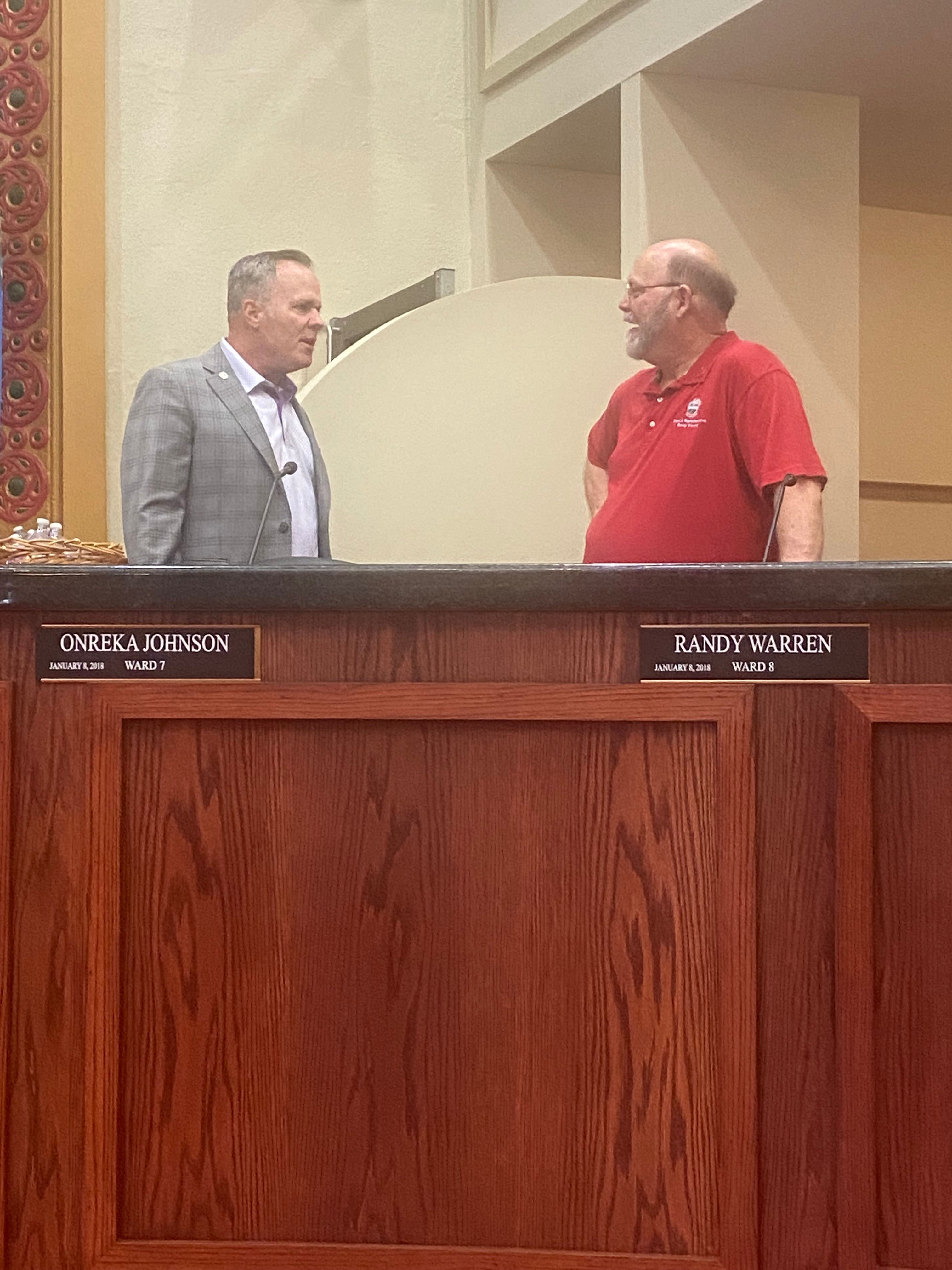
LAWTON – Lawton City Council will wait to decide the future of three wading pools until the city has a master plan for aquatic attractions in hand.
The council recently directed staff to draw up a plan for the city’s municipal pool, splash pads and wading pools.
The council also asked staff to work with the Oklahoma State Historical Society’s State Historic Preservation Office on a study of structures built by the Works Projects Administration, which will determine whether the structures are eligible for inclusion on the National Register of Historic Places.
The decision came after the council heard a July 26 presentation by Water Technology Inc., a Wisconsin-based company that inspected the wading pools at 35th Division Park, Harmon Park and Mocine Park. The company evaluated each pool to determine whether it could be upgraded, along with the possible cost of renovation.
But the company concluded that all three pools should be taken out of service because they do not satisfy safety codes or Americans with Disabilities Act requirements. The pools would require major – and costly – upgrades to remain open.
“I’m here to give you pricing on what it would take to bring these back into code, but that would be a total waste of money,” said Robbie Hazelbaker, project director for WTI. “And you’d have to start over anyway, in our opinion.”
Hazelbaker said the engineering firm Half Associates, which produced the city’s master plan for parks, had recommended developing a similar plan for aquatic attractions. He said he thought the council should follow Half’s advice.
Replacing wading pools
Hazelbaker’s presentation sparked a lively discussion about the city’s aquatic attractions, which include three wading pools, two splash pads and one municipal pool.
Deputy City Manager Dewayne Burk said he did not want to eliminate the wading pools without replacing them with other attractions, such as smaller splash pads.
“I don’t want to take that amenity away from those neighborhoods,” he said. “They’re used to having something there. So, I would seriously recommend us looking at putting something comparable in there, size wise, that would provide those neighborhoods with what they need.”
Burk asked Hazelbaker if he had a cost estimate for tearing out the wading pools and replacing them with smaller splash pads. Hazelbaker said removing the wading pools would cost at least $50,000, while building new splash pads would cost approximately $225,000 to $300,000 apiece.
“But you could use all those floor sprays and really knock the cost down,” he said.
Historical survey
Councilman Randy Warren said he did not want to get rid of the wading pools, but he thought they could be repurposed to create new attractions.
“Just from what we’ve heard today and what we’ve known for years and years now and just didn’t want to admit, it’s extremely expensive to repair them in a way that they’re usable for a long period of time and make them ADA-accessible,” he said. “Once we make them ADA-accessible, they’re not period pieces anymore. So, we should probably think about reusing them as something else and then building a splash pad or some other facility there in the same area with those.”
Councilman Allan Hampton said he was glad the council was talking about drawing up a master plan for aquatic attractions. But he thought the city should work with the State Historic Preservation Office on a survey of Lawton’s WPA structures.
“I think it’s prudent to at least let these people to come down and do an inventory and evaluate those pools historically,” Hampton said.
Previous surveys have found WPA structures in Legion Park, Union Park, Mattie Beal Park, Harmon Park and Highland Cemetery, according to a May 9 letter from the State Historical Preservation Office to Hampton. Those structures included wading pools, gateway arches, fountains, bridges and pavilions.
“Our office is of the opinion that these structures warrant further study to determine eligibility for the National Register of Historic Places,” SHPO said in the letter.
Hampton said if those structures are designated as historic sites, the city could secure state and federal grants for preserving them.
“With that funding – that has nothing to do with the money that we would spend on an aquatics center or any other things in the park,” he said. “We would get outside money coming into our city that want to preserve – from the state and federal level – to preserve the historical properties that are in our city. And that would take care of all those costs.”
Warren wanted to know whether the council would get a chance to weigh in before a structure is added to the National Register of Historic Places.
“I have a real problem with doing that if it’s not clear as to what we have to do with the property,” he said. “Because we found out with this building that you don’t just get on the register and then everything’s hunky-dory and people give you money. That’s not what happens.
“What happens is they say, ‘You will do this, such and so.’ And if this, such and so means that we spend $1.8 million to get a pool working again, I don’t know that that’s what everybody’s going to be able to afford.”