

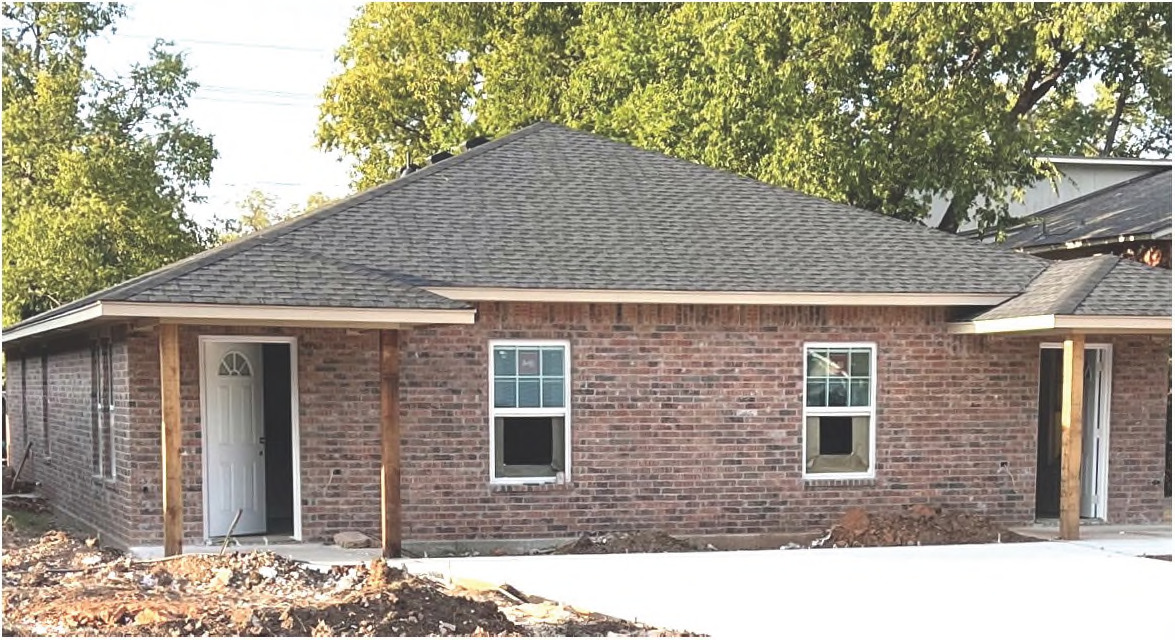
Mayor Stan Booker and Richard Rogalski, executive director of the Lawton Economic Development Authority have devised a plan to promote development of more new housing subdivisions in Lawton.
“We have done a good job of industrial recruitment/’ Rogalski said. Now the city needs to encourage more residential development. Lawton has “a large inventory of housing, but some of the older neighborhoods have become dilapidated, with many structures having been demolished” he noted. “Over the years, new investment to reconstruct and remodel those remaining homes has not occurred at a stabilizing
Development and construction of new residential subdivisions have also slowed, “with vacant lots remaining open for years” in some areas, Booker and Rogalski lamented.
Statistics from 2024 and 2025 provided by Multiple Listing Service, a centralized database used by real estate professionals to share property listings and manage transactional data, “showed that approximately 65% of new home sales occurred outside the City of Lawton although we have 74% of the county’s population,” Rogalski said.
“If this trend were to continue, Lawton’s neighborhoods would continue to age without new construction to sustain our tax base and maintain property values,” he said.
Building a subdivision inside Lawton’s city limits requires construction of water and sewer lines and streets that meet city standards, including installation of fire hydrants and sufficient water volume and pressure for fire suppression. “In Lawton, you can’t get a building permit until the infrastructure is in place,” Rogalski related. Lawton’s building code is “rigorous,” he said, “and we have inspectors to enforce those requirements.”
Subdivisions outside of the city limits, though, “do not provide the same level of infrastructure, he said. Developers have been known to create “wildcat” visions that have residential lots “but don’t provide those services/’ he said. Wedgewood was cited as an example.
All new houses in Lawton must be constructed and inspected to follow international building codes, as required by state statutes. “While the same rules apply to houses built outside of Lawton, building plan review and inspection is not always available/’ Rogalski said.
The Lawton Revitalize, Invest, Strengthen, and Expand (RISE) Project Plan “aspires to increase housing construction within the city by providing an incentive to build and/or buy houses” inside Lawton’s municipal limits.
RISE is intended to increase housing opportunities within the city limits while strengthening neighborhoods, encouraging infrastructure investment, supporting property values, and growing the city’s tax base, Booker and Rogalski said.
The City Council on Aug. 25 approved a “resolution of intent” to consider the RISE Project Plan and create one or more increment financing districts in accordance with the Local Development Act. RISE is on the council’s agenda during a special meeting Tuesday afternoon.
The plan might utilize tools such as reimbursement agreements, pay-as-you-go financing, development-financing assistance, performance-based assistance, and, if authorized, tax apportionment obligations “to help address demonstrated development feasibility gaps,” Rogalski and Booker said.
The RISE Plan would encourage development of new housing in greenfield (undeveloped) subdivision areas and targeted redevelopment areas within the community. Infrastructure “is already there” in redeveloped areas, Rogalski pointed out.
Target: 2,000 houses erected in 10 years
The target is 2,000 houses built in 10 years, Rogalski said. Whether it’s reinvestment in rental property or owner-occupied housing, “either one would be acceptable,” Booker said. “A lot of the redevelopment will be rentals,” Rogalski predicted.
A developer considering a subdivision on the east side of Lawton “is preparing for the incentive program we’ve planned,” Rogalski said. “He builds both owner-occupied and rental properties.”
Lawton needs three- and four-bedroom houses and rental properties to meet the needs of Fort Sill families as well as Lawtonians, Booker said.
“We have a finite workforce in Lawton,” Rogalski said. The employment base in Lawton-Fort Sill in 2024 was 44,476, according to the state Commerce Department. But the agency’s data showed that within a 45-minute drive - Cotton, Stephens, Tillman, Caddo, Kiowa, and Grady counties, and even Wichita Falls, Texas - is a workforce of more than 97,000 people. At least one City of Lawton employee lives in Wichita Falls.
“Redevelopment of underdeveloped and potentially blighted areas increases the value of the redeveloped property, thereby stabilizing and raising the value of the entire neighborhood,” said Booker. “By putting more money into redevelopment, we grow the tax base.”
The basic premise of the RISE Project Plan is to “borrow against future Tax Increment Financing revenue to incentivize residential development in greenfield TIF districts that would not otherwise occur, and to incentivize development in targeted neighborhoods that are not in a TIF district,” records reflect.
Developers, builders, and home buyers “all think incentives should go to them,” Rogalski noted. “I’ve been meeting with developers over the past year and they think incentives should go to them,” he said. But as of now, the City of Lawton can offer no such incentives. “There’s no money for it,” he said. “And we won’t be able to do it until we have a residential TIF district.”
The RISE Project Plan is designed to provide an incentive to the buyer, although there is a potential for some incentive for the builder and/or the developer. “We want to incentivize the buyer, because the goal is to drive demand,” Booker said.
As an illustration, the incentive might be enough money to enable the buyer to make the down payment or pay the closing costs, the mayor said.
“Driving demand is a good way to do it,” Rogalski said. “We don’t want to give an incentive to a company in California, for example.” If the incentive is given to a buyer in Lawton, “There’s a good chance they’ll buy their furniture here, too,” he said.
Review panel
The Local Development Act provides that the first step in reviewing a project plan is appointment of a review committee to examine and make a recommendation about the proposed plan.
The review committee must be comprised of representatives of the governing body (Mayor Booker), of the City Planning Commission (Ron Jarvis), and a representative designated by each taxing jurisdiction within the proposed TIF districts: Dr. Neal Weaver, superintendent of Lawton Public Schools; Deborah Johnson, regional director of the Health Department; Morgan Gould, deputy superintendent of Great Plains Technology Center; District 2 Comanche County Commissioner Johnny Owens; and Lawton City Manager John Ratliff.
It also includes three members representing the public at large. During a meeting earlier this month, the at-large members selected were defense contractor Nate Slate; Jace Zacharias, BancFirst vice president of commercial lending; and Ward 3 City Councilman Kirby Brown.
New housing units already built and more ‘coming in’
Ironically, the RISE presentation to the City Council on Sept. 8 occurred after at least 42 new housing units were constructed in Lawton in less than two years, and scores more are planned for construction during the next 12 months.
“We have issued 153 new housing construction permits since Aug. 31,2025, Charlotte Brown, deputy director of the city’s Community Enrichment Department, informed Southwest Ledger.
Four duplexes have been built in the 300 block of NW Arlington Avenue. The units at 309, 311, and 313 Arlington encompass 1,392 square feet per unit, and the units at 315 Arlington total 1,065 square feet each, according to records filed at City Hall.
Four duplexes also have been constructed at 908,910, 912 and 914 SW D; each of those units contains 1,392 square feet, records reflect.
Builders Investment Group is listed as the contractor on all eight of those duplexes.
A public hearing on a zoning request from Builders Investment Group, to change the zoning at 2018 SW Jefferson from R-l single-family dwelling to R-2 two-family dwelling district, is on the Lawton City Council’s agenda Tuesday evening.
SFR Analytics describes Builders Investment Group as a multi-entity real estate investor active in Lawton, “with 172 recorded acquisitions totaling approximately $5.9 million.”
Besides Builders’ eight duplexes, construction permits for 34 housing projects in the Lawton View Addition have been issued in the past 20 months, Brown said.
Those included six between the 1700 and 1800 blocks of Washington Avenue, one in the 1600 block of Jefferson Avenue, five in the 1800 block of Monroe Avenue, seven in the 2100 block of Dr. Charles W. Whitlow Avenue, three between the 2000 and 2100 blocks of McKinley Avenue, one in the 1400 block of Texas Avenue.
Two in the 1200 block of New York Avenue, three between the 1200 and 1400 blocks of Bishop Road, two in the 1400 block of Tennessee Avenue, two in the 1500 block of Georgia Avenue, one in the 1800 block of N.H. Jones Avenue, and one in the 2100 block of Douglas Avenue.
Additionally, “We have more than 100 residential structures that will be coming in over the next year or so,” Brown told the Ledger on Sept. 1.
“I don’t believe The American Dream is dead, but it is on the ropes” because of “unaffordability,” Rogalski told the Ledger on Sept. 16.
Many of the building permits the City of Lawton issued over the last 12 months were for duplexes and remodels, he said. “Recently I spoke to a developer who told me that building owner-occupied houses is off.”
Almost all of the residential construction market in town is rental property, he said. “Not long ago, they weren’t even building duplexes.” The problem with duplexes, he said, is that “they don’t have carports. Exterior treatment is important.”
D&D properties
In another related matter, the Lawton City Council recently approved requests from owners of dilapidated structures at 1423 NW Ozmun, 1512 SW Dr. Charles W. Whitlow, 1618 NWTaft, 1306 SW H, and 2410 SW G. The owners were granted additional time to continue working toward making their properties habitable again.
Conversely, the council approved resolutions Sept. 8 that condemned, as dangerous and dilapidated, properties at 1501 SW Pennsylvania, 905 SW Summit, 1113 NWTaft, 213 NW Columbia, 407 NW 3rd, 1205 NW Bessie, 1632 SW Dr. Charles W. Whitlow, 2003 SW Douglas, 2111 SW McKinley, and 2514 SW I.
The resolutions order the owners of those properties to abate the nuisance and authorize the city attorney to commence legal action in Comanche County District Court to abate the nuisance.
The council also approved invoices for the demolition of six dilapidated properties at 1123 SW New York, 1615 SW Washington, 735 SW 45th, 101 SW74th, 2004 SW Dr. Charles W. Whitlow, and 1207 SW I. The bills for razing those structures came to $38,551; the city attached liens to those properties in an attempt to eventually recoup some of those costs.
“How many owner-occupied houses are on the city’s D&D list?” Rogalski mused.
Mayor Booker has stated repeatedly that he prefers to have D&D properties rehabilitated rather than torn down.