

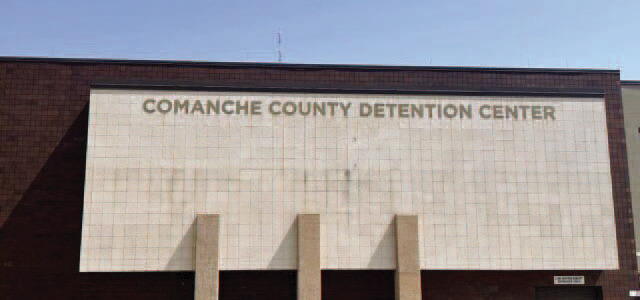
LAWTON –The Comanche County Facilities Authority, which operates the Comanche County Detention Center, is embroiled in a civil rights lawsuit that’s quite similar to a lawsuit filed against the Wagoner County Sheriff’s Office that was settled out of court for $13.5 million.
Joseph Gonzalez, a retired National Guard medic and Iraq War veteran, is the surviving spouse of Tshante To-Shan-Mah GoingSnake-Gonzalez, who died in the CCDC almost three years ago.
Mr. Gonzalez sued the Facilities Authority and its former administrator, Bill Hobbs, who retired in March 2024; the City of Lawton; former Lawton Police Chief James Smith, who died Jan. 22; Brandy Kirkpatrick-Benton, corrections manager of the Lawton City Jail “during the events giving rise to this lawsuit”; plus nine defendants identified as John and Janes Does I-X, “individual detention, law enforcement, and/or medical personnel” at that time.
The petition was filed Sept. 30, 2024. The case is scheduled for trial on the Oklahoma City Western District federal court’s May 2026 jury docket.
Ms. Gonzalez, 40, attended Cameron University and worked in the gaming industry for the Kiowa Casino Enterprises as a human resources specialist.
She “suffered from a serious lupus condition,” the lawsuit alleges. Lupus is a chronic autoimmune disease “that usually occurs when the body’s immune system attacks otherwise healthy tissues.”
The attacks can cause inflammation and can lead to permanent damage “to, among other things, the skin, joints, heart, lungs, kidneys, blood cells, and brain.”
Gonzalez “took medication … to control” her lupus condition.
Gonzalez and her mother, Bobbi Geimausaddle, were arrested by Lawton police detectives and booked into the Lawton City Jail together around 5 p.m. May 1, 2023, the lawsuit relates.
Ms. Gonzalez was charged in Comanche County District Court on May 4 with trafficking in illegal drugs and possession of drug paraphernalia. Ms. Geimausaddle was not charged with anything, according to the Oklahoma State Courts Network.
Both women “repeatedly informed LCJ personnel that Gonzalez needed her prescribed medication to treat her … lupus condition.” However, despite “repeated pleas” for the medication, “they were ignored by multiple LCJ personnel,” the lawsuit claims.
During her last day in the LCJ, “and after Gonzalez and Geimausaddle continued to plead for help and while it was obvious Gonzalez was suffering from a serious medical emergency,” a male detention officer “walked into their cell, saw Gonzalez lying on the ground, intentionally kicked at Gonzalez, and said, ‘Well, did you finally learn your lesson?’” The unidentified detention officer then left the cell.
At one point, a woman “who appeared to be an LCJ detention officer told Gonzalez to “shut up and sit back,” the petition alleges.
During her last 24 hours in the Lawton jail, Gonzalez repeatedly vomited, defecated and urinated on herself, and lost motor functions, “lying helpless” on the floor of her cell and “calling for help,” the petitioner alleges.
After 2 days in LCJ, transferred to CCDC
Gonzalez and Geimausaddle were transferred from the municipal jail to the Comanche County Detention Center about 7 p.m. on May 3, 2023.
A woman detained in a cell near Gonzales her said that for two days she heard the two women repeatedly plead for help, to no avail.
During her first two days in the CCDC, Gonzalez was “observed on multiple occasions by CCDC personnel who … walked away and ignored her,” the lawsuit alleges. During that time she again vomited, defecated and urinated on herself repeatedly, lost motor functions, and “laid helpless” on the floor of her cell.
Several women in the cell with Gonzalez “started lending clothes” to her “as her condition worsened…” Ms. Gonzalez was transported to Comanche County Memorial Hospital shortly after 9 p.m. May 4, arriving in “an unresponsive, traumatic, and emergent state,” the lawsuit reports.
Hospital records confirm her dire condition upon arrival. An attending physician confirmed in Gonzalez’s medical records that she was “unresponsive and without a detectable pulse upon arrival” at CCMH.
Her medical records show that her symptoms upon admission to the hospital included no pulse, gasping for air, drooling, cardiac arrest, diarrhea, hypotension, a respiratory rate of six breaths per minute (compared to 12 to 20 breaths per minute for a healthy adult), “need for immediate compressions” and for “immediate intubation.”
Approximately 16 minutes after Gonzalez arrived at CCMH, “a Code Blue was called by hospital personnel.”
The next day an attending physician reported that Ms. Gonzalez had suffered cardiac arrest multiple times, had acute hypoxic respiratory failure requiring mechanical ventilation, had severe sepsis and lactic acidosis, a 105.1-degree fever, suffered acute kidney injury, had a urinary tract infection, had severe metabolic acidosis, and experienced diarrhea. Also on May 5 a doctor confirmed that Gonzalez had “an anoxic brain injury.”
Prisoner suffered multiorgan failure She was pronounced dead in the hospital at 5:27 pm. May 8, 2023. According to the lawsuit, the medical examiner identified her immediate cause of death as “septic shock with multiorgan failure from an MRSA pneumonia infection.”
The Oklahoma State Bureau of Investigation conducted an investigation into the events surrounding Ms. Gonzalez’s death. The agency said it will “produce its report once it receives a subpoena” from the federal district court. That report was not in the federal court records as of Saturday.
The lawsuit lays much of the blame on Hobbs, alleging:
•Continued overcapacity of inmates in the CCDC overall, which strained all aspects of CCDC functionality and caused inadequate monitoring of the inmate population, such as failure to perform “full and proper sight checks.”
•Overcapacity of inmates in particular cells, which caused inadequate monitoring of the inmates.
•Failures to adequately render medical screenings, medical care within the facility, and access to medical care out of the facility.
•Inadequate staffing levels and ratios.
Similar lawsuit in Wagoner County settled for $13.5M A similar lawsuit was filed in Muskogee’s Eastern District federal court in April 2023, alleging negligence on the part of the sheriff and his staff in the death of a diabetic woman.
Angela Lynn Liggans, 41, was booked into the Wagoner County Jail on May 17, 2021, after her arrest on complaints of assault and battery on a police officer, domestic assault, and obstruction.
A “Fit for Incarceration” form that was filled out by a jail staffer “indicates that at the time of booking,” Liggans was experiencing a cough, shortness of breath or difficulty breathing, body aches, congestion or runny nose, nausea or vomiting, and diarrhea.
“In addition, Ms. Liggans reported a number of medical conditions that needed immediate attention, including COPD, diabetes, ‘unknown heart problem’ and ‘scoliosis,’” according to her mother, Sharon Dee Dalton of Tulsa.
During her booking into the jail, Liggans brought along a medication bag that contained insulin bottles, hypodermic needles, glucose tabs, and several prescription medications.
When she attempted to administer insulin to herself, Wagoner County detention officers physically wrested the insulin from Liggans, forced her to the floor and handcuffed her, and placed her in the jail’s restraint chair, where she remained for an hour and 10 minutes. Throughout that time she requested her insulin “but none was given.”
On May 18, during a medical screening, Liggans was tested and found to have “a dangerously elevated blood sugar level” of 586, the lawsuit relates. Liggans reported “night sweats,” “persistent cough,” “loss of appetite,” “chest pains”, “coughing up blood,” “abnormal weight loss,” and said she was “feeling suicidal.”
During the next two weeks, Liggans hallucinated, displayed “bizarre and psychotic behavior,” suffered panic attacks, became fatigued, experienced shortness of breath, displayed signs of extreme confusion, became so weak she could not walk without assistance.
On May 28, she had a pulse rate of 124 and “passed out.” She “was not seen by a physician nor by a nurse and was not sent to the hospital” that day. However, she was given insulin, although it was administered by “nonmedical staff.” Liggans received no insulin at all on May 31 and June 1. “An insulin-dependent Type 1 diabetic” who required daily blood sugar monitoring and insulin injections, Liggans died in the jail on June 2, 2021.
At various times during those 16 days, Liggans reportedly displayed “signs of extreme confusion and even psychosis,” as well as weakness and fatigue and high blood pressure, and “continued to outwardly display bizarre and psychotic behavior …” On the last day of her life, she lay on the floor of her cell, “motionless, unresponsive and completely discolored,” for at least half an hour before jail personnel checked on her. Nine minutes later, emergency medical technicians arrived and pronounced her dead.
A medical examiner wrote that Liggans “died as a result of diabetes ketoacidosis.”
Liggans’ mother filed a civil rights lawsuit in Muskogee’s Eastern District federal court on April 27, 2023, alleging negligence, against Wagoner County Sheriff Chris Elliott, two of his deputies, a “medical assistant” who was hired by Elliott to serve as the jail’s “health administrator” despite her “lack of training and limited scope of practice,” and a family medical practitioner from a nearby town.
After entering into mediation, Dalton and the Wagoner County Board of Commissioners reached a $13.5 million out-of-court settlement on Aug. 16, 2024. The agreement was not entered into the court record until Nov. 19, 2024 — several days after Elliott was reelected sheriff.
The Association of County Commissioners of Oklahoma Self-Insured Group paid $483,156 from Wagoner County’s $1 million maximum benefit, leaving county taxpayers on the hook for $13,016,843.
Wagoner County residents voted overwhelmingly in favor of a sales tax rather than a property tax to pay off the $13 million out-of-court settlement.
If the sales tax proposal had been rejected, the settlement would have been paid off with a property tax assessment collected over a 10-year period.
Instead, the debt will be retired with a county sales tax of one-fourth of a penny per dollar that went into effect July 1, 2025, and will be levied for 15 years “or until the debt has been satisfied in full, whichever occurs sooner.”
Reportedly, the county borrowed the money from a bank and will repay the loan with proceeds from the sales tax.
The lawsuit settlement provides that the postjudgment interest rate, which started Jan. 1, 2025, will be 4.96% for the first three years and increase to 6% annually in 2028.
Mike W. Ray is a fifthgeneration, award-winning journalist who has more than 55 years’ experience covering municipal, county, state and federal government in Oklahoma and Texas. He can be reached at mike.ray@swoknews. com.