

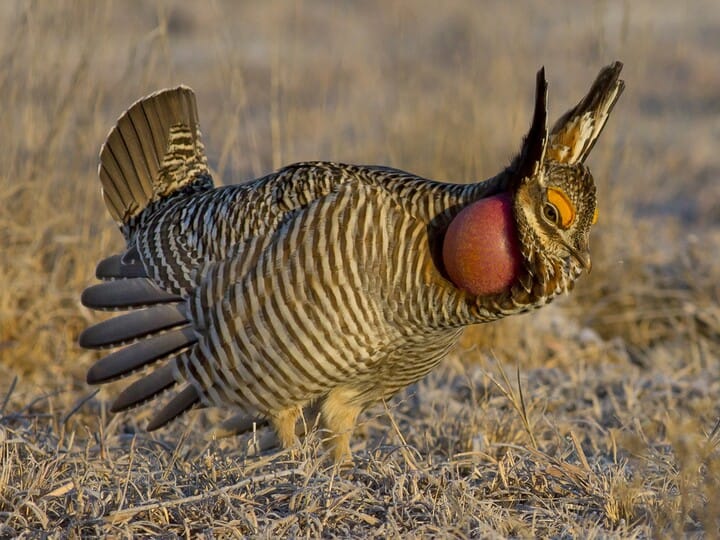
OKLAHOMA CITY — State Attorney General Gentner Drummond announced his intention to sue the Biden administration because its plan to designate the lesser prairie chicken as a threatened species constitutes “an existential threat for cattle grazing, energy production, and other vital aspects of Western Oklahoma’s economy.”
The U.S. Fish and Wildlife Service rule, which is scheduled to take effect March 27, would place burdensome restrictions on Oklahoma ranchers needing to graze livestock and would unnecessarily impede development of energy pipelines, oil drilling, wind farms, and roads, Drummond said.
“This is yet another example of federal overreach by the Biden administration,” Drummond told the Oklahoma Farm Report.
“Environmental activists wielding the authority of the federal government can have disastrous consequences for farmers, ranchers and energy producers,” he said. “As a fifth-generation cattle rancher, I am committed to protecting our way of life, which feeds our state and nation with minimal environmental impact.”
The bird, which is known for its colorful spring mating dance, can be found in Kansas, Oklahoma, Texas and New Mexico. The listing came after years of campaigning by wildlife advocates, including a 2019 lawsuit by three conservation groups. An estimated 90% of the bird’s habitat — unbroken tracts of native grasses — has disappeared.
In a letter to U.S. Secretary of the Interior Deb Haaland and USFW Director Martha Williams, Drummond said the Oklahoma Department of Wildlife Conservation has worked closely with federal agencies, industry leaders, private landowners, conservation groups and other stakeholders to protect the lesser prairie chicken and its habitat.
“Oklahoma has been at the forefront of conserving and enhancing the lesser prairie-chicken’s natural habitat through actions by numerous state and federal agencies to assist landowners with conservation measures, including the ODWC’s Candidate Conservation Agreement with Assurances, which has hundreds of thousands of acres enrolled in the program,” the Oklahoma Farm Bureau said.
“Additionally, the United States Department of Agriculture’s Natural Resources Conservation Service has a long history of working with landowners in the southern Great Plains region to share the costs of conservation practices and assist with whole-farm planning – a measure that benefits both the agricultural land and the wildlife species native to the area.”
The Feb. 2 letter provides a 60-day notice of the intent to file litigation for failing to follow Section 4 of the Endangered Species Act with regard to the final rule the USFW issued on Nov. 25, 2022.
Oklahoma is part of the Northern Distinct Population Segment, where the lesser prairie chicken is to be listed as a threatened species, while birds in the Southern Distinct Population Segment will be listed as endangered.
Farmers and ranchers contend a threatened listing under the ESA alone does little to preserve the species and believe voluntary conservation practices by landowners are more effective in protecting and enhancing critical wildlife populations.
“We all want diversity of our wildlife,” Drummond said. “I do a better job of managing my quail population and providing habitats for geese and prairie chicken than any bureaucrat can from Washington, D.C.”
The Farm Bureau was joined by American Farmers & Ranchers and the Oklahoma Cattlemen’s Association in expressing their support of the anticipated litigation.
A coalition of five states – Oklahoma, Kansas, Texas, New Mexico and Colorado – intends to file the lawsuit, Drummond said.
“We want to make the feds pause and engage with our respective state wildlife departments” before enacting the proposed rule,” he said.
“We in the agricultural community of these Midwestern states know how to properly stock and manage livestock. And the oil and gas industry has evolved over the last 50 years. We don’t need the federal government telling us how to manage our real estate.”
Drummond called on “all affected stakeholders” to join him in a “stand against a hostile and overreaching federal government.”
Kansas Attorney General Kris Kobach claimed the proposed federal protections for the bird are “illegal and potentially devastating to landowners and businesses in our state.”
Kobach said the listing of the bird as a threatened species failed to consider Kansas’ conservation and mitigation measures, and state wildlife officials were already working with landowners to conserve the species.
In December, 10 members of Congress – including Oklahomans Frank Lucas, Stephanie Bice, Markwayne Mullin, James Lankford and Jim Inhofe – introduced a Congressional Review Act joint resolution of disapproval in their respective chambers to strike down the Biden administration’s listing of the lesser prairie-chicken as endangered.
The act is used to block rules issued by federal agencies. Under the act, an agency must submit a report to Congress on its rule. After receiving the report, Congress can submit and act on a joint resolution of disapproval.
Ron Hays contributed to this report.