

Agricultural real estate values in the Federal Reserve Bank of Kansas City’s Tenth District (encompassing the Denver, Oklahoma City and Omaha areas) remained resilient through the end of 2023.
The value of non-irrigated farmland in the region grew around 10% from a year ago despite sharply higher interest rates and a moderation in farm income and credit conditions. Capital spending slowed, however, alongside higher rates and lower farm income. Demand for farm loans picked up for a growing share of lenders at the end of 2023, as lower crop prices and relatively stable production expenses have squeezed margins for some farm borrowers.
The farm economy continued to moderate alongside lower crop prices, but elevated cattle prices and strong farmland values have provided some stability for the sector. At the end of 2023 and beginning of 2024, production forecasts for the current crop year have weighed on crop prices. Prices for corn, soybeans, and wheat declined steadily throughout the fourth quarter, contributing to lower farm incomes compared to a year ago.
Cattle prices have stabilized at high levels alongside historically low inventories, and despite recent concerns related to crop markets, demand for good quality cropland remains robust, supporting real estate values.
Despite lower commodity prices and higher interest rates, growth in farmland values remained firm through the end of 2023. Non-irrigated farmland values across the district increased at a steady pace, while the pace of growth in irrigated farmland and ranchland values slowed slightly.
Alongside a drop in crop prices, contacts across the district reported some financial strain from increased expenses and lower revenues, but values for all types of farmland still grew by about 8%, on average, from the previous year.
Farmland values remained resilient but varied throughout the district. Increases in non-irrigated land values were particularly high in western Missouri and Nebraska; a Nebraska contact reported that land values have remained high alongside strong demand for cropland.
Irrigated cropland and ranchland values increased at a slower rate in Oklahoma, as contacts there reported slight shifts in demand to land for recreation and other investment opportunities amid higher interest rates and lingering drought in some areas.
Cash rents steadied despite further growth in farmland values. Average cash rents on ranchland inched downward from a year ago during the second half of 2023, while non-irrigated and irrigated rents were largely unchanged.
Contacts in Kansas, Nebraska and Oklahoma reported strong prices and revenues for cattle producers that assisted with stabilizing ranchland cash rents. However, contacts in Nebraska and Kansas reported farmers having less cash on hand, but strong asset values, both of which affect farmers’ ability to rent non-irrigated and irrigated land.
A slowdown in the amount of farmland on the market across the district may have contributed to some of the resiliency in farmland values. Farmland sales slowed across the region and in all states except Missouri, where sales increased slightly from a year ago.
The volume of farmland sales slowed the most in Oklahoma, where 45% of respondents reported that farmland sales were lower than a year ago. Overall, it appears that most of the slowdown was due to limited amounts of land being placed on the market, not because of a slowdown in demand.
Demand for land also has remained strong as the share of farmland purchased by farmers increased across the district. The share of farmland purchased by farmers continued to increase to almost 80%, the highest since 2015. In addition, the share of farmland purchased by farmers grew in every state, and some agricultural lenders commented that they have continued to see farmland buyers with ample funding available.
Most agricultural lenders expected farmland values to remain stable in 2024, and a large share still expected an increase in the coming year. More than 70% of survey respondents expected farmland values to increase moderately or remain unchanged. Moreover, fewer lenders expected a substantial decline in farm real estate markets coming into this year.
Expectations for farmland values remained optimistic despite increased costs and risks associated with higher interest rates. Interest rates on all types of loans leveled off in the fourth quarter but remained at elevated levels. Rates were more than a full percentage point higher than average rates last year and stayed between 8% and 9%. Alongside higher interest rates, interest costs on farmland loans have increased dramatically, but the effects on farm real estate markets have been fairly muted so far.
One risk to the outlook for land markets is that a large share of farmland loans could reprice at higher interest rates in coming months. At the end of 2023, nearly half of respondents reported more than 80% of farmland loans with variable interest rates in their bank’s portfolios. Another quarter of respondents reported at least 40% of farmland loans with variable interest rates.
Of these loans with variable rates, almost 20% were scheduled to reprice in the next six months. About 45% of farmland loans had repricing schedules of 18 months or more. However, farm borrowers whose loans were written with shorter terms could face much steeper interest expenses when those loans reprice, since interest rates have recently become much higher than they would have been on any loans originated in the last decade.
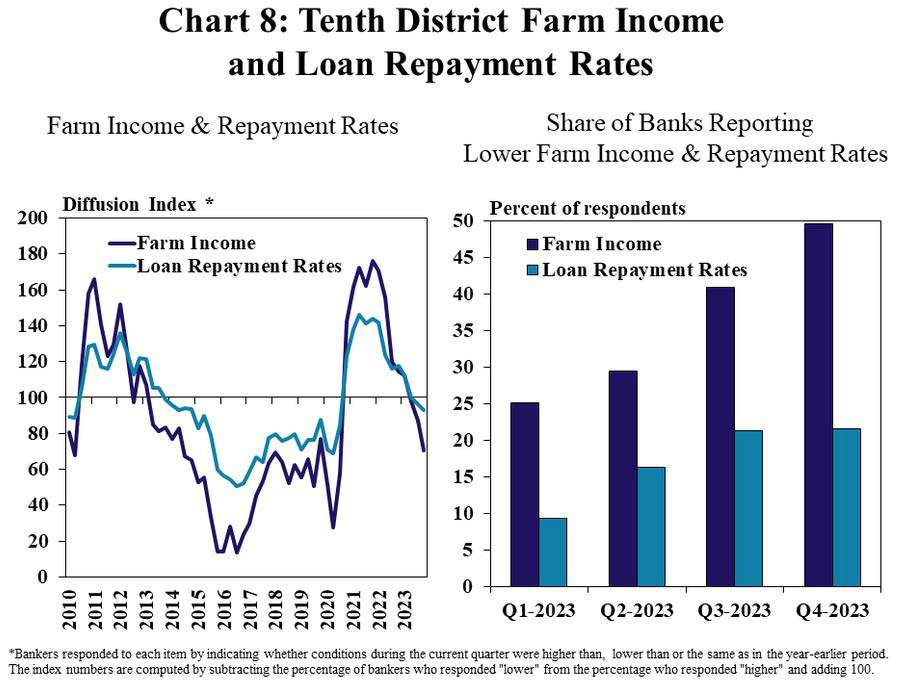
Farmland values also held firm despite a moderation in farm income and credit conditions. The pace of decline in farm income was faster than recent quarters, as the share of respondents reporting farm income was lower than a year ago neared 50% (Chart 8). Farm loan repayment also softened alongside farm income, and the share of respondents reporting lower rates of repayment grew to 20% in the fourth quarter.
As farm finances moderated, demand for farm loans grew at the fastest pace in nearly three years. Demand for non-real estate farm loans was subdued in recent years alongside financial strength across the sector, but showed signs of picking up in the fourth quarter. Farm borrower liquidity has declined over the past year and the share of banks reporting higher loan demand than a year ago reached the highest level since 2019.
Cortney Cowley is a senior economist, and Jannety Mosley is a senior survey analyst, in the Oklahoma City Branch of the Federal Reserve Bank of Kansas City.