

A Texas-based company that bought large quantities of contaminated hand sanitizer hired an Arkansasbased company led by a professional chef to get rid of its useless products after they were recalled by a federal agency.
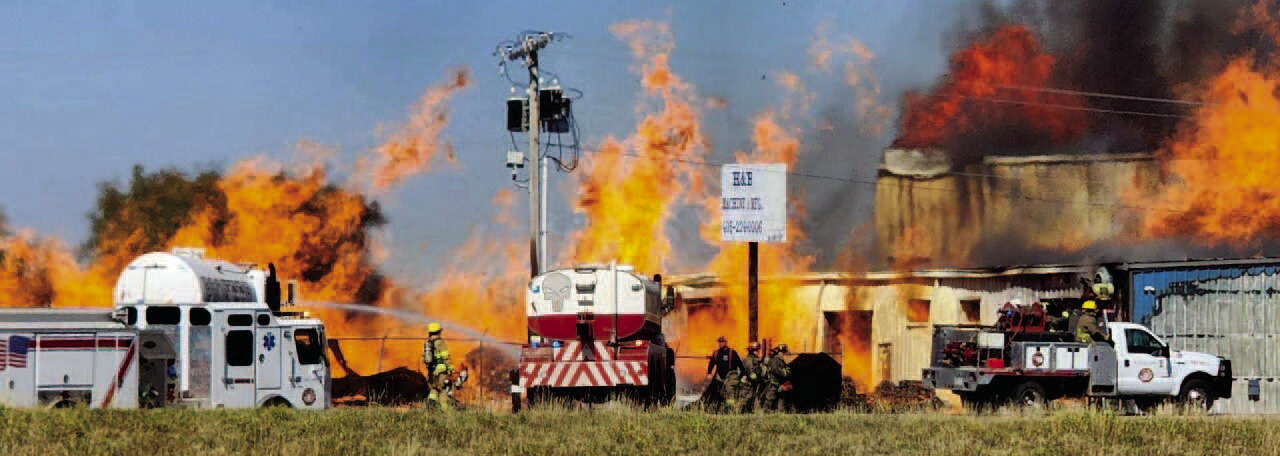
Subsequently, the Arkansas group contracted with a Chickasha businessman to illegally dispose of the ethanol- and methanol-laced sanitizer at three sites in Grady County, where most of the product was incinerated in seven fires.
The Texas company went bankrupt. The Arkansas outfit was fined $271,500 by the Oklahoma Department of Environmental Quality and has since been dissolved by the Secretary of State in Wyoming, where it was established.
The Chickasha businessman pleaded guilty to a federal felony environmental crime and awaits sentencing later this month, agreed with federal prosecutors that a fine of up to $100,000 would be “appropriate,” and accepted a $300,000 administrative “penalty” from the ODEQ that was scaled down from an initial $6.65 million.
The saga starts with 4e Brands Northamerica, a limited liability corporation created on May 19, 2014. Its principal place of business was in San Antonio, Texas, but it was wholly owned by 4e Global S.A.P.I. de C.V., a subsidiary of Kimberly-Clark de México, S.A.B. de C.V.
4e Brands Northamerica manufactured, marketed and sold personal care products, including hand sanitizers, soaps and sprays, throughout the United States soon after the coronavirus epidemic arrived in the U.S. in 2020.
Within four months the enterprise collapsed when the U.S. Food and Drug Administration warned consumers that 4e’s products contained toxic methanol, not the ethanol advertised as its active ingredient. 4e Brands issued recalls of all of its hand sanitizer products on July 24, 2020.
As a consequence of the contamination and recall, 4e Brands Northamerica’s business operations ceased. “The majority of its inventory was deemed worthless” and the company faced multiple “class-action, personal injury and wrongful death lawsuits, as well as customer demands for refunds or replacement products,” wrote David Dunn, 4e Northamerica’s chief restructuring officer.
Claims against 4e Brands Northamerica totaled more than $71.5 million, court records indicate.
4e Northamerica “is no longer operating,” Dunn reported. It filed a Chapter 11 case in the U.S. Bankruptcy Court for the Southern District of Texas, Laredo Division, on Feb. 22, 2022, “to fully wind down its business.” The Joint Plan of Liquidation was approved by the court and went into effect Nov. 1, 2022, records reflect.
According to the Texas Commission on Environmental Quality (TCEQ), when 4e filed for bankruptcy it had 7,402 pallets of inventory which included hand sanitizer recalled by the FDA “due to the presence of methanol in the product.”
Methanol is a toxic alcohol that is used industrially as a solvent, pesticide, and alternative fuel source.
Latitude Liquids’ ‘favorable bid’ was to ‘recycle’ hand sanitizer
4e asked the court for permission to start the disposal process with its proposed “recycling vendor”: Latitude Liquids, which submitted “the most favorable bid.”
Latitude Liquids’ webpage described the company as “an organization experienced in the ethanol-based Hand Sanitizer & Recycling markets...”
Latitude “provides the services of unpacking and recycling methanol- and ethanol-based hand sanitizer,” 4e told the court. “This solution effectively removes expired and unsellable hand sanitizer from the market through socially responsible methods.” The methanol is “typically utilized in biofuels,” 4e wrote.
Latitude Liquids advised a federal court that the products would probably be destroyed in Mexico, but the TCEQ discovered that Latitude developed an outdoor storage/ disposal site near Shamrock in the Texas Panhandle close to the Oklahoma border.
One investigator reported finding approximately 1,400 shrink-wrapped pallets of hand sanitizer, plus 111 “totes” of hand sanitizer, stored in an unimproved outdoor pit. (A tote is an industrial-size plastic tub in which liquids can be transported.) Subsequently two fires at the site destroyed all but 10 pallets of hand sanitizer.
Latitude Liquids also contracted with Chickasha businessman and residential/ commercial property owner Brannan Bordwine and/or his Bordwine Development company “ostensibly to recycle hand sanitizer,” the ODEQ reported.
Neither Latitude Liquids nor Bordwine “possessed the knowledge or equipment to legitimately recycle hand sanitizer,” ODEQ noted.
The Latitude Liquids group, during some communication with 4e Brands Northamerica, claimed that the hand sanitizer would be reused for asphalt and road construction, Bordwine told the ODEQ. However, Latitude Liquids did not provide any documentation “to demonstrate that there is a known market for hand sanitizer to be reclaimed or recycled.”
Starting in June 2022, Latitude Liquids shipped tainted hand sanitizer to three locations in Grady County that were managed by Brannan Bordwine: 1102 Pikes Peak Road in Chickasha, Bordwine Development’s principal headquarters; 1003 Quail Lane in Ninnekah, the site formerly occupied by H&B Machine and Manufacturing; and the former Chickasha Manufacturing building at 5501 S. Fourth Street (U.S. Highway 81 and State Highway 19), which Bordwine leased from Blessed Chickasha Collective.
“In one deal,” ODEQ reported, Latitude Liquids “contracted with 4e to transport approximately 7,000 pallets of off-spec, expired, or discarded alcohol-based hand sanitizer to Chickasha...” Latitude Liquids also had “other deals with 4e and other clients to ship... additional hand sanitizer” to Bordwine’s facilities in Oklahoma.
None of the facilities had a state permit to “treat, store, or dispose of hazardous waste” such as recalled hand sanitizer, ODEQ stressed. Neither Bordwine nor Latitude Liquids “had the proper equipment to legitimately recycle alcoholbased hand sanitizer, and no contracts were in place to have it legitimately recycled.”
Fires consumed most sanitizer
Seven fires at the Grady County sites between Aug. 7,2022, and Nov. 3, 2024, destroyed most of the hand sanitizer. In a lawsuit filed in Grady County District Court, Bordwine attributed the fires to “an act of God.”
The ODEQ found a text message dated Aug. 1, 2022, in which Michael McGovern, the professional chef identified as executive director of Latitude Liquids’ operations, asked Brannan Bordwine, “I was wondering, when you go to ‘destroy’ the hand sanitizer, how many pallets can you normally do in a day?” Bordwine replied, “We are doing around 100 per day now but hopefully with a couple new [pieces] of equipment we can do some more.”
The majority of the hand sanitizer and related products were incinerated in six fires that occurred in 11 months, between Aug. 7, 2022, and July 13, 2023, and in a seventh fire that occurred Nov 3, 2024.
Afterward, approximately 25 totes and 80 pallets of hand sanitizer remained on the Pikes Peak property, ODEQ reported in its July 18,2025, administrative compliance order issued to Latitude Liquids.
In his plea agreement with federal prosecutors, Brannan Bordwine vowed to “properly dispose” of all expired and/or contaminated hand sanitizer “located at any property owned” by himself or his Bordwine Development company. Disposal “shall be in accordance with ODEQ agreements and/or orders for cleanup...” He also agreed to complete at least 50% of the cleanup and disposal “within six months” of his guilty plea, which was dated June 9, 2025.
Latitude owes ODEQ, Bordwine more than $900K
The ODEQ issued an administrative compliance order to Latitude Liquids and a related company, Latitude Insights, on July 18,2025. Neither company was ever registered with Oklahoma’s Secretary of State.
Not only were none of the locations in Grady County permitted to treat, store, or dispose of hazardous waste, neither Brannan Bordwine nor Latitude Liquids or Latitude Insights “had the proper equipment to legitimately recycle alcohol-based hand sanitizer, and no contracts were in place to have it legitimately recycled.”
ODEQ on Jan. 8, 2024, issued a Notice of Violation to Latitude which required a “compliance plan” to be submitted to the agency within 30 days “and stated that failure to do so may result in escalated enforcement.”
Latitude Liquids finally responded to ODEQ’s NOV four months later but did not submit a compliance plan.
“Based on the facts and circumstances” in the case, the ODEQ imposed a $271,500 penalty against Latitude Liquids and Latitude Insights on July 18, 2025, because they “have wholly failed and refüsed to comply with the provisions” of an Administrative Compliance Order issued by the agency.
Latitude Liquids and its principals were served a summons by certified mail but failed to respond within 20 days, and made no payment on the administrative penalty by Dec. 5, 2025. Accordingly, Oklahoma County District Judge Sheila Stinson granted ODEQ’s motion for a default judgment and ordered Latitude Liquids to pay the $271,500 penalty.
“We believe the company has dissolved. No payment has been made,” ODEQ public information officer Skylar McElhaney told Southwest Ledger on July 23.
The Wyoming Secretary of State’s office mailed a tax delinquency notice to Latitude Liquids on Jan. 2, 2024, and declared the company inactive and dissolved on March 11, 2025.
Mike W. Ray is a fifthgeneration, award-winning journalist who has more than 55years’ experience covering municipal, county, state and federal government in Oklahoma and Texas. He can be reached at mike.ray@swoknews. com.