

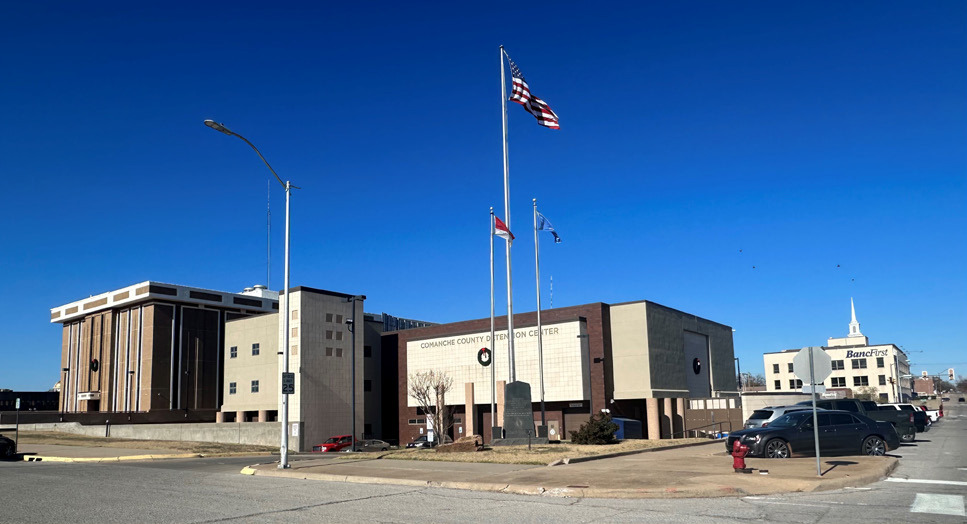
LAWTON – After listening for nearly three hours to testimony, “about half” of which “hasn’t been relevant to this case,” Comanche County District Judge Jay Walker denied District Attorney Kyle Cabelka’s petition to throw out the results of the Aug. 27 county sheriff’s runoff and conduct another election.
The judge said that two state Supreme Court decisions cited by Cabelka did indeed give him legal “standing” to bring the lawsuit, but were “a joke” and “make a mockery of the election process.”
The proverbial “bottom line” of the district court hearing and judicial ruling was that 6,562 votes were counted in the Republican Comanche County sheriff’s runoff election, Michael Merritt bested Andy Moon by 628 votes, and eight ballots – a fractional 12 one-hundredths of the total votes cast in that race – were deemed to be “irregular.”
Cabelka asked Election Board Secretary Amy Sims to define an irregularity. “Something that would cause the [vote] total to be off,” she replied. However, she added, “I have not been told by the state [Election Board] what an irregularity is.”
Assistant Attorney General Evan Edler argued that Cabelka’s petition “seeks to undo” the 3,595 votes that were cast for Merritt, and said those eight ballots were just “a few, miniscule, inconsequential votes” in the context of the total count.
The petition Cabelka filed Aug. 30 in Comanche County District Court contained “a multitude of defects,” Edler wrote.
For example, state law “dictates that a petition such as this may be brought only by a candidate of the relevant election,” Edler said.
Cabelka disagreed. “The law is not clear on who exactly has standing,” he said. And after receiving “numerous telephone calls and emails” about alleged irregularities with the election, and then talking to Sims and the State Election Board, “I felt obligated to file this protest.”
The D.A.’s petition “fails to present allegations sufficient for the purposes” of state statutes, Edler said.
An Oklahoma court ruled in 1989 that an election which is not “clearly illegal” will be upheld. “Absent instances of fraud or corruption, and ‘in the presence of merely statutory informalities,’ election results are not to be disturbed.” Those principles are “based in the electorate’s interest in having its vote count and avoidance of the ‘expense involved in conducting a second election’,” the court ruled 35 years ago.
Cabelka’s petition was entitled, “Petition Alleging Irregularities Other Than Fraud Regarding August 27, 2024, Runoff Election … for County Sheriff.”
Edler argued that Cabelka “has no legal basis” to file his petition. Only a candidate in the Aug. 27 runoff – in which Merritt defeated Moon – “may file a petition contesting the results” of that election.
The state Legislature “set out a clear path for contesting election results,” Edler said. Such a contest “shall be initiated by ‘filing a written petition with the appropriate election board,’ which is the board “with whom the candidate filed his/her declaration of candidacy…” Afterward, the Secretary of the election board that receives the petition “shall set a hearing in the same manner as provided for recounts.”
Sims wouldn’t accept Cabelka’s petition Cabelka attempted to circumvent the process by filing his petition with the Comanche County District Court rather than with Election Board Secretary Sims, as required by state statute, Edler maintained.
Cabelka said, and Sims confirmed, that he attempted to deliver his petition to Sims on Aug. 30, the Friday after the election. But she refused to accept the document, based on advice from the State Election Board and the state Attorney General’s office, she said.
The State Election Board “said that only a candidate could file” such a petition, Sims said she was told.
“That’s why I walked across the hall [in the Comanche County Courthouse] and filed this protest with the court clerk,” Cabelka told Judge Walker.
Edler said state law “explicitly states” that a challenger must list the particular irregularities to contest the results of an election.
Walker dismissed that assertion by pointing out that it would be virtually impossible to expect a challenger to uncover each and every irregularity in an election in less than 72 hours: between the time the polls close at 7 p.m. on election day Tuesday and the 5 p.m. deadline the following Friday.
State statutes governing election challenges are “pitiful,” Walker said.
During an hour and 25 minutes in the witness chair, Sims admitted that not all policies and procedures were followed by herself and her precinct officials, who “fell short of their training and procedures.”
8 ‘irregularities’ found in runoff Sims testified that ultimately eight irregularities were found in the sheriff’s runoff election.
Four of those occurred in Precinct 28, at the Comanche County Fairgrounds, she said.
Evidence presented during the hearing showed that Lawton residents Amber Hall, a registered Independent, and her “significant other’ Seth Moran, a registered Democrat, both received ballots for the Republican sheriff’s runoff election on Aug. 27. Both voted in Precinct 28 at the Coliseum. Moran admitted he was the person who reported the faux pas to KSWO-TV.
The other two irregularities involved ballots from Precinct 28 that were given to Precinct 27, also located at the Fairgrounds, Sims indicated.
In response to a question from Cabelka, Sims said the election workers from those two polling sites were “reprimanded” and will be “retrained.” Contrary to rumors, those workers are still affiliated with the Comanche County Election Board, Sims said.
Lawtonian Debra Myers is a registered Republican who testified she voted in Precinct 13, at Northside Baptist Church. She said she received a ballot for Lawton’s mayor, Ward 2 council member and the Capital Improvements Program sales-tax extension. Not until she got home did she realize she had not received a ballot for the GOP sheriff’s runoff – although her husband and son did – but by then it was too late to return to the polling site, she said.
In Precinct 31, procedures were not followed in the case of approximately 577 voters, Sims conceded. An “R” was not jotted down in the voter registry next to the name of many Republicans in that precinct who voted, she explained. “But that was a mistake, not an irregularity,” she insisted. The vote count was accurate. “Mistakes happen in any election,” Sims said.
After the State Election Board sent a team to Lawton, they “audited” the results of all 40 voting precincts in Comanche County, Sims said. A total of eight irregularities were found, she told State Election Board attorney Rachel Rogers: one ballot in Precinct 1, four in Precincts 27 and 28, and three in Precinct 45. “There were three fewer signatures than ballot ballots issued” in Precinct 45, Sims explained.
She told Rogers that 114 precinct officials worked the Aug. 27 election, and nine of those officials worked in the four precincts where the errors occurred.
“I agree that voters expect better,” Walker said. “But it’s a given that errors are going to be made in elections.”
Mere possibilities or probabilities are “insufficient evidence to overturn an election result,” the judge said. He also reiterated an earlier judicial decision that, as a matter of public policy, a court “usually indulges every presumption in favor of the validity of an election.” There is “no mathematical certainty that Michael Merritt should not be certified” as the winner of the Comanche County sheriff’s runoff election.
Walker offered “kudos to the district attorney” for pointing out “irregularities” that occurred during the election, “but I am totally convinced this election cannot be determined to be invalid.”
The jurist ordered the Comanche County Election Board to certify the sheriff’s runoff election results. Sims said the board met Sept. 13 and certified the count.
The results of Lawton’s election Aug. 27 for Mayor, Ward 1 and Ward 2 councilmembers, and for the PROPEL 2040 sales-tax extension, had already been certified, Sims said.