

Lawton’s three lakes have a combined volume of more than 100 billion gallons of water, according to Public Utilities Director Rusty Whisenhunt. Even if the watershed received “absolutely no rain” during the next 12 months, “We’d still have approximately 30% in storage in those lakes,” he told the City Council Tuesday night.
Whisenhunt made those comments shortly before rain soaked the soil and quenched thirsty yards, trees and plants in Lawton.
An estimated 41 billion gallons of water in Lawton’s lakes “are lost annually to evaporation,” Whisenhunt said. In comparison, just 12% of the water in those reservoirs is used to fulfill downstream water rights or is processed in the city’s two water treatment plants for residential, commercial and industrial usage by Lawton customers, he said.
The current combined capacity of the three lakes is approximately 76%, Whisenhunt told the council.
Waurika Lake is almost full, David Taylor, manager of the Waurika Lake Master Conservancy District, told Southwest Ledger on Wednesday.
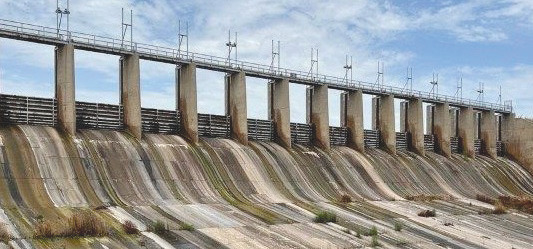
Lake Lawtonka is at 84% capacity, Whisenhunt said. Lake Ellsworth is down to about 45%, he said, because the normal pool elevation was lowered 3½ feet while construction continues on rehabilitation of the spillway.
The concrete spillway was damaged after heavy rains in 2015 forced the city to open the floodgates to release runoff water that otherwise would have topped the dam.
The floodwaters damaged concrete panels in the spillway. Further analysis revealed other problems, such as empty spaces beneath the spillway that were identified after geotechnical and engineering analyses. The spillway “floated” during the water releases, Whisenhunt told the Ledger.
The $46.4 million dam repair project started last summer and is “moving along” but is not expected to be finished for two more years, he said.
Meanwhile, no water is being pumped to Lawton from Lake Waurika because an $18 million renovation project is underway on the latter’s pump stations, Whisenhunt said.
“We’re still in very good condition with our three lakes,” Whisenhunt said. The National Weather Service projects normal rainfall this year. Even during the drought period of 2010 into early 2015 “we received 15 to 20 inches of rain during those years,” he said.
Over a year’s time, Lawton’s average water consumption rate is 18.5 million gallons per day, Whisenhunt said.
Waurika Lake rehab project
The Waurika Lake Master Conservancy District is experiencing “a temporary outage” during installation of new equipment, Taylor told
_____________________ __ __
the Ledger.
The WLMCD is installing new pumps, motors, and variable speed drives. The district also is installing a new electronic SCADA system; a “Supervisory Control and Data Acquisition” system is used to monitor and control industrial processes remotely and in real time.
The district also is installing replacement transformers and building new electric transmission towers to transmit signals via the district’s redundant telemetry system “because we’re so spread out,” Taylor explained.
The WLMCD is “essentially a small town,” Taylor said. Public Service Company of Oklahoma provides the electricity but the district “owns the equipment.”
Construction on the renovations began last summer, Taylor said. “It’s been a tremendous amount of work but we’re on schedule,” he said. “It’s crunch time,” he added.
Rust, obsolescence, and decay have taken a toll on the district’s equipment over the years. “When we’re back up and running, we should be at normal capacity with better reliability and improved equipment.”
The improvements are being financed with the proceeds of an $18,564,000 American Rescue Plan Act federal grant administered by, and approved almost three years ago by, the Oklahoma Water Resources Board.
“We were blessed to get that grant,” Taylor said. “We’re thankful for our legislators and representatives of our member cities” who were instrumental in securing that funding.
When the improvements are completed, “We’ll have a fish fry and tours, probably in June,” he said.
Because WLMCD supplies water to six cities, the district has four major pump stations, Taylor said. Two pump houses are located at the north end of Waurika Lake, one is south of Duncan, and another is south and east of Lawton.
The west water line – which serves Temple, Walters, and Lawton, along with Fort Sill and seven rural water districts via water purchases from Lawton – has two segments, Taylor said. Water is pumped from the lake to the pump house southeast of Lawton, and from there to Lake Ellsworth – a total distance of approximately five miles.
One pump house on the district’s east water line pumps water “about halfway” to Duncan, and then another pump house sends the water on to Duncan and Comanche, Taylor indicated.
The town of Waurika receives water from its namesake reservoir via a gravity-fed line.
Average peak usage from the lake during summer months is 30 to 35 million gallons per day, Taylor said.
Waurika Lake collects raw water from a watershed of approximately 600 square miles, and the WLMCD manages the reservoir in partnership with the U.S. Army Corps of Engineers. “And then we pump almost all of it back uphill,” Taylor noted.
Mike W. Ray is a fifth-generation, awardwinning journalist who has more than 55 years’ experience covering municipal, county, state and federal government in Oklahoma and Texas. He can be reached at mike.ray@swoknews.com.