

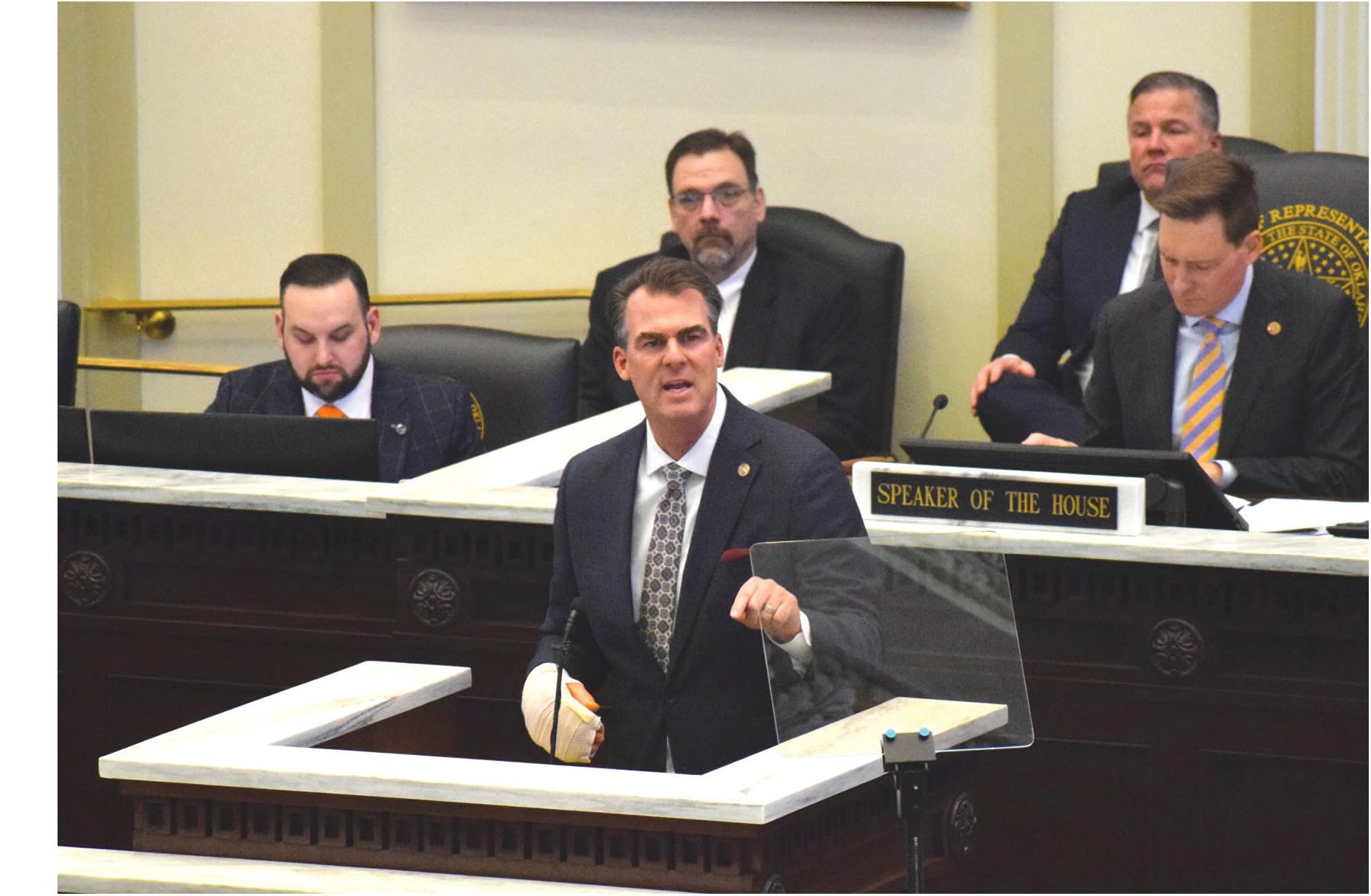
OKLAHOMA CITY - The Second Session of the 60th Oklahoma Legislature opened Monday and, just like the previous seven sessions, it kicked off with a speech by Gov. Kevin Stitt.
This speech, however, was the governor’s last State of the State address since Stitt’s tenure as the state’s chief executive ends this year. And Stitt went out with a bang.
Speaking to a joint session, Stitt spent a portion of his speech reminding lawmakers - and the public at large - of his legacy. In addition, Stitt called on the Legislature to make several policy changes and eliminate the election of the State Superintendent of Public Instruction and, instead, make that position appointive.
“It has been one of the greatest honors of my life to serve as your Governor,” Stitt said.
“It’s amazing to see all we have accomplished together over the last 7 years. The state of our state is the strongest it’s ever been. And ladies and gentlemen, we’re not done yet.”
Stitt said the last seven years “have been the greatest in state history.”
“We’ve gone from budget deficits to historic savings,” the governor said. “We increased public education funding more in my term as governor than in the past 25 years combined.
At the same time, we’ve cut taxes by $1.6 billion dollars and let Oklahomans keep more of their money. We diversified our economy, maintaining one of the lowest unemployment rates in the nation. We’ve seen median income increase by nearly $11,000.”
Oklahoma, the governor said, has shown the nation why the state is the best place to pursue the American Dream.
But, the governor added, there was still more to do.
And while Stitt laid out an ambitious plan, several of his ideas were greeted with a less than enthusiastic response from the Legislature.
In addition to his call for less spending, Stitt said he was calling for a state question on the ballot that would place a 3% annual cap on recurring spending growth and “lock in future cuts with ironclad rules.”
“This keeps the growth of government in check and protects the Oklahoma taxpayers,” he said. “And where I have authority, I’ll rein in welfare spending. Government dependency is a trap. It robs self-reliance and balloons budgets. I always say government programs should be a trampoline, not a hammock, but too often that is not the case.”
As an example, the governor pointed to Medicaid. He said Medicaid was driving massive spending growth while enabling waste and predicted that in 10 years, Medicaid would eat up 37% of the state’s annual budget - about $6 billion dollars.
“We have to make a change,” he said. He said his recent executive order would ramp up work requirements and vetting for Medicaid, SNAP, and other federal welfare benefits.
“But I need your help,” Stitt said.” I’m calling on the Legislature to send a question to the voters that would allow adjustments to Medicaid expansion so that we protect the program for those who really need it, not those who should be working.”
The governor also called on lawmakers to create the Taxpayer Endowment Fund and earmark it with $750 million of existing savings.
“Let’s imagine what’s possible - $750 million invested today can turn into $3.2 billion in just 20 years, generating sustainable revenue every year,” he said. “Let’s lock in these gains and let them grow for the future.”
Stitt, echoing a call from President Donald Trump, said the Legislature should add $250 to every newborn child’s account. Previously Trump said he wanted to give every newborn child $1000 for their future. Stitt said his plan could be funded if lawmakers reappropriated $12 million.
Stitt also called for a state question that would freezes property tax growth across the board. “Send it to the people,” he said.
Lawmakers seemed supportive of several of the governor’s ideas, applauding loudly, and in some instances, giving the governor a standing ovation. Stitt also called on lawmakers to reduce the cap on the Parental Choice Tax Credit, which he described as “the most impactful education reform in our history.”
“Let’s eliminate the cap,” he said. “Let the money follow the student.”
Along with tax and policy changes, Stitt called for a state question to eliminate the state’s medical marijuana industry.
“Now, we have more dispensaries than we do pharmacies,” he said. “These storefronts hide an industry that enables cartel activity, human trafficking, and foreign influence in our state. This industry is plagued by foreign criminal interests and bad actors, making it nearly impossible to rein in.”
Oklahomans, he said, “can’t put a Band-Aid on a broken bone.”
“Knowing what we know, it’s time to let Oklahomans bring safety and sanity back to their neighborhoods, the governor said. “Send the marijuana issue back to the vote of the people and shut
Turn to it down.”
Stitt wrapped up his speech doubling down on his long-running fight with tribal nations.
He said the 5-4 Supreme Court decision - written by Supreme Court Justice Neil Gorsuch - decided that half the state was a reservation. “In the wake of the McGirt decision, I have worked tirelessly to hold the line to keep one Oklahoma and protect the rights of every Oklahoman/’ he said. “We need to stop any effort to federalize half of our state.”
Stitt said state laws should apply equally to all Oklahomans with no exceptions. “An Indian named Kevin Stitt shouldn’t be treated differently than a single mom of a different race. Every decision we make here must be in pursuit of the good of Oklahoma’s future.”
While the Republican- dominated legislature seemed supportive of the governor’s plans, some lawmakers - both Republican and Democrat - had issues with many of his ideas.
House Minority Leader Cyndi Munson, a Democrat from Oklahoma City said Stitt’s speech did not make her confident the governor was listening to and prioritizing the needs of everyday working Oklahomans.
“He touted historic investments during his tenure as Governor, but those are the result of historic cuts made to core services on which Oklahomans rely,” Munson said. “Nearly 50% of working Oklahomans cannot afford basic necessities, which contradicts his claim that the state is the strongest it has ever been.”
Every elected official at the Capitol, Munson said, represents Oklahomans “who are struggling with health care costs and access.”
“Cutting Medicaid expansion - of which nearly half of the recipients are children - would be devastating for the over one million Oklahomans that rely on it,” she said.
“I agree that we need better access to affordable housing and improved literacy rates,” Munson said. “I don’t agree that eliminating the cap on the Parental Choice Tax Credit, diverting millions away from our public schools to put into private schools, is the way to achieve that. I also don’t agree that cutting the state’s income tax, only benefiting the wealthiest Oklahomans, would help with the growing need for housing in Oklahoma.”
Munson said she was also concerned by the governor’s statement about tribal relations.
“His comments today about our tribes were deeply troubling. The Oklahoma House Democratic Caucus supports tribal sovereignty and acknowledges that our tribes fill important gaps in our education and healthcare systems, as well as other areas throughout our state,” she said. “I am extremely grateful for the work our tribes have done and continue to do despite vicious attacks on them by the Governor.”
Munson wasn’t the only lawmakers who didn’t like Stitt’s comments about tribal relations. Scott Fetgatter, a Republican from Okmulgee, said the governor “made a mockery of our state’s unique history and the valued partnership our state has had with our tribal citizens for over 100 years.
“The governor says he has worked tirelessly to maintain unity of one Oklahoma however he continues to ignore the reality of who we are as a state and singlehandedly has destroyed decades of collaboration between state and tribal leaders,” Fetgatter, the chair of the Joint Committee on State Tribal Relations, said in a media statement.
Fetgatter said Stitt had the opportunity to correct the wrongs he has inflicted on state tribes.
“He instead chose to exacerbate the divide and ignore the partnerships that have benefited Oklahomans for years in health care, public safety, education, infrastructure and many other areas of potential collaboration,” Fetgatter said. “The Supreme Court ruling did not in any way make half of our state a reservation, and the governor knows it. The McGirt decision simply affirmed the U.S. constitutional law of citizens who were unjustly removed from their homes and were given a promise of self-governance.”
Fetgatter said the end of Stitt’s term gives Oklahomans an opportunity to build on existing partnerships with the tribes. “I hope our state’s next governor embraces and respects these sovereigns and their many contributions to our state,” he said.
Chickasaw Nation Gov. Bill Anoatubby said he wasn’t surprised by the governor’s speech. Anoatubby and the leaders of several tribal nations listened to the speech from the gallery in the House chamber.
“It’s pretty much the same thing we’ve heard for seven years,” Anoatubby said. “The issue isn’t about race. It’s about the relationship the United States has with another nation.”
With the Second Session of the 60th Oklahoma Legislature now underway, lawmakers will have until late May to examine the governor’s proposals.
M. Scott Carter is an award-winning political and investigative reporter with more than 40years’ experience covering federal and state government and politics in Oklahoma. He can be reached at scott.carterta) swoknews.com.