

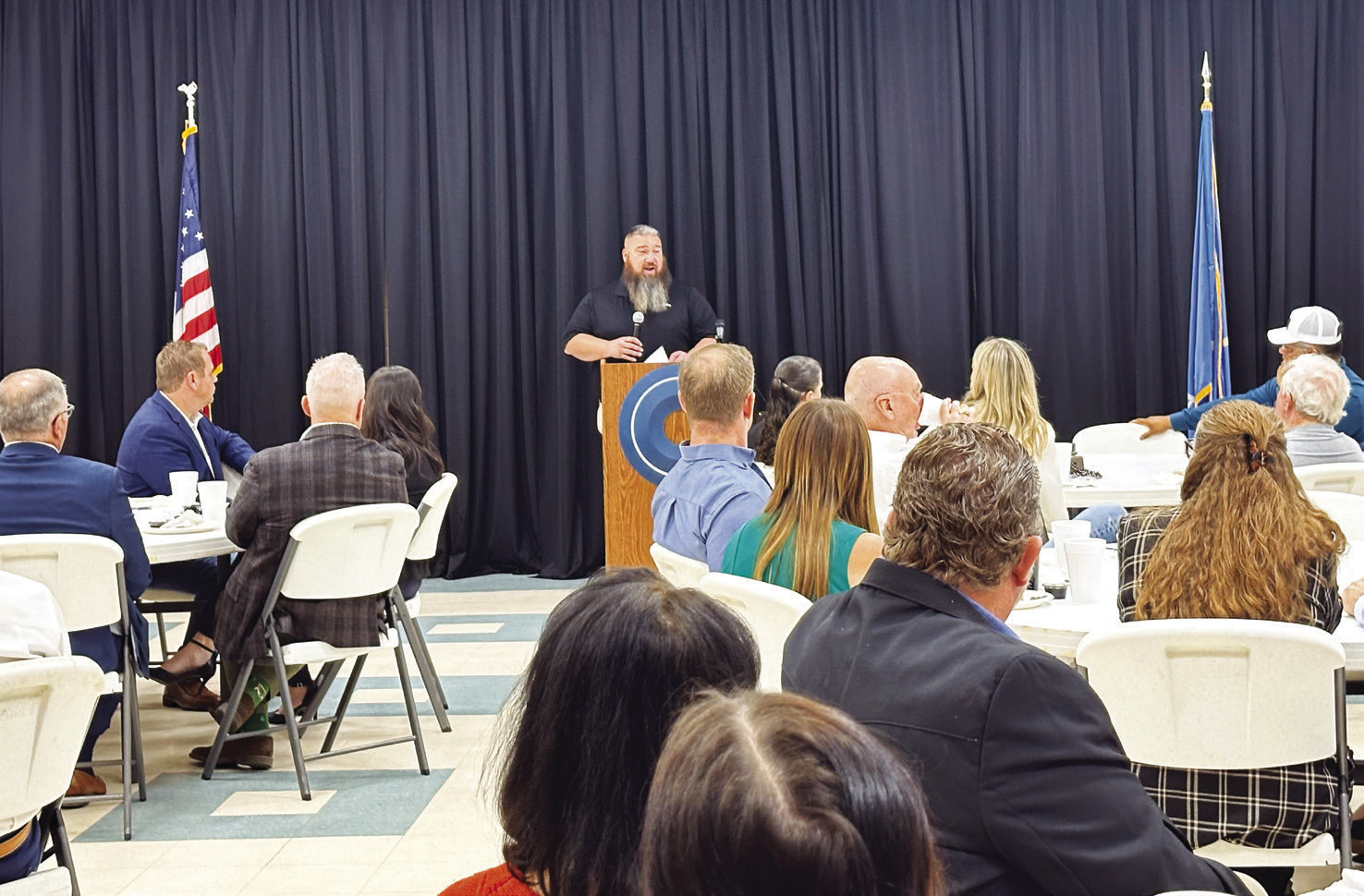
Chickasha “has made great strides in the past year,” Mayor Zach Grayson said during his first State of the City address Oct. 31. “But I have to ask myself: Is it enough?”
Local voters approved a permanent 1.25% capital improvement sales tax on Aug. 8, 2023, the proceeds of which will pay for “a desperately needed new water treatment plant and critically needed water distribution infrastructure improvements,” he noted. Those projects will constitute “a giant leap toward correcting our water quality issues: its appearance, taste and smell,” he said.
“But I have to ask myself: Is it enough?”
This year the City Council approved the creation of two tax increment finance districts “to help put a new tool” in the community’s “economic development toolbox.”
Also, Chickasha is “approaching the finish line with the downtown grant program,” because the funds are nearly exhausted. More than a dozen grants have been awarded from the proceeds of a special five-year excise tax that voters approved in 2011 for economic development purposes.
“But I have to ask myself: Is it enough?”
The town now has a Starbucks and a Chickfil- A, which three years ago were “considered a pipe dream.” Just last month the council approved the preliminary plat on a 74-unit single-family residential development, “and we have more housing developments going on right now than Chickasha has seen in years.”
Nevertheless, “I have to ask myself: Is it enough?”
The city has prioritized infrastructure repair and replacement, and has “gained ground on our ability to recruit and retain” police officers and firefighters,” but is “still trying to fill their ranks.”
The council has “doubled down on capital expenditures” to ensure that the city staff has “the equipment they need to do their job safely and efficiently.” For example, the council recently approved the acquisition of two new fire trucks, although they’re on order and won’t be delivered for three years.
But still, “I have to ask myself: Is it enough?”
During the last 18 months City Hall has “engaged our citizens” for their opinions and suggestions on the comprehensive land use plan of “how they want to see Chickasha grow in the future.” City Council meetings are open to the public and can be watched from remote locations.
“But I have to ask myself: Is it enough?”
Grayson said he believes Chickasha is “on the verge of growth it hasn’t seen in decades. We must capitalize on the momentum we have.”
However, “That does not mean we should rush headlong into unchecked development with reckless abandon or without proper planning,” he cautioned. “But we can keep our foot on the gas and map out our journey as we usher Chickasha into the future.”
He pledged to “give Chickasha all that I have … because one day the question undoubtedly will become, ‘Was it enough?’” For the community and its future generations, “I sure hope it was.”
Responding afterward to questions, the 14-year Army veteran and Chickasha business co-owner said:
• The biggest challenges facing Chickasha over the next five years are “its infrastructure and keeping up with growth.”
• The Comprehensive Plan is “90% complete.”
• Quality-of-life issues, such as Shannon Springs Park and the annual Festival of Light, are important to “any employers who are looking to bring high-paying jobs” to Chickasha.
• Asked about workforce development, Grayson, a Chickasha resident for 11 years, said the University of Science and Arts of Oklahoma and the Canadian County Technology Center are “feathers in our cap.”
• City officials are hopeful that construction of the new hangars “will draw more aircraft” to Chickasha’s municipal airport. “We’re right down the road from Will Rogers” airport in south Oklahoma City, he added.
• “One of my goals is to keep our sports complex packed every weekend.”
• Several city streets have been resurfaced recently, and city officials “hope to do a lot of work on our water and sewer lines,” he said. “All it takes is time and money,” he quipped.
Also during the meeting, which drew 121 people to the event held at the Grady County Fairgrounds:
• City Manager Keith Johnson said acquisition of land for the new water plant “should be wrapped up in a month or so.” Construction is expected to start next March “and will take about a year and a half” to complete, he said.
• “We don’t want to focus just on bringing in new businesses” to Chickasha, Chamber of Commerce President Jim Cowan said. City officials also need to focus on retention and expansion of companies it already has. “We have had five manufacturers who have expanded their operations in the past three years,” he said.
In addition, “We have hosted five conferences this year, and three more are coming up soon,” he reported. Among them will be a two-day Oklahoma Municipal League leadership class later this month.
• Fire Chief Tony Samaniego said work on conversion of a building at Fourth and Washington into a third fire station is “in the engineering phase.” The new station would “cut our response time to fires on the east side of town from about 8 minutes now to 2 minutes.” During his recent State of the City address, Mayor Zach Grayson praised his predecessor, Chris Mosley, who “brought us out of a time where we were almost insolvent as a city.”
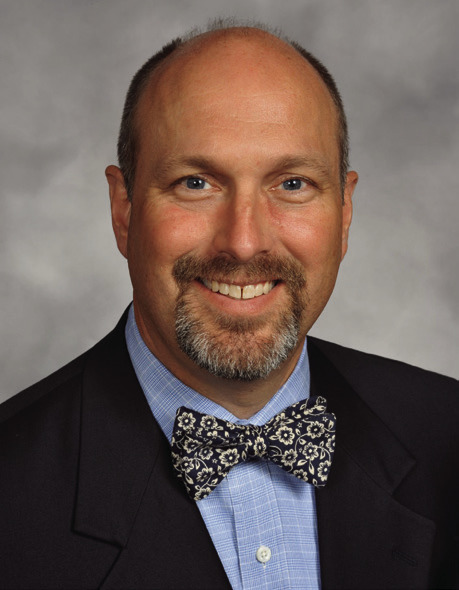
That occurred in July 2020 during his second term as Chickasha’s mayor, Mosley told Southwest Ledger.
Money was tight and after the city budget was adopted, “I started digging into it.”
He examined audits of the city’s books for several prior years “and found that our fund balances were declining,” he said. “We would have run out of excess cash by December ’21.”
After Mosley was appointed interim city manager (January 2021-mid-October 2021) while also serving as mayor, he contacted other city managers for advice about how to perform the job, and he talked to officials at the Oklahoma Municipal League “on a regular basis.” Also “we had a great staff, great people to work with.”
He soon took a long, hard look at the city’s two principal revenue sources: sales taxes and water sales. “I knew I couldn’t affect the sales tax, but realized we needed to do more about the water.”
At approximately the same time, the Fort Cobb Reservoir Master Conservancy District (FCRMCD) “informed us they were increasing the cost of water we were buying from them by 33%,” he recalled.
“At the time I did not know what the cost of water was, yet it accounted for half of our budget.” (The City of Chickasha pays the FCRMCD $33,841 per month for water.)
The FCRMCD authorizes Chickasha to pump up to 1.5 billion gallons of water per year from the lake, which lies approximately 35 miles northwest of Chickasha in Caddo County. (The city was billed for 1.037 billion gallons in 2022 and 1.048 billion gallons in 2023, records reflect.)
Mosley visited the water treatment plant and asked U.S. Water Services Corp., which operates Chickasha’s water and wastewater treatment plants, “How much water are we treating in a year?” At that time it was 940 million gallons, he said.
Mosley also checked on how much City Hall was billing for water. That number was 680 million gallons, he said – which meant nearly 300 million gallons were unaccounted for.
Further proof was provided by an audit of the city’s financial records for Fiscal Year 2021 (July 1, 2020, through June 30, 2021). Andy Cromer, director of HSPG & Associates of Oklahoma City, had a dire message for Chickasha officials.
The amount of water for which utility customers were billed indicates “you have leaks,” Cromer said. The city could not “reasonably verify or corroborate” that its customers were being billed for the correct volume of water they consumed, he said. The amount of water purchased and the amount that customers are billed for “are magnitudes off.”
It is not unusual for a municipal water system to report the loss of 10% of the water it buys or processes in a treatment plant. The reason? Line leaks and breaks, faulty meters, and water consumed to irrigate lawns and gardens doesn’t enter the municipal sewer system.
But in Chickasha, almost 28% of the water the city was paying for was unaccounted for.
In May 2021 city officials established that a major leak was occurring somewhere on the waterline from Fort Cobb, but despite repeated searches the location wasn’t discovered for 18 months, in November 2022.
Mosley, who owns an insurance company in Chickasha, was the insurance agent for Verden schools. One night, during a Verden school board meeting, he casually asked those in attendance whether anyone knew the location of the leak on Chickasha’s water line from Fort Cobb Reservoir. “One guy raised his hand and said he knew exactly where it was – and he even had drone video of it.”
The leak was north of Verden, near Lake Chickasha, Mosley related. The location of the leak went undetected for 18 months because “the water wasn’t ponding,” he said. “It was flowing from a break in a gravity-fed main and into a nearby creek” which emptied into the Washita River.
After the leak was repaired, “a massive change” occurred in the city’s finances, Mosley said.
City finance personnel participated in a training program, the city changed billing/collection vendors in Fiscal Year 2022, all of the city’s 6,600 utility accounts were audited, and all water meters were inspected.
The city discovered that some customers who were thought to have one meter actually had multiple meters (such as one for the home and another for an irrigation system to water the yard and flowerbeds); some meters were inoperable and others were running slow; and some meters were calibrated for incorrect waterline sizes (for example, the meter was set for a 1-inch line but was attached to a 2-inch or a 4-inch line).
“We found we had 400 customers who weren’t getting billed accurately for the water they received from the city,” Mosley said. “We informed them they had 10 days to update their accounts or their meter would be pulled.”
Chickasha still has “a tight city budget,” Mosley acknowledged. “But we have cash flow.”