

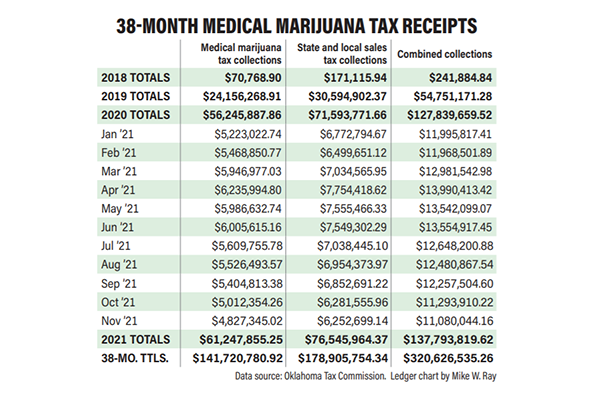
OKLAHOMA CITY — Collections from the 7% tax on medical marijuana sales in Oklahoma declined in November for the fifth consecutive month, to their lowest level in more than a year.
The $4,827,345 collected last month from the MMJ tax was the lowest amount that levy has produced since November 2020, when the take was $4,816,567, Oklahoma Tax Commission ledgers reflect.
“It’s likely due to normal fluctuations in the market,” said Kelsey Pagonis, communications manager for the Oklahoma Medical Marijuana Authority (OMMA). The same thing happened during a three-month period last year (September through November 2020), she noted.
Last month’s MMJ tax receipts represented almost $69 million in sales of medical marijuana products – an average of $179 for each of the 384,645 Oklahomans who had been issued an MMJ patient license by the state Health Department as of Nov. 5. The number of patient licenses increased by 23,904 during the preceding 12 months.
Compared to collections in June from the 7% MMJ tax, November receipts were:
• 29% lower in Carnegie.
• more than three times greater in Elgin.
• 34% lower in Lawton.
• almost 12% lower in Hollis.
• nearly 15% higher in Altus.
• 22% lower in Waurika.
• 347% higher in Hobart.
• 31% lower in Mountain View.
• 46% lower in Comanche.
• 18% lower in Duncan.
• 34% lower in Marlow.
• 35% lower in Frederick.
The MMJ tax is still a major revenue producer, generating $61.2 million during the first 11 months of this year, more than was collected in all of 2020.
The number of medical marijuana businesses licensed in Oklahoma continued to grow this year.
As of Nov. 5, licensed processors numbered 1,617, a 28% increase from Jan. 5, OMMA records reflect.
Dispensaries numbered 2,431 on Nov. 5, an 18% increase from Jan. 5. MMJ dispensaries in Southwest Oklahoma last month included 69 in Lawton; Altus, 16; Duncan, 15; Elgin and Hobart, 5 each; Marlow, Frederick and Devol, 4 each; Rush Springs, Cement and Hollis, 3 each; Apache, Comanche and Waurika, 2 apiece; and Medicine Park, Cache, Carnegie, Eldorado, Fort Cobb, Geronimo, Mountain View, Ringling and Walters, 1 each.
Growers Increased
By 40% This Year
Licensed growers as of Nov. 5 numbered 9,178, an increase of 40% from the 6,564 licensed marijuana farmers 10 months earlier.
Southwest Oklahoma had more than 465 MMJ farmers on Nov. 17, OMMA records show. Those included: Lawton, 53; Duncan, 50; Marlow area, 50; Rush Springs, 36; Fletcher, 21; Elgin, 19; Comanche, 18; Altus, 16; Cement, 13; Foster area (in Stephens County), 13; Cache, Apache and Ringling, 12 each; Geronimo and Waurika, 11 each; Cyril and Hobart, 10 each; Carnegie and Lone Wolf, 9 each; Devol, 8; Grandfield, Faxon, Frederick and Blair, 6 each; Walters, Eldorado and Mountain Park, 5 each; Tipton, Fort Cobb and Hollis, 4 each; Indiahoma, Temple, Hastings, Mountain View and Terral, 3 apiece; Roosevelt and Elmer, 2 each; Sterling, Chattanooga and Duke, 1 each.
While Oklahoma City and Tulsa certainly have a large number of growers, rural Oklahoma has attracted several thousand licensed marijuana farmers.
For example, Muse, an unincorporated community of about 300 population in LeFlore County at the southern edge of the Ouachita National Forest, has seven licensed growers. And Webbers Falls, a Muskogee County town of approximately 600 residents near the south bank of the McClellan-Kerr Arkansas River Navigation System, has 48 licensed MMJ growers.
How MMJ Taxes
Are Allocated
A law the Legislature passed, and Governor Stitt signed in May, Senate Bill 229, spells out how receipts from the 7% MMJ tax will be disbursed.
59.23% of the first $65 million in revenue (or $38,499,500) will be apportioned to the State Public Common School Building Equalization Fund, which is also known as the Redbud School Funding Program for disadvantaged public and charter schools.
34.62% of the first $65 million (or $22,503,000) will be earmarked to underwrite operations of the Oklahoma Medical Marijuana Authority. The agency’s budget for FY 2021, which ended June 30, was $25,472,344.
6.15% of the first $65 million (or $3,997,500) will be allocated to the State Health Department for drug and alcohol rehabilitation programs.
Any MMJ tax collections above $65 million will be deposited in the state’s General Revenue Fund. The 7% MMJ tax produced $61.2 million during the first 11 months of this year, an average of more than $5.5 million monthly.
A related measure the Legislature passed, Senate Bill 1033, authorizes the Oklahoma Tax Commission to keep 1.5% of the proceeds from the MMJ tax as a handling fee for collecting the tax and enforcing the law.