

Volunteers fanned out across cities, towns and rural areas last January to count as many homeless people in America that they could find. Those results, released on December 27, were bleak. The number of homeless people in the U.S. had climbed to the highest level on record: 771,000.
And that number does not reflect individuals who have lost their homes and moved in with a relative or friend.
Homelessness continues to grow across the United States, and Lawton is no exception.
The most recent head count of the homeless population in Lawton by the Southwest Oklahoma Continuum of Care, which is administered by the MIGHT Community Development and Resource Center, placed the number at 350-plus people, “but the actual number is much higher than that,” said Bernita Taylor, CEO of MIGHT.
According to the Legal Services Corp., 8,301 eviction applications were filed in Comanche County District Court from mid-March 2020 through November 2024.
Last year more than 2,000 eviction hearings were held in Comanche County District Court. During the first eight months of the year, default judgments were approved in 419 of those cases because the tenants were no-shows for the hearings, Legal Services reported.
Also in Comanche County: 43.5% of the residents are rent-burdened, compared to the national average of 45.83%; and 16.4% are impoverished, compared to the national average of 12.94%, MIGHT found.
Simultaneously, complaints about homeless people in Lawton are mounting.
Lawton Police Department officers “are hearing from businesses that their employees coming to work in the mornings are having to wake up people who are sleeping at their entrances,” LPD Sgt. Matt Dimmitt told the City Council. “They’re having problems with homeless people defecating on their property. Customers are having to walk around people who are sleeping on sidewalks. This is somebody who’s in a sleeping bag or in a tent, not somebody sitting at a curb or waiting for a bus,” Dimmitt said.
Other concerns associated with homeless populations include needles and other paraphernalia, trash and other types of waste.
Consequently, dozens of local businesses and groups are assisting three organizations – The Salvation Army, C. Carter Crane Center, and MIGHT – that provide resources to those who have no home.
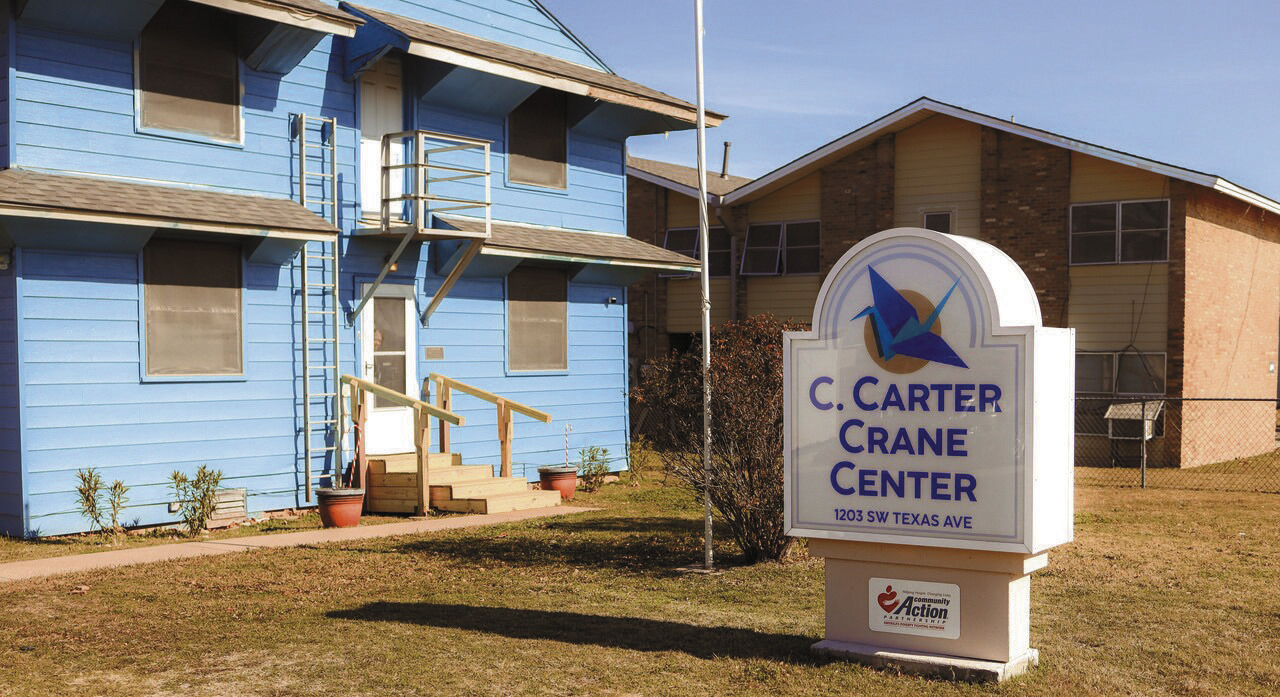
C. Carter Crane Center The C. Carter Crane Center operates under the umbrella of Embrace Hope, a 501(c) (3) tax-exempt organization. The center’s purpose is “to promote resilience, collaboration and support for families.”
Embrace Hope assumed management of the 28-bed homeless shelter last July from the Great Plains Improvement Foundation after its dissolution. At that time the center housed five females and six males, a July 15, 2024, Facebook post related.
The facility closed temporarily and was remodeled because it had “tremendous deferred maintenance issues,” including plumbing problems, director Brenda Spencer-Ragland told the City Council.
Plumbers and HVAC contractors “jumped in and made sure our needs were met,” she said. And on Aug. 7 “we had 165 volunteers who cleaned the shelter” and City Hall provided two trash dumpsters that were filled with “old stuff we threw away.” Afterward, the fire inspector “walked through” the center and gave it a ‘thumbs-up.’
The shelter staff try to “make sure the people here are safe, secure, have food and shelter, and know that they still belong,” Spencer-Ragland said. The homeless shelter has round-the-clock security cameras.
Residents of the shelter are provided with food, clothes, household items, transportation, and a new pillow, all at no cost to them, and they received gifts on Christmas Day, she said. In exchange, the residents have duties while staying there: finding a job or securing services they need. The center also sponsors church services and Bible study through a local ministry.
Twenty-eight of the center’s residents have transitioned into low-income housing, Spencer- Ragland said.
C. Carter Crane Center partners with The Salvation Army for job searches and training, and with Catalyst Behavioral Services for drug and alcohol recovery. Residents receive help in getting needed medical and dental care. In addition, “We work with the Comanche County Health Department, with Jim Taliaferro Community Mental Health Center, and with Comanche County Memorial Hospital.”
The average age of the shelter’s occupants is 55, Spencer-Ragland said. As a general rule, no one under the age of 18 may stay in the center unless he/she is accompanied by a parent or guardian. All residents must remain drug/alcohol free and have committed no violent felony crimes.
“Currently we provide shelter and meals for an average of 15 people each evening, including some mothers and their children,” Spencer-Ragland said.
The maximum length of stay at the C. Carter Crane Center is six months, during which time they are not charged for room and board nor any services they receive.
Operation of the center is financed entirely from individuals, churches and businesses, Spencer-Ragland said. “We are up to 93 pledges; our goal is 100.”
The Salvation Army In 2023 The Salvation Army in Lawton served 7,373 individuals, served 1,765 food boxes, provided 2,901 nights of shelter, and assisted 178 families in paying their utility bills, Capt. Bryan Brinlee said.
The shelter had more than two dozen beds “but only eight people, on average, were taking advantage of them,” he said. The shelter is closed temporarily for major repairs and renovation – which could cost an estimated $360,000. When the shelter reopens “we hope to accommodate 30 to 50” needy individuals, Brinlee said.
“We have chronic homelessness in Lawton,” he said, “so I decided to write a ‘three-year battle plan’ to address the issue.”
For example, “We set aside $62,000 to hire homeless people at $12 an hour to ring the bells” at kettle collection sites during the Christmas holiday. “For five weeks’ work they could earn $3,270.” The Salvation Army’s goal is “to pull homeless people off the street.”
The Salvation Army stepped up after the City Council adopted an ordinance Oct. 22 that prohibits unauthorized camping in public areas. The ordinance decrees that no person “may utilize public property” to establish an “unauthorized camp.”
Camping is defined in the ordinance as “to reside or dwell temporarily in a place, with shelter,” which includes “any tent, tarpaulin, lean-to, sleeping bag, shanty, bedroll, blankets, or any form of cover or protection from the elements other than clothing.”
Conviction for a violation will be a misdemeanor for which the penalty is a fine of up to $50 and/ or confinement in the city jail for up to 15 days.
However, the new law provides that anyone who commits an initial violation will receive a warning, and no citation will be issued “unless the person refuses any assistance offered to them” by the police officer. That assistance may include “information about or transportation to a shelter, food pantry, or other place where resources are made available to assist the indigent and unhoused.”
“We are criminalizing only those individuals who refuse to accept assistance,” City Attorney John Andrew said at a September council meeting.
“We are a caring, compassionate community,” Dimmitt said in a recorded interview posted on the City of Lawton’s Facebook page. “We are trying to provide a service, get them the help they need and protect them from the elements and from crimes that happen to them on a daily basis.”
The city attorney explained why the ordinance was deemed necessary.
“There’s a finite amount of resources, and we have some folks who come in and want to drain those resources,” Andrew said. “They’re just looking to live maybe a nomadic lifestyle or some kind of unhoused lifestyle. We need to make sure our resources are going to folks who legitimately want to move up and be a part of society.”
The anti-camping ordinance includes an exception: its provisions “shall not apply to public property where authorized camping has been expressly allowed by city ordinance, state statute, or by express written authorization” of the City of Lawton.
That section was needed, in part, because of a council discussion about designating Olson Park as a possible location for homeless “outreach and support services,” including tents. The park was suggested because it is “often utilized as a temporary shelter site,” Lawton Parks Director Larry Parks explained.
However, those plans were shelved after Brinlee said he would open a lot behind their facility at 1306 SW E Ave. “to allow the homeless to camp there, where they will have access to a cot, food, and ministry services if they want it,” City Hall spokesperson Caitlin Gatlin related.
Brinlee said it also provides opportunities for engagement with the homeless community. “The people who are on the streets, living off in the woods, camping behind buildings – that ‘housing-first’ model is not working for them.”
MIGHT CDRC “Our priority is to empower, not enable” the homeless, Bernita Taylor told the Lawton City Council on Dec. 10. “We raise people up to be self-sustaining and to realize their greatest potential.”
Taylor, who was homeless as a teenager, is the founder and chief executive officer of Q.U.E.S.T. of Oklahoma d/b/a MIGHT Community Development and Resource Center.
MIGHT CDRC was founded in 2001 and incorporated in 2003 as a faith-based nonprofit organization that collaborates with government agencies, churches, fellow partners and other community agencies to address the needs of individuals and families.
MIGHT “started our efforts with the Lawton Housing Task Force and now works with 42 organizations,” Taylor said.
The task force has four divisions, she related: prevention, intervention, stabilization, and continuum of care. “We use many avenues to address and prevent homelessness.”
As an illustration, she said they partner with Legal Aid, and work with Realtors and property managers, in eviction cases. Also, they collaborate with Marie Detty Youth and Family Services, which provides an emergency shelter for victims of domestic violence; Catalyst, which provides detox and recovery assistance for homeless individuals who have substance and alcohol abuse problems; and the Jim Taliaferro Community Mental Health Center.
Barriers for the homeless include poor physical health, lack of job skills, little education, addiction (to drugs, alcohol and/or gambling), physical disabilities, lack of identification, and family issues. However, the biggest problem is mental health.
“We need shelters, we need emergency beds,” Brooke Brown of MIGHT told the City Council. “Many people remain on the street because of resource shortages here.”
MIGHT CDRC plans to convert the former Roosevelt elementary school at 1502 SW I Ave. in Lawton into a homeless shelter and a day center, Taylor said.
Q.U.E.S.T. of Oklahoma has acquired title to the building from Salt of the Earth Ministries, Comanche County Assessor records show. Taylor indicated the U.S. Department of Housing and Urban Development approved a $404,302 grant to finance the purchase.
American Rescue Plan Act funds were awarded two years ago for renovation of the school building. However, the $1.1 million ARPA grant will cover only part of the cost, Taylor said. “We still need $2.5 million,” she told Southwest Ledger. “We plan to raise the rest of the money through other grants, private donations, and fundraising,” she said.
“We really don’t have a choice. We took this on two years ago. This is a situation that no matter what the cost is, we have no choice.”
When the project is completed and the building has been renovated, 10 families will be housed there, she said. It will have bedrooms, restrooms and kitchenettes. The plan is to help primarily families with children, she indicated.
The “day center” will have multiple offices for resource representatives.
“It won’t be a place to hang out,” Taylor said. “We will be a provider of resources, a one-stop shop for people who have housing issues such as eviction or homelessness.” The center will offer resources for “anything pertaining to basic needs: jobs, IDs, Social Security, medical, veterans – resources to help with any situation for people who are having problems with homelessness or possible homelessness,” Taylor said.
In addition, several tiny homes are planned to be built at the shelter campus “over the next five to 10 years,” Taylor said.
“The maximum stay in our shelter will be three to six months, and transitional housing will be six to 12 months,” she said.
Transitional housing is important because “many people cannot go directly from a no-cost shelter to rent averaging $750 a month,” she added. MIGHT will “provide continuum of care for up to a year” as one step toward addressing chronic homelessness.
Over a 20-month period, investments in MIGHT totaled $500,608, Taylor said. “We might ask the City of Lawton for $150,000 for furnishings and equipment” for the new shelter, but to date, “We haven’t asked the city for any money,” she said.