

The open-range cattle era lasted for barely a quarter of a century, 1866-1890, and the Old West era is technically defined as having lasted for 46 years, from 1866 (immediately following the Civil War) to about 1912 (just prior to the start of World War I), although the last stagecoach robbery in U.S. history occurred in Nevada in 1916.
Nevertheless, the myth of the “wild West” endures, romanticized in films such as the classic “Red River” (1948) by director Howard Hawks and starring John Wayne and Montgomery Clift; “Lonesome Dove” (1989-90) starring Tommy Lee Jones and Robert Duvall; and “The Culpepper Cattle Company” (1972).
What’s truly interesting about these films and television series such as “Gunsmoke” and “The Virginian” is that few of them portrayed the West as it really was.
Yes, the gunfight at (actually, near) the OK Corral did occur in Tombstone, Ariz., in 1881. And yes, William “Billy the Kid” Bonney, John Wesley Hardin and James Butler “Wild Bill” Hickok were notorious pistoleros. But gunplay wasn’t nearly as frequent as the dime novels, the “oaters” and “shoot-’em-ups” would have you believe.
According to author Christopher Knowlton, the worst cattle-town shootout occurred in Newton, Kan., in 1871, when four men were killed, and four others were badly wounded.
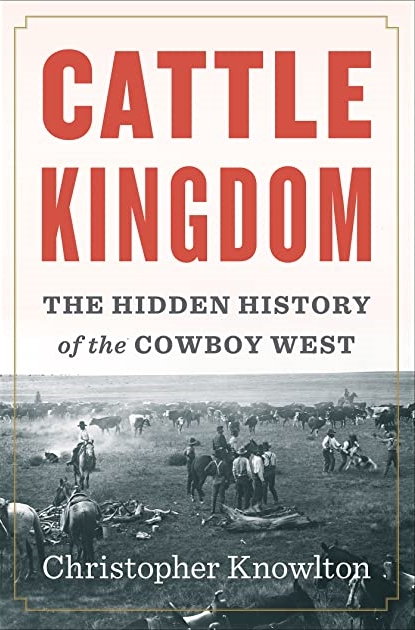
Most cowboys didn’t carry firearms, Knowlton claims in “Cattle Kingdom: The Hidden History of the Cowboy West” (426 pp; Houghton Mifflin Harcourt; © 2017).
The cost of a Colt single-action pistol, $100 per pair, would have been “a huge amount of money” for a cowboy, who typically was paid $25 to $40 a month, Knowlton says. And a cowboy who did own a revolver “usually kept it in his bedroll” because a loaded six-shooter worn around the waist was “both cumbersome and heavy when riding or walking.”
Also, most cowboys knew that toting a six-gun in a cow town was “an invitation to gunplay.” Consequently, cowboys tended to settle their disputes with fistfights. A revolver was best used to kill varmints such as snakes, to put wounded animals out of their misery, or to signal for help, Knowlton writes.
The image of the lawman as “a daring gunslinger” was a myth largely invented by the press via “dime novels” that “became a staple of the Western, both on television and in the movies.” Many law enforcement officers preferred a shotgun to a pistol, Knowlton says.
Contrary to popular belief, Knowlton reports, no one was killed in 1869 nor in 1870 in Abilene, Kan., site of the first railroad depot established for the sale of cattle. “Ironically, no one died in a cattle-town gunfight until the arrival of the sheriffs and marshals who were hired to prevent such murderous acts.”
Even in 1878, the worst year for Dodge City, Kan., only five men died in gunfights, records indicate. Dodge City, the longest-lived of the Western cattle towns, “boasted a distinguished cast of lawmen and gunmen,” Knowlton notes. They included brothers James, Ed, and Bartholomew “Bat” Masterson; Bill Tilghman, who later became police chief in Oklahoma City and subsequently was murdered in Cromwell, Okla.; and Wyatt Earp of OK Corral infamy.
Historian Robert Dykstra counted only 45 homicides in all of the Kansas cattle towns during the cattle era. (In comparison, New York City logged approximately 400 murders each year in the late 1860s.)
Disease – such as tuberculosis, typhoid or smallpox – was “a far greater scourge” most likely to claim a cowboy’s life, Knowlton writes.
The open range to support cattle began with an “orgy of slaughter” of millions of buffalo in less than 20 years, a deliberate tactic intended to deprive Plains Indians of their basic source of food and clothing, and thus starve them into submission. As a result, by 1879, “when the beef bonanza took full flight,” Knowlton writes, the greatest threat facing drovers was a cattle stampede, Indian attacks posed no real threat to cowboys or cattlemen on the open range, and the American bison was driven to the brink of extinction.
Simultaneously, a huge demand for beef developed in the northeastern United States; among forts, Indian reservations and mining towns of the newly opened American West; and in Europe. By 1877, a thousand pounds of American beef was being exported weekly to England and Scotland, thanks largely to a disease that struck Britain in 1865 and wiped out half a million head of cattle in two years.
To meet this demand for beef, routes such as the Chisholm and Western trails through what is now Oklahoma and the Goodnight-Loving Trail were blazed for sending Texas longhorns to market, first in Kansas and then to New Mexico, Colorado, Missouri, Wyoming and Nebraska. “In all, some 10 million cattle would be driven north out of Texas, accompanied by half a million horses and some 50,000 cowboys,” – and a few rustlers – Knowlton writes.
Establishment of the depot in Abilene ultimately led to Chicago’s “primacy as the cattle hub of the West and ultimately the headquarters of the meatpacking industry,” Knowlton writes.
At least eight men were required to drive 1,000 head of cattle, Knowlton reports. Many of these cowboys were former Confederate cavalrymen, but their numbers also included European immigrants, Mexicans, African American former slaves who fled Southern plantations, and Native Americans.
Similarly, historian Lewis Atherton reported that the 800 inhabitants of Abilene in 1870 represented 27 states and 13 foreign countries.
The invention in 1874 of barbed wire – via the use of a coffee grinder – presaged the end of the frontier. Homesteaders needed some way to keep open-range cattle and herds of trailed Texas cattle from wandering onto their acreage, “devastating their crops or infecting their livestock with contagious diseases,” the author writes. And the railroads needed a similar deterrent to keep bison and elk off their tracks.
Barbed wire had its drawbacks, though. It gouged holes in the animals’ skin, leading to screwworm infestations. And in a blizzard, it trapped cattle against fences, where in many instances they froze to death; in the absence of the wire, they could drift downwind safely before a storm.
This drawback became all too apparent in the winter of 1886-87, when the thermometer dropped to 46 degrees below zero. Nearly a million head of cattle died, along with 320 cowboys and settlers. The debacle was quickly labeled “the Big Die-Up.” It also spelled the end of giant cattle ranches and burst the speculation “bubble” in cattle.