

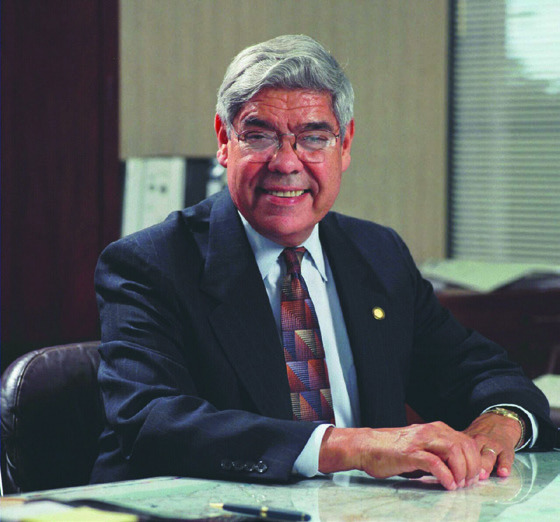
Neal A. McCaleb, a distinguished civil engineer, state and national public servant, and an influential member of the Chickasaw Nation, died Jan. 7 at the age of 89.
Visitation at Crawford Family Funeral and Cremation Service in Edmond will be held Jan. 15, from noon to 8 a.m. A funeral service is scheduled for 2 p.m. Jan. 16 at Henderson Hills Baptist Church in Edmond.
Born in Oklahoma City on June 30, 1935, McCaleb grew up hunting and fishing on the shores of Lake Overholser and graduated from Putnam City High School in 1953. He then earned a bachelor's degree with honors in civil engineering from Oklahoma A&M College (now Oklahoma State University) in 1957.
His career spanned more than eight decades, during which he made significant contributions to Oklahoma’s infrastructure and Native American affairs.
McCaleb’s public service began in the Oklahoma House of Representatives, where he served for eight years, 1975-82, including a term as House Minority Leader.
“Neal recruited my mother to run for the state Legislature in the 1970s and they served together in the Oklahoma House of Representatives,” Congressman Tom Cole recalled.
McCaleb was appointed as Oklahoma’s first Secretary of Transportation by Gov. Henry Bellmon in 1987, a role he reprised under Gov. Frank Keating in 1995. He also was the first person in state history to hold three concurrent positions as Secretary of Transportation, director of the Oklahoma Department of Transportation (ODOT) and director of the Oklahoma Turnpike Authority (OTA).
“Neal and I served in state government together when he was Oklahoma Secretary of Transportation in the Bellmon Administration and I was a state Senator,” Cole noted. “In the Keating Administration we were close allies and associates and both of us served in the Governor’s cabinet: he as Secretary of Transportation and I as Secretary of State. We worked together on road projects, negotiating the Indian Fuels Tax agreement with tribal governments, and numerous funding bills with the Legislature.”
Of the accomplishments of which he was proudest, McCaleb considered his work bringing the first cable barrier system to Oklahoma highways, which has saved thousands of Oklahoman lives since they have been installed, to be among the most important work of his life.
He was responsible for many transportation programs and initiatives that improved transportation infrastructure in Oklahoma, including construction of the urban turnpikes in Oklahoma City and Tulsa, and safety initiatives and programs to improve access to rural Oklahoma.
Both ODOT and the OTA stated that under McCaleb’s leadership the two agencies “have been forever changed for the better, realizing significant strides in transportation infrastructure improvements.” McCaleb followed in the footsteps of his father, Burt, who served as ODOT’s chief engineer.
In 2001 President George W. Bush appointed McCaleb as Assistant Secretary of the Interior for Indian Affairs, where he led the Bureau of Indian Affairs and advocated for tribal economic development.
“In that position he did an outstanding job for ‘Indian Country’ throughout his tenure,” said Cole, a fellow Chickasaw. “Our paths continued to cross many times in many ways as Neal rendered distinguished service to the Chickasaw Nation in a variety of positions.”
McCaleb also served as a presidential appointee on Ronald Reagan’s Commission on Indian Reservation Economies in the 1980s.
After returning to Oklahoma in 2003, McCaleb served as an economic development consultant and special adviser to Gov. Bill Anoatubby of the Chickasaw Nation. McCaleb eventually rose to the role of Ambassador of the Chickasaw Nation, a post he held until his passing.
To commemorate his legacy, the Chickasaw Nation opened a scholarship in his honor: the “Ambassador Neal McCaleb Scholarship for undergraduate Chickasaw students attending Oklahoma State University.”
He was a defender of tribal sovereignty, and in 2012 he was honored as the Red Earth Ambassador of theYear for his commitment to Native American interests.
During his lifetime McCaleb received numerous honors, including induction into the Chickasaw Hall of Fame in 1999, the Oklahoma Hall of Fame in 2014, the OSU Hall of Fame, and the OSU College of Engineering, Architecture, and Technology Hall of Fame.
He loved spending his free time with his wife, Georgann, and their family at their condo in Colorado, where he skied into his 70s and was still enjoying hikes well into his 80s.
McCaleb was an avid reader and amateur history expert. He played a significant role within his own family and many others he mentored, by sharing through stories of personal experience and tribal history of what it means to be a member of the Chickasaw Nation.
He helped fund higher education for all of his grandchildren, whether they went to cosmetology school, earned a bachelor’s degree, or attended law school.
McCaleb was preceded in death by his father and mother, Burt and Zelma McCaleb; his siblings, Juanita Roper, John B. McCaleb, and Marion McCaleb; as well as a son, Adam McCaleb.
He is survived by his wife, Georgann, to whom he was married for 69 years; his son, Kevin McCaleb; his daughter and sonin- law, Kate and Bryan Turner; and his son and daughter-in-law Caleb and Terri McCaleb; 16 grandchildren and six great grandchildren.
In an interview with Voices of Oklahoma, McCaleb said his biggest wish is to be remembered as a good father and grandfather.
The family requests that in lieu of flowers, please donate to the Chickasaw Nation’s Neal McCaleb scholarship.