

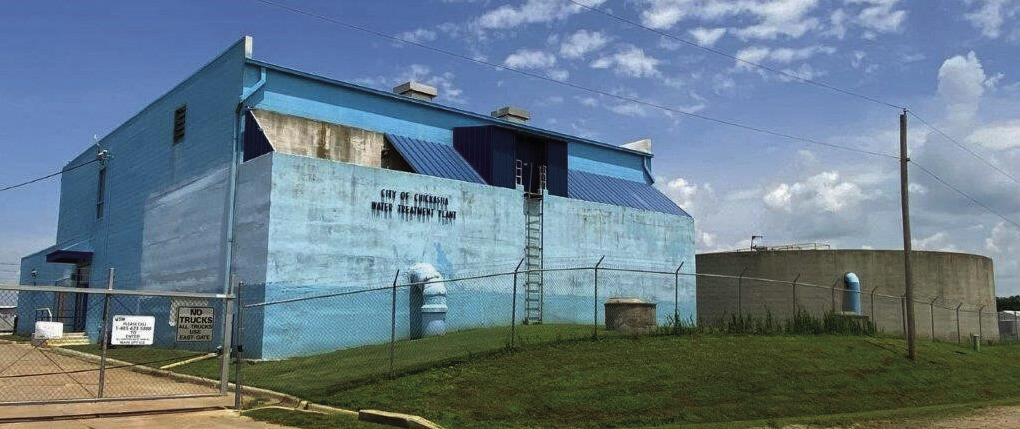
CHICKASHA – Freese & Nichols will spend up to $2 million to provide multiple phases of engineering services to the City of Chickasha during development of a new water treatment plant.
The Oklahoma City company’s “engineering scope of services” will include an evaluation of the quality of drinking water sources and treatment process recommendations.
Chickasha’s water treatment plant, which is at least 60-plus and perhaps 70-plus years old, is incapable of adequately treating water from the lake, Mayor Chris Mosley said.
The plant was designed to process 6 million gallons of potable water daily, but now its “functional capacity” is 4.2 million gallons per day to serve the 16,500 residents of Chickasha and the nearby community of Norge, professional engineers Clay Herndon and Jason Cocklin from Freese & Nichols told the city council on Jan. 16.
The new facility planned by the Municipal Authority will be capable of producing up to 6 million gallons of drinking water daily “with provisions to expand to 8 mgd.”
Chickasha receives its water from Fort Cobb Lake approximately 35 miles northwest in Caddo County. The raw lake water is conveyed to Chickasha’s water treatment plant on Genevieve Street through a concrete asbestos pipeline.
Chickasha’s contract with the Fort Cobb Master Conservancy District allows the municipality to draw up to 5,125 acrefeet of water (almost 1.67 billion gallons) per year, Office Manager Ginger Abbott told Southwest Ledger.
The city’s metered pump station recorded Chickasha drawing 1.037 billion gallons of water (3,184.57 acre-feet) from Fort Cobb Lake in Calendar Year 2022, and 1.093 billion gallons (3,355.106 a-f) in CY 2023.
The FCMCD “wants us to find an alternative source of water” to supplement Chickasha’s withdrawals from Fort Cobb Reservoir, Mosley said. Lake Chickasha was a logical source of supplemental water because it’s relatively close – approximately nine miles west of Chickasha, in Caddo County – and the city owns it.
“It is assumed that Fort Cobb Reservoir will continue to be the city’s source” of drinking water, but Lake Chickasha “will be reviewed and considered as an alternative source,” the agreement with F&N provides.
Blending water from Lake Chickasha with water the city buys from Fort Cobb Reservoir “can meet your needs now and into the future,” Cocklin and Herndon said, although they did acknowledge that Lake Chickasha “has some water quality challenges.”
Unless it’s first purified in a treatment plant, water from Lake Chickasha is unfit for human consumption. The lake’s water quality issues were examined by the Ledger in its Feb. 6 issue.
F&N wrote that it would prepare a preliminary design report “summarizing the water quality testing results and treatment recommendations…” Based on water quality data and flow rates from Fort Cobb Reservoir and Lake Chickasha, F&N will develop “a range of blended water quality scenarios for treatment parameters” and will develop recommended treatment design points “based on levels of risk.”
The new water treatment plant will resolve Lake Chickasha’s water quality issues, city officials and F&N engineers believe.
Clearwell, pump station to be built; some things will be demolished F&N reported that a pump station and a ground storage tank (clearwell) will be required to transfer water from the new water treatment plant to the municipal distribution system. F&N will evaluate the type and size of clearwell needed to receive flows from the treatment plant “to provide a reservoir for a high-service pump station.”
“It is anticipated that a 24-inch distribution/ transmission line will need to be installed” from the water treatment plant pump station “to a point along the existing distribution system located on the west side of the railroad tracks.”
The preliminary design phase also will include “recommended treatment facilities,” connection to the existing water distribution system, and a “phasing plan” to “transition service” from the existing water treatment plant to the new facility.
F&N also will provide an evaluation of the existing treatment plant and recommend “processes and structures to be decommissioned and/or demolished.”
The contract with F&N provides that the engineering firm will coordinate and participate in two meetings designed to provide information to the public.
They also will coordinate two meetings with the Oklahoma Department of Environmental Quality. Issues to be cleared with the ODEQ include options for removing solid treatment waste from the treatment plant, and analysis of each treatment and solids handling option “for environmental constraints and permitting impacts.”
Freese & Nichols is a privately owned engineering and architecture planning and consulting company that was founded in 1894.