

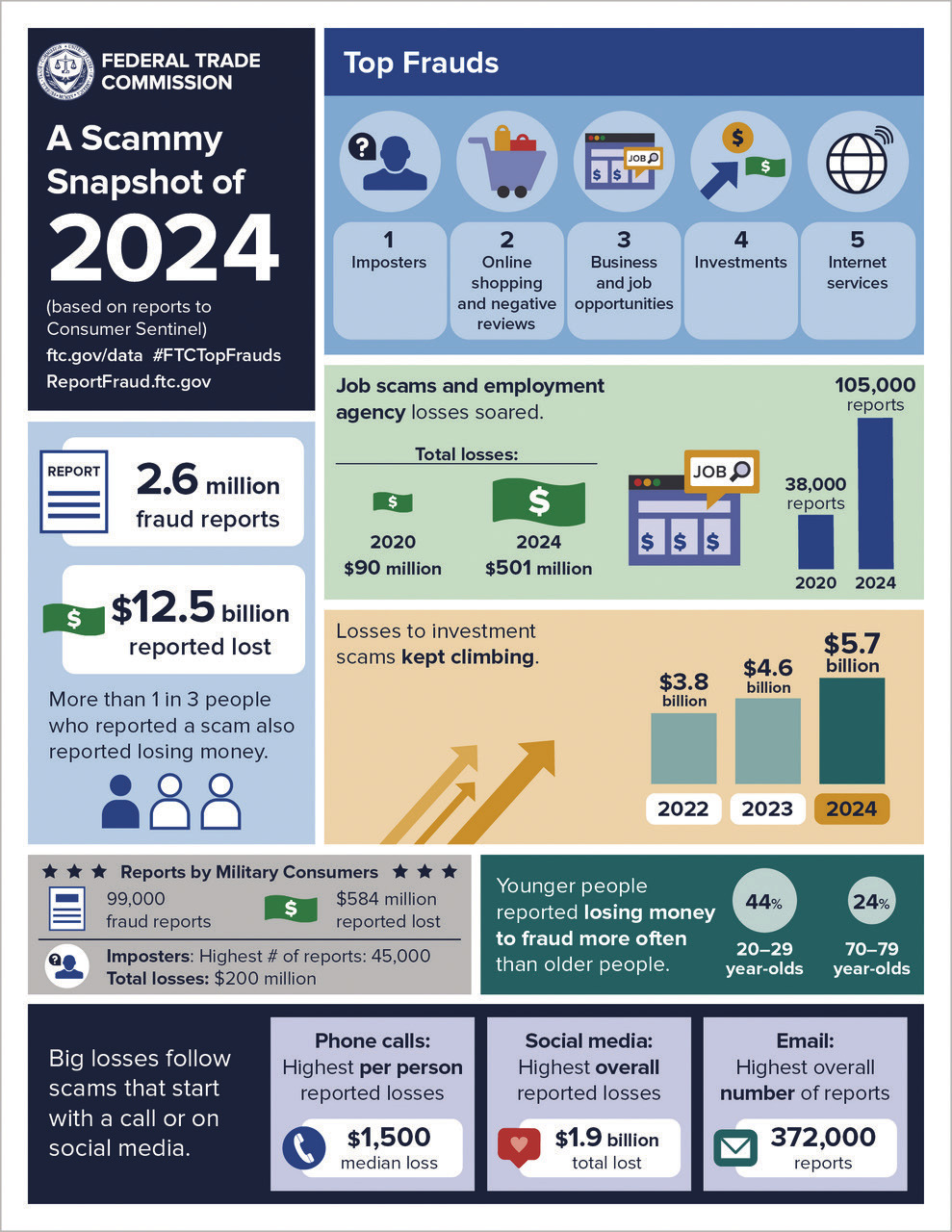
From staff/wire reports WASHINGTON – Newly released Federal Trade Commission data show that consumers reported losing more than $12.5 billion to fraud in 2024 – a 25% increase over the prior year.
According to the FTC’s data book, this number was not driven by an increase in fraud reports, which remained stable. Instead, the percentage of people who reported losing money to a fraud or scam increased by double digits. In 2023, 27% of people who reported a fraud said they lost money, while in 2024 that figure jumped to 38%.
Consumers reported losing more money to investment scams – $5.7 billion – than any other category in 2024.That amount represented a 24% increase over 2023.
The second highest reported loss amount, $2.95 billion, came from imposter scams. Losses to government imposter scams in particular increased $171 million from 2023 to a total of $789 million in 2024. Consumers reported losing more money last year to scams where they paid with bank transfers or cryptocurrency than all other payment methods combined.
“The data we’re releasing show that scammers’ tactics are constantly evolving,” said Christopher Mufarrige, director of the FTC’s Bureau of Consumer Protection.
The FTC received fraud reports from 2.6 million consumers last year, nearly the same amount as 2023.
More than 19,300 incidents of fraud were reported by Oklahoma consumers last year. A little over half of the victims, 10,150 Oklahomans, gave their ages and estimated their losses at $31.5 million. The biggest losses were reported by consumers aged 40 to 79.The leading fraud subcategories last year for those Oklahoma consumers were: • Business imposters: 3,050.
• Online shopping: 2,770.
• Government imposters: 2,163.
• Prizes, sweepstakes and lotteries: 1,337.
• Phone devices, accessories and services: 834.
Online shopping issues were the second most commonly reported fraud, trailing only imposters. This was followed by business and job opportunities, where reported losses totaled $750.6 million – up nearly $250 million from 2023. The other most reported categories of fraud were investment-related reports and internet services.
Showing major growth in recent years within business and job opportunities is the subcategory of job and employment agency scams, where the number of reports tripled from 2020 to 2024.The amount consumers reported losing to these scams jumped from $90 million to $501 million in that time frame.
For the second consecutive year, email was the most common way that consumers reported being contacted by scammers. Phone calls were the second most commonly reported contact method for fraud in 2024, followed by text messages.
The FTC monitors these trends carefully and takes a comprehensive approach to detect, halt, and deter consumer fraud.
The agency’s Consumer Sentinel Network is a database that receives reports directly from consumers, as well as from federal, state and local law enforcement agencies, the Better Business Bureau, industry members, and non-profit organizations. More than 20 states contribute data to Sentinel.
Sentinel received 6.5 million reports in 2024; these included the fraud reports previously mentioned, as well as identity theft reports and complaints re-lated to other consumer issues, such as problems with credit bureaus, banks and lenders.
More than 1.1 million reports of identity theft were received last year through the FTC’s IdentityTheft. gov website.
A full breakdown of reports received in 2024 is available on the FTC’s data analysis site at ftc.gov/exploredata. These dashboards break down the reports across a number of categories, including by state and metropolitan area, and also provide data from a number of subcategories of fraud reports. New this year is a data dashboard showing more detail on fraud reports received for each state, broken down by age.