

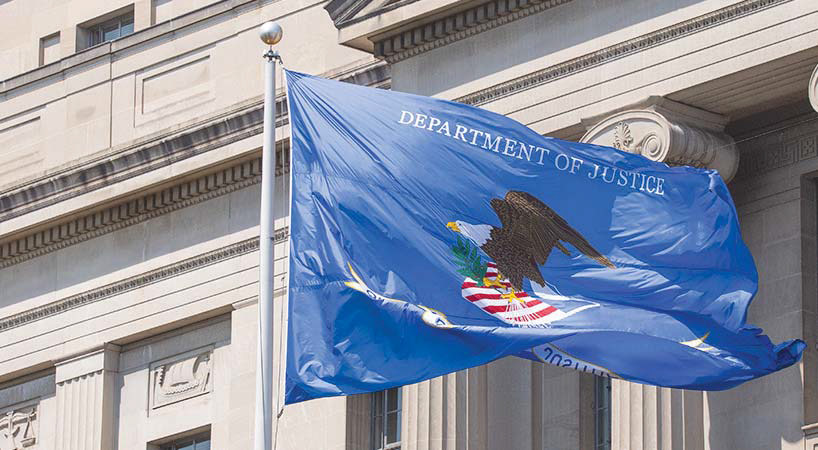
OKLAHOMA CITY – The U.S. Justice Department filed suit Thursday against five more states – Oklahoma, Utah, Kentucky, West Virginia, and New Jersey – alleging failure to produce their full voter registration lists upon request.
This raised to 29 and the District of Columbia the number of states sued by the DOJ.
“Accurate, well-maintained voter rolls are a requisite for the election integrity that the American people deserve,” U.S. Attorney General Pamela Bondi said. “This latest series of litigation underscores that. This Department of Justice is fulfilling its duty to ensure transparency, voter roll maintenance, and secure elections across the country.”
“The Justice Department will continue to fulfill its oversight role dutifully, neutrally, and transparently wherever Americans vote in federal elections,” said Assistant Attorney General Harmeet K. Dhillon of the DOJ’s Civil Rights Division. “Many state election officials, however, are choosing to fight us in court rather than show their work. We will not be deterred, regardless of party affiliation, from carrying out critical election integrity legal duties.”
The Oklahoma Election Board said it would not make an official comment about the lawsuit because they hadn’t been served yet.
The DOJ contends the U.S. Attorney General is uniquely charged by Congress with broad authority to request election records under the Civil Rights Act of 1960. This Act allows Bondi to demand the production, inspection, and analysis of statewide voter registration lists that can be cross-checked effectively for improper registrations.
However, the U.S. Constitution – the supreme “law of the land” – accords states the primary authority to regulate elections.
Article I, Section 4, known as the Elections Clause, provides that state legislatures determine the “times, places, and manner” of elections for federal offices, including Congress, and by extension, Presidential elections. This means states set voter qualifications, registration procedures, polling locations, ballot design, and vote counting processes. State legislatures also control how electors are chosen for the Electoral College in Presidential elections. The President has no independent power to regulate elections.
The Associated Press reported on Aug. 3, 2025, that the Justice Department was “ramping up an effort to get voter data and other election information” from several states.
During the preceding three months, the department’s voting section requested copies of voter registration lists from state election administrators in at least 15 states, AP wrote. Of those, nine states are controlled by Democrats, five are dominated by Republicans, and one was led by a bipartisan commission.
In Colorado, the department demanded “all records” relating to the 2024 election and any records the state retained from the 2020 election. Democrats have held the Colorado governorship for 24 of the last 32 years, and since 2008, the state has voted Democratic in five consecutive presidential elections.
The Justice Department sued Illinois, Georgia, Wisconsin, and the District of Columbia in December in an attempt to get the lists of their registered voters. In each case, the states and D.C. refused to turn over the information. They cited local laws intended to protect the privacy of voters.
The DOJ requested Oklahoma’s statewide voter registration list “several months ago,” Misha Mohr, director of communications and public information for the State Election Board, told The Lawton Constitution in late December.
The Justice Department was provided with instructions for accessing the list through the OK Election Data Warehouse, Mohr said. “However, no request for access was received.”
DOJ sent requests to wrong address
Public records showed the DOJ demanded Oklahoma turn over confidential voter data for months. However, the state Election Board reported it never received a formal request, because the DOJ repeatedly sent its emails to the wrong address.
Emails show a Department of Justice attorney first contacted Oklahoma State Election Board Secretary Paul Ziriax in 2025, requesting extensive voter information. In that email, the DOJ attorney asked the Election Board to turn over personal data for every registered voter in Oklahoma.
That request included publicly available information such as voters names, birth dates, and party affiliations. It also sought private data, including driver’s license numbers and Social Security numbers.
“As we discussed,” Ziriax responded on July 8, 2025, “the publicly available voter list does not include a driver license number or last 4 SSN because these items are not public records and are required to be kept confidential” pursuant to Title 26 of the State Statutes.
He asked the DOJ attorney to “provide the citation” to any federal law that supersedes Oklahoma’s statutory confidentiality requirements.
Ziriax also wrote, “There also may be questions regarding the security protocols that will be in place to protect our state’s data, so if you can provide this information I will share it, too, with our legal counsel” in the Oklahoma Attorney General’s office.
Apparently, the DOJ did not respond. Effective Nov. 1, 2025, in compliance with 26 O.S. § 7-103.2, access to Oklahoma’s voter registration list is now limited to the following, Mohr noted:
•Bona fide residents of Oklahoma who are U.S. citizens, or
•Official representatives of recognized political parties in Oklahoma, or
•Candidates for offices in Oklahoma and their official representatives, or
•Other persons, as authorized by state law.
“We are not aware of any other laws which authorize persons other than those listed in 26 O.S. § 7-103.2 to access the voter registration list at this time,” Mohr said.
Information about accessing the voter list is available at https:// oklahoma.gov/elections/candidates/ voter-list.html.
Information about the data included in the voter registration list can be found in the OK Election Data Warehouse Information Packet.
Oklahoma elections ‘safe and secure’
The DOJ lawsuit is mystifying for a couple of reasons.
For one, Republicans occupy every statewide elected office in Oklahoma plus all five congressional seats and both U.S. Senate seats.
For another, Oklahoma elections have been proven repeatedly to be secure and accurate.
In Oklahoma, 39 suspected voting offenses were reported during the statewide 2024 General Election. Those transgressions constituted 25 tenthousandths of 1 percent of the 1,566,173 votes cast in the Presidential election, the contest that received the most votes.
The 21st Oklahoma Multi-County Grand Jury indicted an Oklahoma City woman Oct. 9, 2025, on a felony count of voting twice during the 2024 General Election. However, 38 other potential violations of state election laws – including 26 other potential instances of double voting – also were reported during that election.
Victoria Vincenza Dill, 32, is accused of voting illegally in the Nov. 5, 2024, election. The Oklahoma State Election Board discovered Dill voted in person in Oklahoma County and submitted an absentee ballot in Payne County on the same day. A preliminary hearing in Dill’s case was continued to Feb. 27 in Payne County District Court. She was released from custody on a $2,000 appearance bond.
Until Dill’s felony charge was filed, the last time a major voter fraud case was reported in Oklahoma was in 2021, when the daughter of a former legislative leader pleaded “no contest” to a misdemeanor voter fraud charge arising from the 2020 General Election. She submitted an absentee ballot for her father 12 days after he died.
The woman pleaded guilty, received a deferred 60-day county jail sentence, a $10 fine and $466.50 in court costs.
After the Oklahoma State Election Board reviewed information it received from Oklahoma’s 77 county election boards, the total number of voter irregularities detected during the November 2020 statewide general election was set at 66, Mohr said.
Those 66 incidents constituted .0042% of the 1.566 million votes cast in the Presidential race that year – 42 tenthousandths of 1 percent.
Post-election audits have consistently proven that Oklahoma elections are safe and secure, Ziriax said last year. “The accuracy of Oklahoma election results has been confirmed, time and time again, through both manual postelection audits and candidate-requested recounts.”
Post-election audits were enacted by the state Legislature and implemented by the State Election Board in 2022 “for the purpose of maintaining the security of the election system…” Post-election audits are defined as “a manual or electronic examination of a limited number of ballots.”
Mike W. Ray is a fifth-generation, awardwinning journalist who has more than 55 years’ experience covering municipal, county, state and federal government in Oklahoma and Texas. He can be reached at mike.ray@swoknews.com.