

The farm economy in Oklahoma generally has remained solid, with growth in farm income outpacing other states in the Federal Reserve’s Tenth District.
(Besides Oklahoma, the Tenth District includes Colorado, Kansas, Nebraska, Wyoming, 43 counties in western Missouri and 14 counties in northern New Mexico.)
In contrast to a few years ago, historically high cattle prices have contributed to a more positive story for the agricultural sector in Oklahoma this year, while low crop prices and elevated expenses have led to weaker farm financial conditions in other states. Strength in Oklahoma’s agricultural economy has supported broader economic conditions and business activity.
However, developments in agricultural credit conditions and farm household spending have been similar across all states. In addition, elevated input costs, particularly for fertilizer and diesel, and expanding drought remain key concerns for all producers.
Farm income in Oklahoma has remained relatively stable compared with other states in the Tenth District. In Q2 2026, farm income in Oklahoma rose at a faster pace than a year ago. Farm incomes in the rest of the District continued to decline, albeit at a slower pace than the previous year.
In Oklahoma, 50% of agricultural lenders reported farm income was higher in the second quarter compared with last year, while only 12% reported lower farm income. At the same time, in the rest of the Tenth District only 11% of agricultural lenders reported higher farm incomes, and 57% reported farm incomes were lower.
Stronger farm incomes have supported broader economic conditions and business activity in rural parts of Oklahoma. In Q3 2025, 65% of Ag Credit Survey respondents from Oklahoma reported recent agricultural economic conditions had a positive effect on broader economic conditions and business activity, compared with 15% who thought agricultural economic conditions were having a negative effect.
Comparatively, only a quarter of respondents from other states in the Tenth District reported economic conditions in agriculture were supporting broader business activity. A much larger share (64%) reported that conditions in the farm economy were having a negative effect on the broader economy.
Farm and rural economies in Oklahoma have been supported by stronger profit margins in the cattle industry, while profit margins have have remained tighter for crop producers.
Input costs for all producers rose dramatically in the aftermath of the pandemic and have remained elevated.
After Russia’s invasion of Ukraine in early 2021, prices for crops, including wheat and cotton, rose sharply, creating the best profit opportunities for Oklahoma crop producers in years. However, since 2022, profit opportunities for both wheat and cotton have been scarce.
Conversely the margin between cattle prices and average production costs has continued to expand.
Indeed, Oklahoma’s inflation-adjusted farm income reached its highest level in more than 50 years in 2025, amid elevated cattle prices.
Cattle prices increased to record levels in recent years alongside historically low cattle inventories and strong demand for beef in the United States.
At the same time, crop prices have remained much lower than their 2022 highs.
Beef imports had an adverse effect
In recent months, however, feeder cattle prices have fallen 20% due to announcements of higher beef imports and the closure of several slaughter facilities by large meatpacking firms. Winter wheat prices rose 20% from late June to September, due in part to dry weather, expectations of lower crop yields, and geopolitical tensions. However, cattle futures prices have started to rebound, and despite the uptick in crop prices, input prices have remained elevated, maintaining pressure on profit margins.
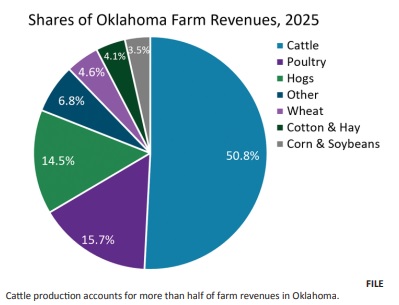
In addition, prices for hogs and poultry products had been strong for most of 2026, but profit margins have tightened in Oklahoma’s secondand third-largest agricultural industries recently, alongside slower demand at restaurants and higher feed and fuel costs. Overall, stronger prices in the cattle sector have likely contributed to the overall strength in Oklahoma’s farm economy, where more than 50% of farm revenues are generated from cattle production.
In addition, farm real estate values have been relatively more stable in Oklahoma than in other states. Farmland values in Oklahoma typically are not as volatile as in other states, and in the second half of 2025, non-irrigated cropland values in Oklahoma continued to increase by about 5% year over year, while cropland values in the rest of the District declined slightly. Also, until recently, ranchland values had increased at a faster pace in Oklahoma, while growth in values for pastureland in other parts of the region slowed.
Farmland values in Oklahoma and the surrounding region have continued to grow despite declining rates of return. Over the past four years, risk-free rates of return have increased with interest rates and outpaced capitalization rates on non-irrigated cropland, which have declined to below 3%. This trend is a reversal from previous decades, when capitalization rates for farmland were higher than returns on other investments. Stable land values have provided some financial stability in the agricultural sector. In the longer term, continued appreciation of values has continued to position farmland as an attractive investment for farmers and investors.
Despite stronger economic conditions, agricultural credit conditions have been similar across states.
Higher interest rates may have contributed to slower capital spending in Oklahoma and in the rest of the District in 2025. Interest rates on farm loans have declined slightly since peaking in 2024.
Additionally, rates in Oklahoma tend to be higher than average interest rates for the rest of the District. Although rates have declined slightly, the average rate on an operating loan in Oklahoma ticked back above 8% in Q2 2026.
Higher interest rates make carrying credit balances forward considerably more expensive. Also, higher interest rates, together with historically high cattle prices, have limited the ability of ranchers to grow their herds and keep pace with growing domestic beef demand.
Amid higher interest rates, loan demand has stayed strong, and credit conditions in Oklahoma have continued to stabilize. Demand for loans has continued to increase in Oklahoma this year. In fact, in Q2 nearly one-third of agricultural lenders reported demand for new loans had increased relative to the same time last year. In addition, renewals and extensions on existing loans also increased sharply in the first two quarters of 2026, after declining in 2025.
Despite the uptick in demand for credit, repayment issues have continued to ease in Oklahoma and across other states in the Midwest and Great Plains.
Farm loan repayment rates continued to decline in the state but at a slower pace than in previous quarters in 2026.
Only 4% of agricultural lenders in Oklahoma reported lower farm loan repayment rates in Q2 2026, compared with 23% in Q2 2024.
Headwinds for future growth
Elevated operating expenses and drought are headwinds for future growth.
The rising cost of inputs has remained a key risk to the outlook. Prices for fertilizer and diesel have been volatile in recent years. Just last month the price of diesel reached record-high levels ($6/ gallon). According to the U.S. Energy Information Administration, the cost of crude oil accounts for more than half of retail diesel prices.
Following disruptions related to the conflict in Iran, prices for all energy commodities spiked and have remained volatile. But prices for diesel have risen especially high due to tight global distillate supplies, low U.S. inventories, and strong seasonal demand. In addition, prices for fertilizer had declined during the first half of 2026 but have rebounded slightly in recent months.
The outlook for agriculture within the state could vary greatly, depending on geography.
Conditions in western Oklahoma have become increasingly dry, while drought in the eastern side of the state has remained moderate. Counties east of Interstate 35 typically receive 20 to 30 more inches of rain per year than counties west of 1-35, on average. However, this year has been especially dry in western Oklahoma and one of the hottest summers on record.
As of mid-September, some counties in southwestern Oklahoma recorded nearly 60 to 90 consecutive days with less than a tenth of an inch of rainfall.
Most of Oklahoma’s cropland is located on the western side of the state. Therefore, drought and low crop prices have likely contributed to a weaker outlook for farmers and agricultural lenders in western Oklahoma relative to the eastern side of the state, which is more concentrated in livestock production.
Summary, Conclusion
Due in large part to a relatively large concentration in cattle production, Oklahoma’s farm economy has remained solid and grown at a stronger pace than the rest of the Tenth Federal Reserve District. However, rising input costs have made it difficult for crop producers in the state to maintain profitability. Also, although high cattle prices have contributed to strong profit margins, feed costs have increased, and high prices alongside elevated interest rates have created challenges for some producers looking to maintain or restock herds.
Moving forward, severe drought and higher diesel prices may dampen the outlook. According to the Drought Monitor, west-central Oklahoma has experienced the driest year on record, while southwest Oklahoma has had the second-driest year.
Overall, however, the agricultural economy in Oklahoma has continued to expand and has supported broader economic and business activity in the state.
Cortney Cowley serves as Oklahoma City Branch executive and assistant vice president for the Federal Reserve Bank of Kansas City. Chase Farha is a research associate in the Regional Affairs department at the Oklahoma City branch of the Federal Reserve Bank of Kansas City.