

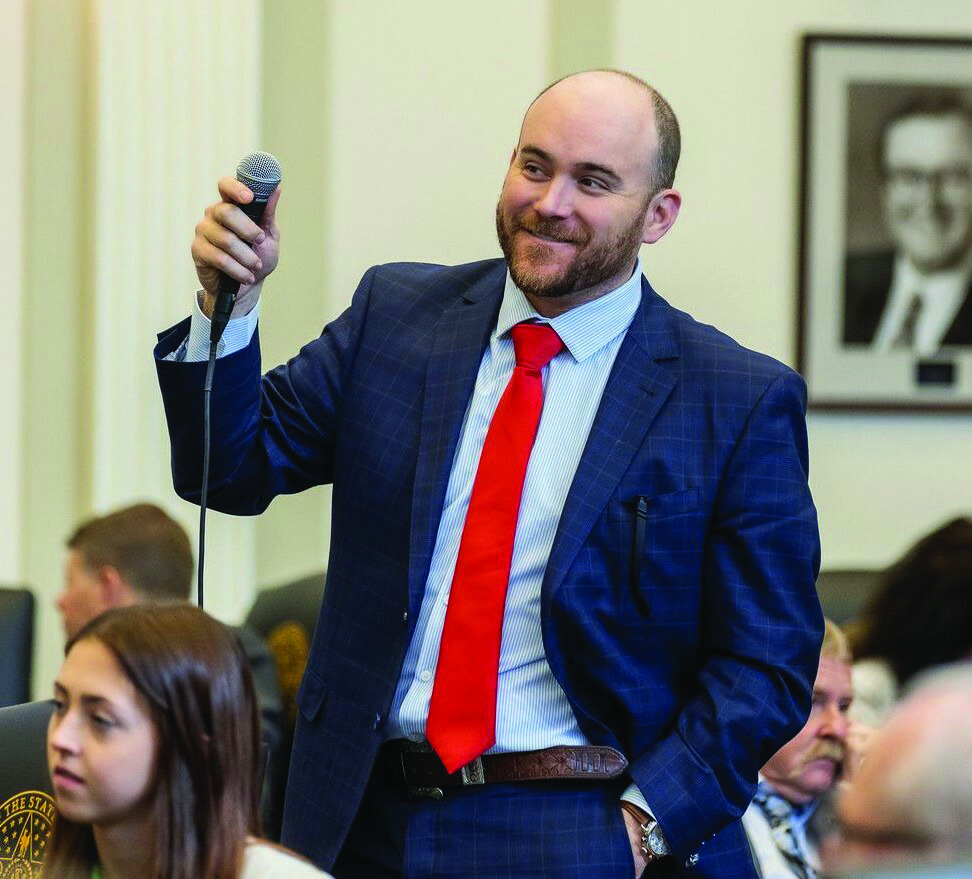
OKLAHOMA CITY – A measure that many have called a “right of first refusal” bill, but Rep. Trey Caldwell insists isn’t, won overwhelming support in a state legislative committee and passed the House of Representatives in a split vote.
However, House Bill 2747 by Caldwell (R-Faxon) was amended multiple times in the House before it finally cleared and was sent to the Senate, where it’s sponsored by Sen. Shane Jett (R-Shawnee).
The House Energy and Natural Resources Committee voted 13-2 to send HB 2747 to the full House for consideration.
The state Corporation Commission, which regulates public utilities, is required by law to approve an application for an electric generating facility or long-term purchase power contract within 240 days of the filing of the application. However, Caldwell’s bill would reduce that time to 180 days if the generation facility “uses natural gas as its primary source of fuel.”
HB 2747 also decrees that no Commission rate regulated retail electric supplier would be allowed to offer “ratepayer- funded incentives, rebates, or inducements to its customers to promote the switching of fuel sources from natural gas to electricity.”
Caldwell’s bill also would allow a utility to “begin to recover … Construction- Work-In-Progress expenses prior to commercial operation of a newly constructed electric generation facility.”
Critics – including former state Corporation Commissioner Jim Roth – charged that the legislation is simply an effort by Caldwell to produce a Right of First Refusal (ROFR) bill to help utilities avoid competitive bidding on transmission projects in the state. Caldwell denied those assertions.
A Right of First Refusal is a legal clause that gives a specific party the first chance to purchase or lease a property before it’s offered to anyone else. Essentially, if an owner wants to sell or lease, they must first offer it to the ROFR holder on the same terms as they would offer it to another party.
The House committee members who opposed the measure were Reps. Jared Deck (D-Norman) and Mickey Dollens (D-Oklahoma City). Supporters of the measure were Reps. Brad Boles of Marlow, John Pfeiffer, Nick Archer, Caldwell, Mark Chapman, Rusty Cornwell, Mike Dobrinski, John George, Jim Grego, Ken Luttrell, Kenton Patzkowsky, Ajay Pittman and Rick West.
When his measure finally was brought up for consideration on the House floor, Caldwell spent time being peppered by questions from mostly Democratic members who wondered about what roadblocks such a law would present for renewable energy in the state.
“This bill will promote more transmission lines,” Caldwell said; it would allow the state and not the federal government to have a say on construction of such projects.
He later said there were misconceptions about the bill and charged “the well has been poisoned.”
HB 2747 won approval in the House of Representatives by a vote of 68-28. But it didn’t take long for opponents to criticize passage of the measure.
‘A rotten deal for customers’ The bill is “a rotten deal for residential utility customers,” AARP Oklahoma Advocacy Director Joy McGill charged.
The bill mandates an “anti-competitive practice” that will drive rates up even higher for utility customers, she said. “The bill would allow companies to build new transmission lines but, upon completion, they would be required to sell those lines to the existing utility, such as OG&E or PSO.”
Public Service Co. of Oklahoma, based in Tulsa, is an electric utility company that serves customers in 232 communities in eastern and southwestern Oklahoma, including Lawton, Altus, Duncan, Cache, Elgin, Fletcher, Porter Hill, Sterling, Apache, Cement, Cyril and Frederick.
McGill said ratepayers are already facing a proposed, combined $550 million rate hike this year. “This bill will gouge Oklahomans pocketbooks even more.”
Under the act, competitive bidding would be in the form of utilities seeking lower costs for construction of their transmission lines. Yet the utilities would continue to own the finished product.
“It would inject more people to bid on a project,” Caldwell argued, adding later in the discussion, “Someone from Oklahoma should have a say and this would give Oklahoma ratepayers oversight.” The oversight would come from the Corporation Commission.
Caldwell claimed numerous times that the act would create a “natural pushdown on costs.”
Caldwell told OK Energy Today that his bill would increase the number of companies that can bid on and build transmission lines. Plus, he said his bill would pull back regulatory authority from the Federal Energy Regulatory Commission by requiring ownership to be held by someone with retail customers in Oklahoma. It would ensure Corporation Commission jurisdiction, he said.
“Just by passing this piece of legislation, our consumers, our constituents, our ratepayers in the state of Oklahoma will immediately see at least, a bare minimum, a 1% drop in the overall rising cost,” he asserted.
Turn to CALDWELL, p3 ‘No guarantee’ of lower rates But during debate, Democrat Oklahoma City Rep. Forrest Bennett stated, “This legislation lends us no guarantee for lowering the rate…” Representative Dollens argued the last thing that Oklahoma utility customers need is another rate increase, and said it is time to end g overnment- sanctioned monopolies that since statehood have profited from their power.
“This bill does the opposite: it further entrenches legacy utilities’ monopolistic control,” said Dollens, who urged legislators to vote no.
“Using government to ban competition means more power for the utilities. Using government to ban competition means less power for senior citizens living on f ixed incomes. Using government to ban competition means more money for shareholders. A no vote on this means a yes for the free market. A no vote on this will empower Oklahomans.”
HB 2747 would not require major utilities to allow competitive bidding for their projects. The House announcement of the vote said it was approval of legislation to implement free market principles and assert states’ rights in high-voltage transmission construction and ownership.
“We all know how unpredictable utility bills are, and our constituents are paying more and more every month. Legislators should jump at every opportunity to lower customer costs, especially one that creates the optimal balance of free market principles and states’ rights,” said Caldwell.
ROFR pro, con issues debated ROFR was debated at length in a state Senate committee hearing in 2023.
“It’s an issue most of our members never heard of until last year,” said Senate Pro Tem Lonnie Paxton (R-Tuttle) when he opened the interim study hearing before the Senate Energy and Telecommunications Committee. “It’s a complex issue that will affect every one of our constituents in the state.”
The hearing featured three groups opposed to Right of First Refusal for utilities and three who favor the ability to reject competitive bidding.
“No doubt about it,” declared David Osburn, general manager of the Oklahoma Municipal Power Authority. “This is all about money.”
He told legislators, including state Representatives members who joined the hearing, that there will be more transmission buildouts coming from the Southwest Power Pool, the grid control group of which Oklahoma is a member. Osburn argued ROFRs will only mean higher costs for consumers and urged legislators not to listen to the “scare tactics” of those fighting the competitive bidding requirement.
But Emily Shuart with OG&E said it’s about “hope” on the part of those who oppose to ROFR laws, claiming there is no evidence of cost savings by requiring competitive bidding for major transmission line projects. She labeled competitive bidding “a cumbersome and bureaucratic process… The reasoning of cost savings has not been proven true,” she argued.
Chris Winland, director of strategic planning for ITC Great Plains, said the competitive bidding requirement would bring “more harm than good.” He contended that the current order from the Southwest Power Pool, requiring competitive bidding for smaller transmission projects, “is resulting in higher costs.”
Matt Horeled, vice president of Regulatory & Finance with Public Service Co. of Oklahoma, charged that “anticipated benefits have not happened” as a result of required competitive bidding on transmission projects. “Getting the projects done is more important than requiring competitive bidding,” he asserted.
But Matt Pawlowski with NextEra Energy Transmission maintained “ROFR will increase rates in Oklahoma.” He told the hearing, “It’s critical that Oklahoma legislators put Oklahoma customers first.”
Josiah Neely with R-Street Institutes called ROFR a “bad move for Oklahoma,” adding, “When you eliminate competition, you raise costs.” He declared that competitive bidding would save 20% to 30% on project costs and the savings would be passed on to consumers.
Legislators had a variety of questions, including how efficient the Oklahoma Corporation Commission is in handling electric power issues. Another questioned the possibility of foreign countries becoming owners of transmission projects in Oklahoma.
Senator Jett wondered how many of the firms supporting ROFR have positions on ESG [environmental, social, and governance] and climate change. He said ESG is not about economics and is “strictly political.” The senator wanted to know from the companies how much of their stock is owned by BlackRock, Vanguard Investment Services, and foreign firms.
At the conclusion of the hearing, Committee Chairman Paxton admitted the testimony and atmosphere “went a little better than expected. It could have gotten out of control but it was very informative.”