

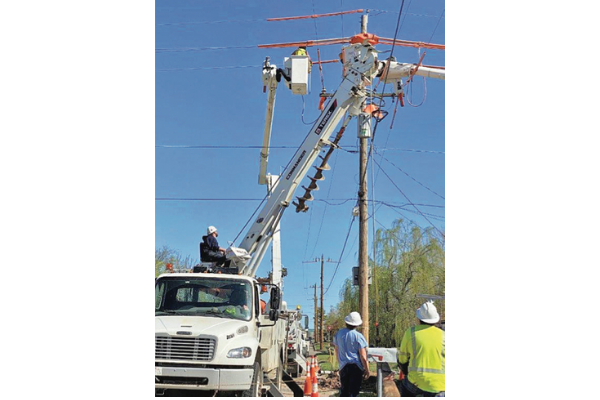
TULSA – Public Service Co. of Oklahoma (PSO) gave a “tip of the hard hat” to lineworkers on Sunday, which was observed as National Lineworker Appreciation Day.
“They are the workers who keep our lights on,” said Stan Whiteford, PSO’s region communications manager.
Established in 2013, National Lineworker Appreciation Day honors those who risk their health and lives to keep electricity flowing. An estimated 115,000 men and women are employed as lineworkers in the U.S., Whiteford said.
PSO has approximately 700 employee and contract lineworkers serving the company’s more than 560,000 customers in 232 cities and towns across Oklahoma, including Lawton, Altus, Duncan, Cache, Elgin, Fletcher, Hobart and Rush Springs.
“We are extremely proud of our lineworkers for their commitment to provide an essential service to customers in all weather conditions, around the clock and every day of the year. They are truly heroes and are among the best in the business,” said Steve Baker, vice president for PSO Distribution Operations.
“Our lineworkers safely operate and maintain a complex electric system that includes more than 22,000 miles of distribution lines and more than 3,700 miles of transmission lines. As a result of their hard work and dedication, PSO customers enjoy some of the most reliable electric service in the country.”
PSO ultimately had more than 1,000 individuals “in the field working storm recovery” after the ice storm last October 26-28 that coated much of Oklahoma, Whiteford said. That number included all PSO crews in western Oklahoma, PSO employees from the eastern half of the state (including Tulsa), workers from PSO’s sister company SWEPCO augmented with personnel from AEP Ohio and Kentucky Power, plus outside contractors and tree crews.
The three-day ice storm brought a continuous wave of rain, sleet, snow, frigid wind and freezing rain.
Transmission and distribution damages, the company reported, included replacement of approximately 250 utility poles, replacement of 713 crossarms, 308 downed spans of conductors requiring replacement of more than 89,000 feet (approximately 17 miles) of electric lines, 61 transmission line outages, change-out of 63 distribution transformers, and replacement of 214 damaged switches/cutouts.