

By Mindy Ragan Wood When the thought of wrongful convictions springs to mind, it’s easy to assume that scientific breakthroughs make it almost impossible to become a victim.
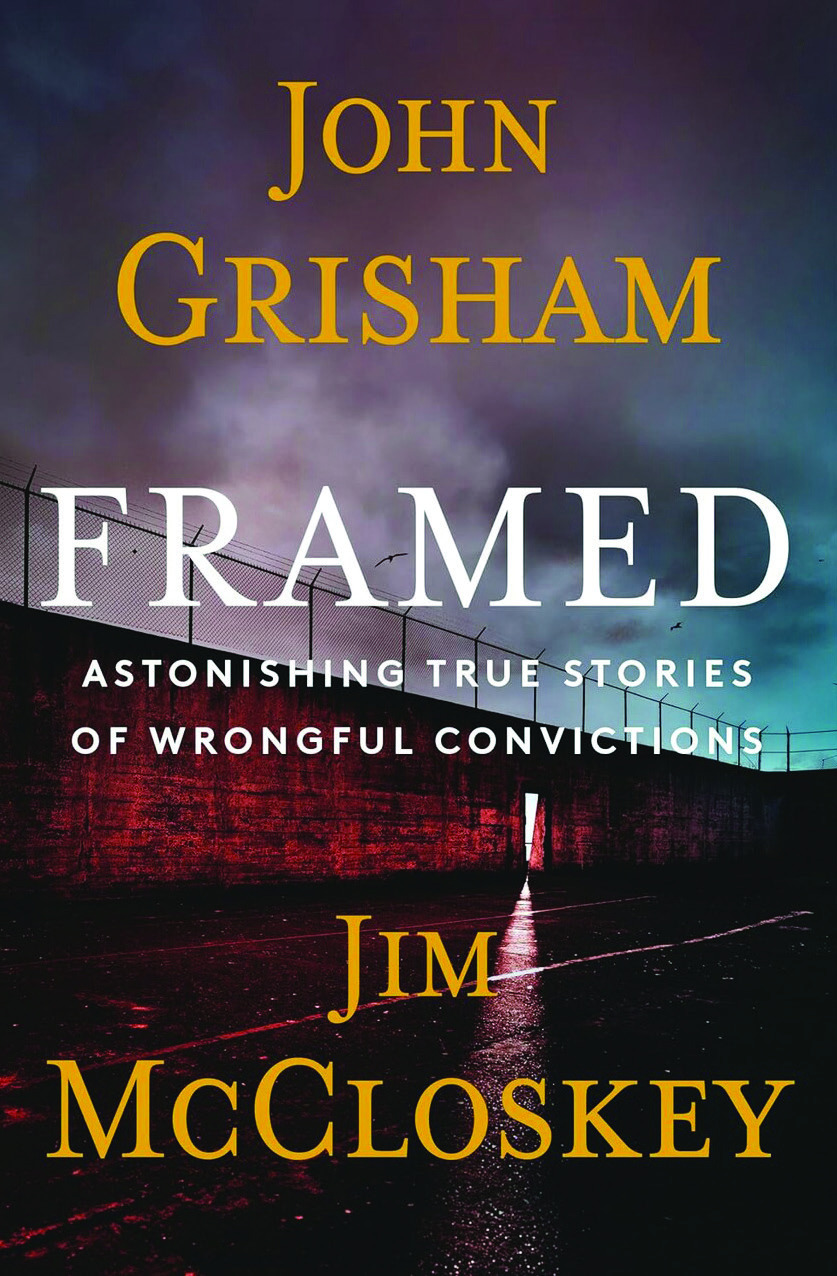
John Grisham and Jim McCloskey’s book, “Framed: Astonishing True Stories of Wrongful Convictions,” illustrates in 10 terrifying cases that almost anyone can be convicted of crimes they didn’t commit.
Grisham, an attorney turned best-selling fiction author and innocence activist, teamed up with McCloskey, founder of Centurion Ministries, a nonprofit organization that secures exonerations for the wrongfully convicted.
While racial bias in the courts, especially the South, is well documented, even white defendants with the best attorneys and DNA evidence are no match for junk science, perjured witnesses, dishonest law enforcement and apathetic jurors.
DNA was no match for the innocent when exhibits were hidden or disappeared during discovery, if police ignored or overlooked evidence or suspects, and when witnesses were persuaded to recall events to the prosecution’s favor. These and other flaws in the justice system, Grisham and McCloskey say, are the currency of wrongful convictions.
False confessions following 10- to 12- hour-long interrogations were common, the authors wrote. While law enforcement could not “beat a confession” out of a suspect, they could choose not to record an entire interrogation from start to finish. How would those juries learn a confession was extracted under extreme mental exhaustion?
In one shocking case, Grisham told the story of a suspect who had been so browbeaten by detectives he believed he was implicated in the rape and murder of a woman. He even wrote a letter of apology to the woman’s family! Then, he, along with other suspects, received life sentences without parole for a crime they did not commit. Their DNA tested negative against the lone profile found at the scene, just one piece of evidence among others that the killer acted alone. The detective in the case was later convicted of extortion for charging drug dealers a fee to seek leniency with prosecutors.
Years later, the real killer, whose DNA matched, confessed.
The authors did well to title their book “astonishing.” Mississippi medical examiner probed Some convictions also hinged on fraud by medical examiners, and other experts.
Dr. Steven Hayne, a Mississippi medical examiner in 1990, who was not a trained forensic scientist, ran a “sausage” factory of cadavers –– only about a third of which he ever opened up for examination, the authors allege. Hayne shuttled in some 1,200 bodies a year, far more than 250 a year examiners should be limited to, according to national accreditation standards. Hayne boasted making a million dollars a year from the fees he charged law enforcement agencies. Allegations of mislabeled and tainted evidence and prejudices to favor prosecutions began to surface from defense attorneys. The press also became suspicious of Hayne.
The state ultimately removed him from the list of approved forensic pathologists, PBS reported in 2008. That year, he sued the Innocence Project, which advocates for wrongfully convicted prisoners, after the organization alleged he mishandled evidence. Though the lawsuit was settled, Hayne continues to be the subject of petitions for exoneration based on the findings that came to light in that lawsuit. ‘Bad science’ draws attention The authors also noted the role of junk science. Bite mark evidence appears in one account. Despite several professional organizations condemning it as unreliable, many states still allow it. It demonstrates another flaw in the system, the writers say, that judiciaries have ignored debunked, or at least questionable, evidence by experts allowed in court.
Even when defense attorneys introduce contradictory evidence to question “bad science,” jurors do not always believe it, the authors note.
In the wake of destruction wrongful convictions inflict, the authors do not fail to demonstrate the ultimate price of that injustice in their last story.
They allege that Cameron Todd Willingham, an Oklahoma father who was living in Corsicana, Texas, was convicted on bad science following the death of his children in a 1991 house fire. Willingham was executed by lethal injection in Huntsville, Texas in 2004.
For Willingham, DNA was not pivotal to his innocence. Grisham argues that fire investigators relied on disproven theories that accelerants burn hotter than wood alone and that a pattern throughout a structure of high heat always indicates a trail of accelerants. Willingham’s last minute pleas for stay of execution to contest the expert testimony was denied by the Texas governor and the state’s pardon and parole board.
As infuriating as it is to read it, “Framed” is also a thrilling page-turner. Grisham fans will also not be disappointed to see the material is meticulously researched.
Though the cases featured are typically 30 years old, the flaws of unethical behavior in the system remain. Until such failures in the execution of justice are remedied, these cases remain frightfully relevant. Call to action?
My one criticism of the book is that the reader is left without any call to action or any method to affect change in their state and federal judicial system. While “Framed” is not intended to be a manifesto for reform, it does leave the reader with a sense of outrage in the absence of the slightest remedy to these flaws in the legal space.
Still, there are lessons to be learned by reading “Framed.” Mistakes of the wrongfully convicted included failure to invoke their right to an attorney or at least remain silent, and their ignorance of unethical police tactics. These cases are also a dire reminder for the juror that everyone is innocent until proven guilty — beyond a reasonable doubt.
Published by Doubleday New York, 2024, Grisham and McCloskey’s “Framed: Astonishing True Stories of the Wrongfully Convicted” is available at Amazon, Target, Walmart, Books-A-Million and Barnes & Noble.
Mindy Ragan Wood is an award-winning journalist with 20 years’ experience in city and county government and criminal justice. She can be reached at Mindy.Wood@Hilliary.com.