

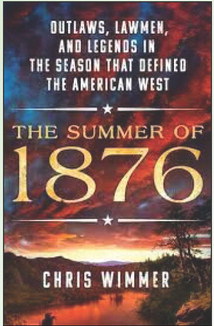
“The Summer of 1876: Outlaws, Lawmen, and Legends in the Season That Defined the American West,” a book that often reads like a page turning novel, is a m ust have for history buffs and any Oklahoman with an interest in the Wild West.
Full disclosure, I come from an Old West family.
My great, great grandfather Frank Ragan was a former deputy U.S. Marshal who served under “Hanging” Judge Isaac Parker. A secretive man of intrigue, Frank hunted criminals throughout Indian, and later Oklahoma Territory, as he tried to scrape out a meager living for his growing family.
My own ancestor aside, I approach historical books with an aversion to sensationalism and uninformed assumptions, but author Chris Wimmer is also a journalist who has studied the American West. So, when I got the chance to read and review “The Summer of 1876: Outlaws, Lawmen, and Legends in the Season That Defined the American West,” I hoped to learn something new about this time in histor y.
I wasn’t disappointed.
Wimmer transports the reader into the lives of famous lawmen, outlaws and Native American heroes at a time when the political climate would determine the future of Oklahoma and other western states.
His meticulous research reveals facts, little known stories and the historical nuance of the period to better understand these villains and victors.
Some stories serve as lessons for the reader, like the account of Lakota War Chief Red Cloud.
He knew the best way to beat an opponent is to test their reactions and discover their modus operandi.
Wimmer tells the story of Red Cloud’s young warriors ready for battle in northern Wyoming near Fort Phil Kearny. The warriors were itching with bloodthirsty courage and emblazoned with rage, but Red Cloud convinced them to hold back for a wiser war strategy than mere force and speed.
Fortune may favor the brave, but only if they’re wise and Red Cloud was both.
He had his men ambush the fort’s soldiers, but pull back well short of a sus tained attack. From a distance, Red Cloud watched the entire skirmish and in moments learned exactly how soldiers at the fort behaved when surprised, the number of soldiers and their defense procedures.
Upon their return a few weeks later in the de ad of winter, the warriors returned and decimated the fort’s army.
Lesson learned.
You won’t find those kinds of details on Wikipedia, but you’ll find it in Wimmer’s book.
Other daring tales include those of outlaws like Billy Thompson and Jesse James.
Lawmen’s troubles, too, find their way into Wimmer’s account, such as the story of “Wild” Bill Hickok and the reason he gave up his badge. Hickok mistook his friend and deputy, Mike Williams, as an outlaw during a gun battle and shot him dead.
Hickok was never the same, Wimmer wrote. I don’t suppose Hickok went around telling that story in his day, but Wimmer ferreted it out.
The author holds back no punches when it comes to national politics and public opinion at that time toward Native Americans.
National politicians were under pressure to give ambitious white Americans more lands to develop and more gold to glean, and they did not disappoint their constituents. Native Americans were often forced onto reservations through lies and bloodshed, but the gold and glory would tarnish as history later unfolded the awful truth.
In reading his accounts, the reader can speculate that political leaders of the day could not know or did not care how future Americans would judge these decisions, nor of the social and economic consequences on the nation’s First Americans that linger today.
My one criticism is that Wimmer weaves together so many characters and historical events in numerous locations the boo k is at times tricky to follow. I found myself having to go back and check a name or wondering what the next three paragraphs had to do with the f irst—but his vivid storytelling, and the subject, made me forgive and keep reading.
I enjoyed Wimmer’s fairness when telling the stories of all these c haracters who were often sensationalized by reporters—and certainly in autobiographies— of the time. You won’t find any rose-colored glasses when you pick up this book, but rather an eye-opening retelling and a perspective that captures a single year’s importance in shaping Old West history.