

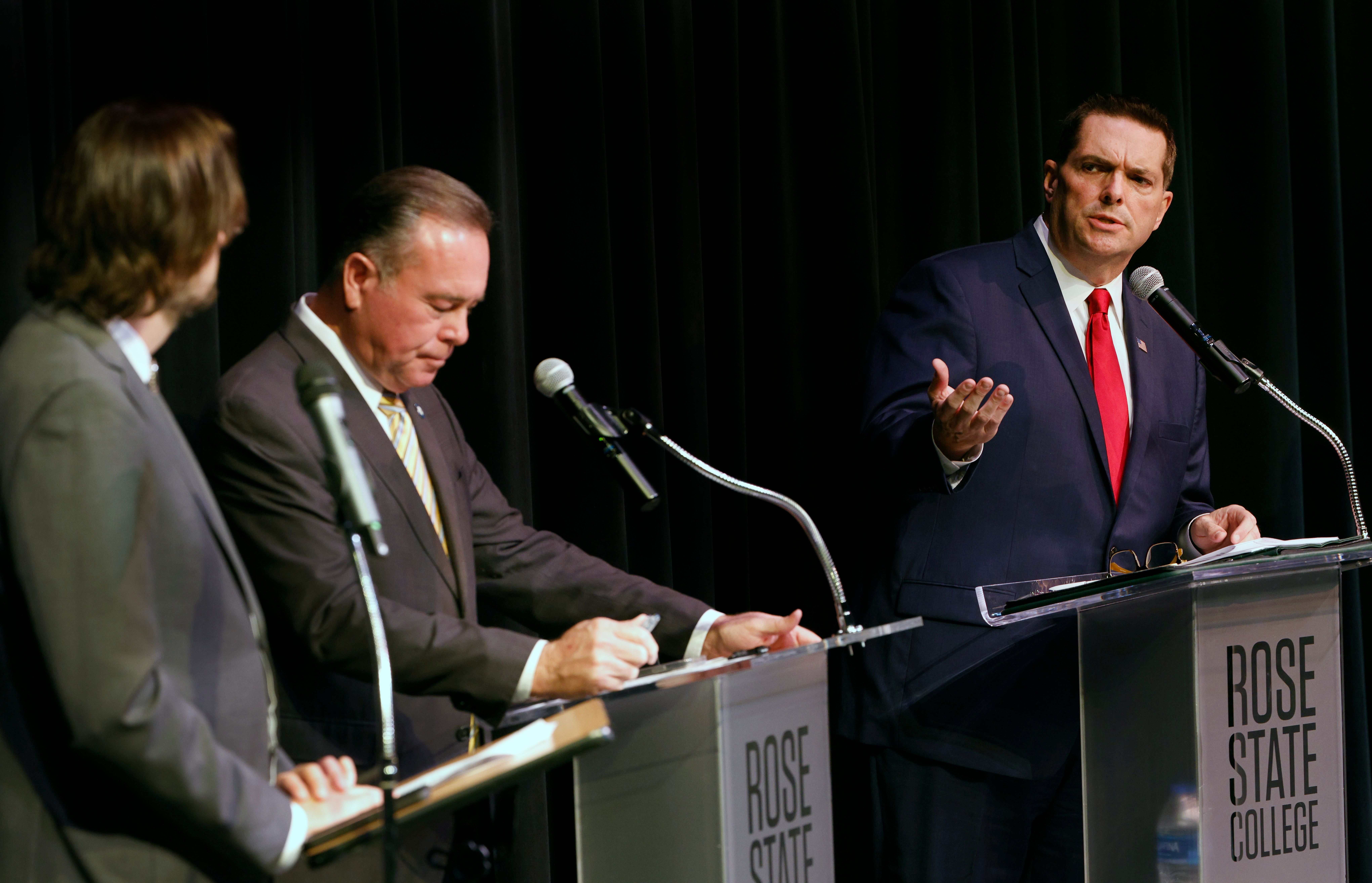
OKLAHOMA CITY – The two former lawmakers who are seeking the Republican nomination for state treasurer worked hard to paint themselves as the more conservative one in the race, during a rough-and-tumble debate at Rose State College last week.
Former state Sen. Clark Jolley and former House member Todd Russ clashed over term limits, their relationship with Native Americans, social issues, education and who was really a true Republican during the hour-long event.
Jolley launched his attack early.
Just days before the event his campaign issued a press release on Aug. 15 questioning Russ’s tenure as the CEO of the Washita State Bank and releasing commercials that urged Oklahomans not to trust Russ with their money. The release from Jolley’s campaign said FDIC documents “expose serious concerns about Russ’s bank management and fiscal responsibility.”
During the debate Jolley doubled down on his attack.
Russ countered, saying that the criticism of the bank came after he had left. However, documents show federal regulators were concerned by actions taken during the time Russ led the bank.
Russ also criticized Jolley’s tenure on the Oklahoma Tax Commission. He said Jolley’s record while in the state Senate didn’t echo a letter from other Republican state treasurers who vowed to push back again “woke” capitalism.
“Sen. Jolley has said he’ll sign the letter on the first day and that he believes in all the great things that are great Oklahoma values when it comes to oil and gas. But unfortunately, he signed a bill that ended up having a $132 million impact on the oil and gas industry. So, if we’re really going to protect the oil and gas industry, we got to mean that with everything that.”
While the office of state treasurer is a statewide position in Oklahoma, the office generally has little impact on social policy – normally a venue frequented by the state Legislature. Oklahoma’s State Treasurer’s Office acts as more of an internal state back that manages money oversees the state’s unclaimed property fund and provides investment services for state funds.
Jolley said Russ voted in favor of the largest tax increase in state history – a measure that had bipartisan support in both houses of the Legislature.
“He (Russ) has voted eight times to increase taxes on Oklahoma families and Oklahoma businesses by the tune of about $2.6 billion,” Jolley said. I understand that the budget was in dire times during that time. The budget was in dire times when I was chairman of Senate appropriations.”
While both former lawmakers said they supported term limits for public officials they differed on the length of that term.
Russ said he believed the 12-year limit was too short and should be expanded to 16 or 20 years so those in office could gain experience and seniority.
“I’ve had six campaigns,” he said. “If you could stretch that out to 16 or 20 years, the House members could actually dig in, get their seniority and go a little bit longer and not have as much turnover.”
Jolley countered that 12 years was plenty of time for a public official.
“Twelve years is a long time. We have a state of four million people. We have a lot of people who are qualified and capable of stepping into roles of leadership and leading with excellence,” he said. “We don’t need to have the same people making the same decisions. I’m very proud of my service. My 12 years of representing the Edmond area in the Oklahoma State Senate was the honor of a lifetime to represent that area. But 12 years is enough.”
Last week’s debate also highlighted a topic not normally seen in a race for treasurer – tribal relations.
During the floor debate on a bill in 2016 about a measure that would increase sales of alcohol, Russ said Native Americans could not process alcohol like other people. Russ eventually apologized but the issue resurfaced during the campaign.
And while Jolley didn’t attack Russ directly on his previous statements about Native Americans, he told the audience that public officials must “be very responsible” about who they present themselves.
“I think all of us in public office sometimes make statements that we regret, and we shouldn’t,” he said.
Russ said those who were upsent by the statement were ‘out-of-state’ special interest groups and that those who heard his comment were compassionate and understanding.
“I was defending the Native Americans, and all of the other — any minorities and Americans that have these genetic dispositions that cause them to have an alcohol problem and these things — I was explaining how it affected my family,” he said. “It was very much a compassionate, defensive position from them.”
Jolley said the person who objected to Russ’s comment was a member of the Oklahoma House. “The offense was taken immediately on the House floor. An objection was made immediately after that statement was made. So, I don’t believe it was outside groups that were offended. It was a member of the House who stood up on personal privilege and objected to that characterization,” he said.
Russ countered that Democrats “distorted the langue and tried to create a controversy” over something that wasn’t mean to be offensive.
With Tuesday’s runoff primary election set to narrow the field of candidates, the winner of the Republican contest will face Democrat Charles de Coune and Greg Sadler, a Libertarian, in the November general election.