

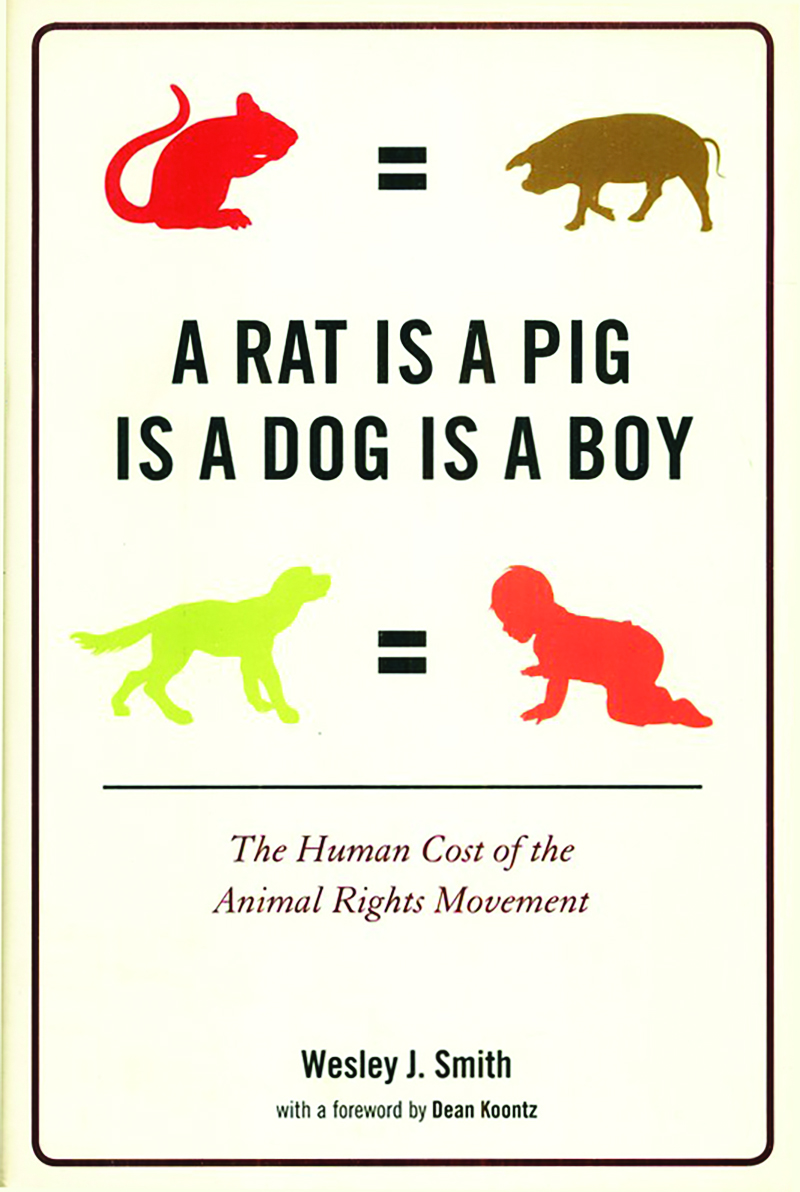
Fido is perhaps a beloved member of your household, but should animals be equals with humans in the eyes of the law?
Author Wesley J. Smith mounts a spirited defense of the belief that human beings “stand uniquely at the pinnacle of moral worth,” a concept known as “human exceptionalism.” The “only true moral species” is Homo sapiens, he asserts. “We understand the concepts of right and wrong, good and bad.”
In “A Rat is a Pig is a Dog is a Boy: The Human Cost of the Animal Rights Movement” (Encounter Books, 312 pages, © 2010), Smith condemns “the antihuman ideology” of the animal rights/liberation movement.
The unusual title for the book came from a comment uttered in 1986 by a cofounder of People for the Ethical Treatment of Animals (PETA). “A rat is a pig is a dog is a boy,” she said. “They are all mammals.”
India’s Mahatma Gandhi taught that, “The greatness of a nation and its moral progress can be measured by the way its animals are treated.”
One of the earliest challenges to the belief that animals have no rights was raised by Jeremy Bentham (1748-1832), an English philosopher, jurist and social reformer.
Bentham – who was skeptical of the legal philosophy of Sir William Blackstone, the foremost exponent of the common law – established the philosophy now understood as Utilitarianism. As he observed the movement to abolish slavery during the French Revolution, Bentham began to question other abuses. In “An Introduction to the Principles of Morals and Legislation” (1789) he wrote about animals, “The question is not, Can they reason? Can they talk? But, Can they suffer?”
Because most Americans are urbanites, “we disassociate ourselves” from the myriad ways we use animals, Smith notes. We kill animals “for food and leather, in medical research, in sport, and to ensure environmental balance when necessary.”
Animal rightists promote veganism and vegetarianism as a matter of ethics and human health. Smith, though, maintains that humans are “biologically omnivores” and have consumed meat “for well over one million years.”
Animal experimentation is “merely one important tool out of many” that produces “biological knowledge,” he adds.
If humans were prevented from domesticating animals, Smith says, medical research would be “materially impeded” and there would be no more cattle ranches, leather shoes, steak barbeques, animal parks, bomb-sniffing or Seeing Eye dogs, wool coats, fish farms, horseback riding or pet stores. If animal rights activists had their way, rodeos would be abolished, lions and tigers would disappear from circuses, and fishing would be banned.
The common theme that unites disparate animal rights/liberation groups is “the belief that it is wrong to treat human beings differently from animals – which many consider to be as odious as racism or other forms of bigotry,” Smith claims.
Earlier this year the heart of a pig was implanted into the body of a human, but the recipient, a 57-year-old Maryland man who was ineligible for a human heart transplant, bedridden and on life support, died two months later.
Some extremists have suggested that it would be “appropriate” to transplant the heart of a severely mentally impaired child into the body of a sick chimpanzee or baboon, Smith writes. Activists know that animal rights “are unlikely to be enacted through democratic processes anytime soon,” he says. “But the courts might be willing to force the door open … if proponents … can liken the treatment of the most intelligent mammals to that of people with disabilities.”
More than a few animal rights members resort to violence, Smith relates.
A doctor at UCLA who conducted animal experiments found a pipe bomb beneath his car, and the Santa Cruz, California, home of a medical researcher was bombed; animal rights extremists claimed credit. In 2007, the home of a UCLA lab administrator was first flooded and then set afire by the Animal Liberation Front.
The children of a researcher in Britain were sent an HIV-infected hypodermic needle in the mail. Also in the United Kingdom, animal rights extremists robbed the grave of the mother-in-law of a farmer who raised guinea pigs for use in medical research, and held the body hostage until the family agreed to stop raising the rodents.
In an effort to drive one animal testing lab out of business, animal rights extremists terrorized its employees and the employees of its banks, insurance companies, its customers, and even employees of its stationery suppliers.
Arson has been committed against animal feed companies, slaughterhouses, department stores and fur shops, fast-food restaurants, and transport trucks owned by industries that consume animals, Smith says. More than 80 scientists who use animals in their research received letters booby-trapped with razors.
Nearly 100 law schools in the U.S. offer animal law classes or programs, Smith reports. According animals “legal standing” is a goal of the animal rights movement, and gradually the crusaders are gaining a foothold, he shows.
A proposal was introduced in Spain’s Parliament to enact the Great Ape Project into law; the GAP seeks a United Nations declaration that would grant great apes (chimps, gorillas and orangutans) full membership with human beings in a “community of equals.’” In 2005 a Brazilian court allowed a chimpanzee to bring a lawsuit in his own name – and awarded the animal a writ of habeas corpus against its keeper.
In 1997 the Animal Legal Defense Fund and four individuals brought a lawsuit that complained of injury to their “aesthetic interest” while observing primates confined in a zoo under allegedly inhumane conditions. The plaintiffs won at trial but lost on appeal.
Florida voters in 2002 passed an amendment to their state Constitution that granted pregnant pigs a constitutional right not to be kept in gestation crates, which are used to prevent sows from rolling on and crushing their piglets.
If animals could sue, Smith points out, “hundreds if not thousands” of lawsuits would be ‘filed’ by cattle against ranchers, elephants against zoos, horses seeking injunctions against stables and race tracks, mice against research labs, and maybe even dogs and cats suing their owners.
All animal abuse is wrong, and animal protection advocacy “has encouraged people to care far more about animal pain, suffering, and intrinsic value than we would have otherwise,” the author concedes.
Nevertheless, Smith asserts that the very concept of animal rights should be rejected, “because by seeking to destroy the principle of human exceptionalism, the movement …undermines our ability to promote human health, prosperity and well-being.”