

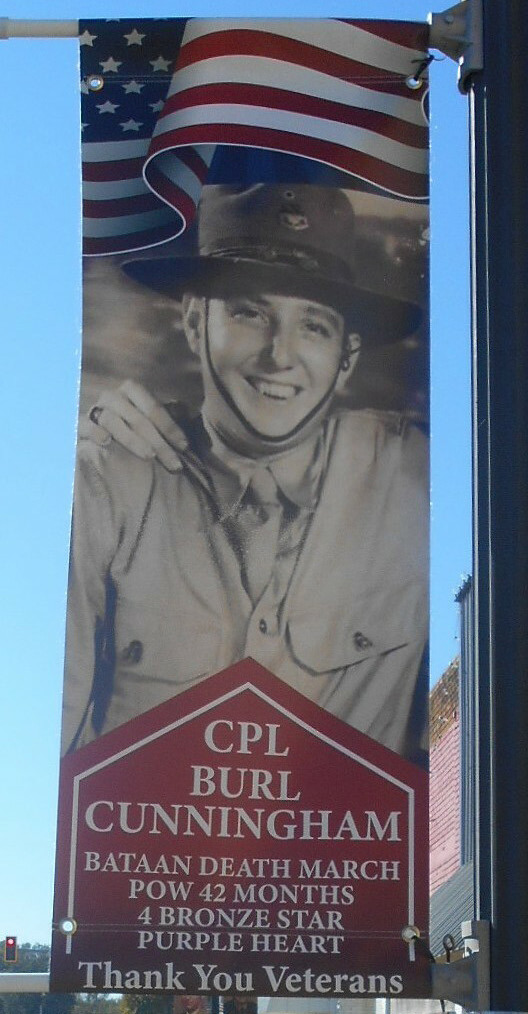
By Jerry Ellis Burl Cunningham was born Jan. 6, 1920, in the small southeastern Oklahoma community of Rufe. A 20-yearold enlistee into the Army at Texarkana, Burl traveled by train to California, where he was sworn in on Jan. 28, 1941, less than two months after the Japanese Empire bombed Pearl Harbor naval base in Hawaii.
Cunningham’s division of the 31st Infantry left eight weeks later for the South Pacific for one year of duty as garrison soldiers at Corregidor, Island of Luzon, in the Philippine Islands.
It all came apart on the night of Dec. 6, 1941. “Every single day from December 7, they bombed and blitzed us daily. Word had come in about Pearl Harbor, but nobody knew just what was going on.”
In the spring of 1942, General Jonathan Wainwright and his troops at Corregidor found out the hard way. On May 5, Japanese gunships appeared on the horizon and started blasting at the garrison with 5-inch guns. Late that night, thousands of Japanese infantrymen boarded landing craft and headed ashore.
“General Wainwright had already prepared us for surrender. We didn’t have a prayer. By 11 o’clock the next morning, May 6, a white bedsheet was run up the flagpole to replace Old Glory, and we thought it was over ... God only knows, it had just begun.”
Cunningham was in a small hole carved into the beach and sandbagged. Four other companions joined him.
“We saw them coming toward us. One was an officer who carried a sabre (sword) at his side. When they got to our position, I was sitting on a sandbag. I started to rise and halfway up the Jap officer pulled his sabre and with both hands swung and knocked my helmet off. It sailed 20 feet away and I could see the ivory handle on his sabre with a Chinese dragon carved on the end of the handle ... I’ll never forget that look in his eyes when he touched the tip of that long blade right between my eyes. Right at that time Jap soldiers had already bayoneted two of my buddies trying to climb out of the bunker and I thought to myself ... Dear God, here I come.”
“I looked him that Jap officer in the eye. It seemed like an eternity. Then they yelled something we didn’t understand and motioned for us to get out and gather up with the rest of what was left of the American soldiers, bunched up in the open a few yards away.” Fewer than 10% would survive.
Burl remembered getting one bowl of slimy rice a day, with all the grasshoppers he could catch, for the next three and a half years.
The prisoners were used for slave labor in copper mines and farms in the Pacific. The first job each day was to bury fellow soldiers who died the night before. Burl recalled a POW friend telling him before he went to sleep, “Burl, you can have my bowl of rice tomorrow.”
The days soon ran together. Is today Sunday? Two or three months later nobody knew Sunday from Friday, 1942 from eternity.
Two atomic bombs were dropped on Japan on Aug. 6 and Aug. 9, 1945. Japan agreed to surrender Aug. 14, and Japan signed the surrender to General Douglas MacArthur aboard the USS Missouri on Sept. 2, 1945. Pockets of Japanese continued to fight until ordered by Emperor Hirohito to surrender in September 1945.
Burl Cunningham was a Japanese prisoner of war for 42 months and 6 days before freedom came on Sept. 12, 1945; he weighed approximately 80 pounds when liberated. He died March 22, 1989.
Jerry Ellis, who lives in Valliant, Oklahoma, is the founder and publisher of the Southeast Times newspaper in Idabel.