

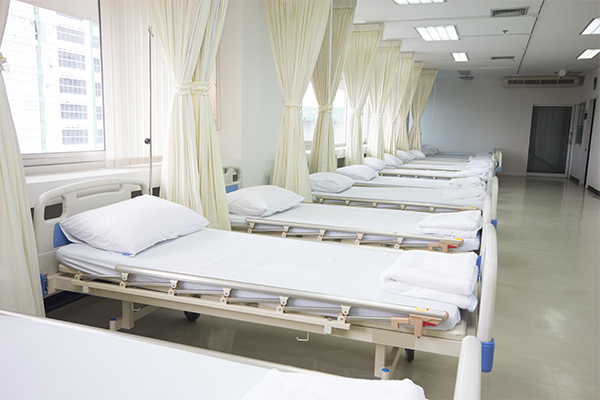
Rural hospitals have taken a hit in recent times so state Rep. Trey Caldwell is trying to help at least one community regain its only major healthcare facility.
“Frederick lost its hospital a year before I was elected, but they’re not the only ones who have suffered in rural Oklahoma,” he said.
Caldwell’s proposal, which will be introduced as legislation in February when lawmakers begin the 2022 legislative session, would seek a federal grant and allow a sister hospital such as Comanche County Memorial Hospital in Lawton or Duncan Regional Hospital to build and operate the facility in Frederick. CCMH has taken the lead in submitting the grant request, Caldwell said.
It’s been more than 40 years since a rural hospital was built in a county under 15,000 people anywhere in the U.S., Caldwell (R-Lawton) said. The demise of rural healthcare in Oklahoma has been obvious since 13 rural hospitals have closed in the last eight years, he said.
Frederick could be labeled with a rural critical access designation since the town is 35 miles away from another hospital. That designation could place Frederick in a better position to receive the federal funding, Caldwell said.
Of the 154 hospitals in Oklahoma, 40 are designated as Critical Access, according to the Oklahoma Hospital Association. Some of the requirements for Critical Access Hospital certification include having no more than 25 inpatient beds; maintaining an annual average length of stay of no more than 96 hours for acute inpatient care and offering 24-hour, seven-day-a-week emergency care.
Communities that are fortunate to have a Critical Access Hospital enjoy a significant economic impact since it is usually one of the largest employers in that community, according to the hospital association. An assessment conducted in 2013-2014 by OSU Extension and the Oklahoma Office of Rural Health of nine CAHs representing seven counties found enormous economic impact.
The direct economic impact per hospital was more than $3.8 million and the total economic impact per hospital was more than $4.5 million. Taking that average total economic impact and multiplying it by the 40 CAHs in Oklahoma resulted in a total economic impact of $162 million for the state.
Trooper increase
Caldwell also will introduce a bill that would provide funding for an annual Oklahoma Highway Patrol academy. The measure, if approved, would train 30 new trooper candidates. Funding for the academy will be specified in the legislative bill.
“We want a continued flow of troopers so the bill will request funding for that each year,” he said. “We’re going to lose 240 in the next two years due to retirement.
As a short-term solution, the highway patrol will host its first “bridge” academy starting April 21, 2022. Applications will be accepted through Dec. 20.
Montgomery’s issues
State Sen. John Michael Montgomery, R-Lawton, wants to endow some of the state’s $1.8 billion in cash and place it in a fund that will generate more revenue.
“There are states with a lot of oil and gas money that do this already,” he said.
Montgomery said this issue would not require a bill, but rather be an accounting function that protects Oklahoma’s cash reserve.
In addition, Montgomery also wants to focus on the state’s tax code and provide some reforms during the next legislative session. Specifically, the senator wants to address ad valorem issues, how commercial property is assessed and the burden tax protests have on entities such as public school districts.
Montgomery pointed to wind farms as an example when the companies protest an assessed valuation. That protest, he said, can force the ad valorem taxes wind farms would pay into an escrow account while the protest is considered. The biggest beneficiary of property taxes in Oklahoma is school districts.
Montgomery believes holding the ad valorem taxes can create problems for schools that rely on that money for operations and new building projects.
“The schools are on the hook until that protest is resolved,” he said. “The issue is having consistency on assessments statewide. We need a financing mechanism for schools where they are covered until the protest is resolved.