

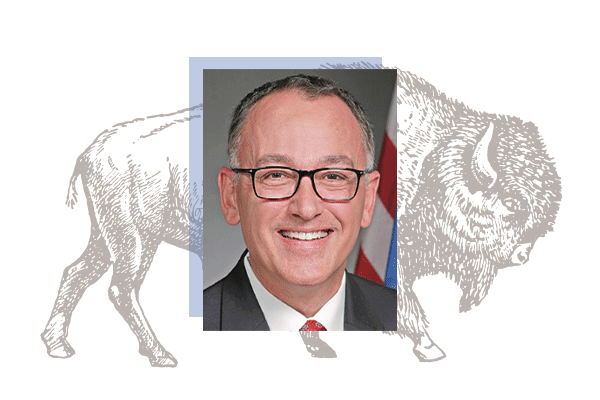
OKLAHOMA CITY – Saying state government has done well managing its finances during the pandemic, Standard & Poor’s Global Ratings has revised Oklahoma’s outlook from negative to stable, State Treasurer Randy McDaniel announced Wednesday.
S&P had placed the state on negative outlook at the start of the COVID-19 pandemic last year. With the revision announcement, the state’s current credit rating of AA was affirmed.
McDaniel said the outlook change is encouraging and should help the state reduce interest costs on future bond issues – such as the Utility Consumer Protection Act proposal unveiled in the Legislature this week.
“State leaders have exercised fiscal discipline during the pandemic,” McDaniel said. “This announcement from a widely respected independent source is welcome news.”
The S&P outlook change also anticipates responsible decision-making will continue.
The report states the revision is based in part on “the expectation that Oklahoma’s legislative and executive branches will reach consensus on actions to restore and maintain structural balance in future budgets and sustain a commitment to rebuilding reserves.”
Just recently the leader of the state Senate said he opposes legislation that would phase out the state’s corporate income tax over the next five years.
Senate President Pro Tempore Greg Treat, R-Oklahoma City, said there is no widespread support in the Senate for the proposal from House Speaker Charles McCall, R-Atoka, meaning the tax cut legislation is unlikely to succeed this year.
“We are living in a time that is uncertain financially,” Treat said. “Having come through COVID we are sitting very nicely financially as a state. But I need to remind you we cut the budget by $1.3 billion last year when it turns out we needed to cut it about $800 million.”
As an incentive to attract more businesses to Oklahoma, McCall proposed phasing out the state’s 6% corporate income tax by 20% a year over five years.
In a House floor debate, Appropriations Chairman Kevin Wallace, R-Wellston, said McCall’s House Bill 2083 would result in a $377 million annual decrease in tax collections when fully implemented. Treat, though, said that over the course of the next five years the proposal would cut $642 million in taxes, including some funding for the Teachers’ Retirement System.
The state’s primary reserve funds are the Constitutional Reserve Fund and the Revenue Stabilization Fund. They currently contain approximately $230 million, which is about 3% of general revenue appropriations. The combined balance topped $1 billion prior to the global health crisis.
Other factors cited by S&P for its more favorable outlook include the state’s decade-long history of funding pensions at sufficient levels, and Oklahoma’s relatively low debt burden.
Oklahomans enjoy one of the lowest tax burdens in the nation, according to WalletHub, a personal finance website that utilized data collected from the Tax Policy Center.
The report focused on tax burden, which measures the proportion of total personal income that residents pay toward state and local taxes, including property taxes (49th lowest in the nation), individual income taxes (36th), and sales and excise taxes (Oklahoma’s 3.54% versus Hawaii’s 6.65%).
Oklahoma’s 7.13% overall tax burden compares to New York’s 12.79%, highest in the nation, WalletHub reported.