

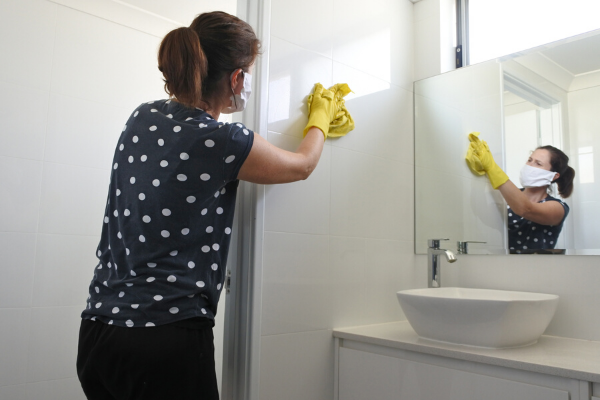
For Heather Popowsky, her husband and their combined six children, keeping their house clean and sanitized isn’t just expected, it’s necessary, especially in the age of coronavirus.
A self-proclaimed “sanitizing expert,” Popowsky reads labels on any cleaning product she uses. If a product does not claim on the bottle that it kills 99.9 per- cent of germs and bacteria, she knows it won’t work as a sanitizer.
“The FDA has rules that you can’t claim that it sanitizes if it doesn’t,” she said. “I use scented bleach when I’m doing laundry, but I use regular bleach if I’m cleaning. I use a lot of Clorox bleach. But you have to read the label on how to use it effectively because it is a potent chemical.”
As the world scrambled for sanitizing cleaning products, many homeowners grabbed whatever bleach they could find. Unfortunately, not all bleach are created equal. Scented and splash-free bleach, for instance, does not have enough concentration of the effective ingredient sodium hypochlorite to kill germs and viruses.
For many people, what they are cleaning surfaces with simply isn’t effective.
HOW TO USE BLEACH PROPERLY
For household cleaning, do not use splash-free or scented bleach. Put simply, neither has the hypochlorite concentration need to kill bacteria and viruses. The sodium hypochlorite concentration in splash-free bleach is only 1 to 5 percent, compared to 8.25 percent in regular bleach.
Deodorizing bleach is also too diluted and will not kill viruses, said the Centers for Disease Control and Prevention (CDC). In order to be effective, the CDC recommends using unscented household bleach. Homeowners should wash surfaces first with warm water and soap and then sanitize the surface with household bleach.
For surfaces that are not porous, like floors, stoves, and countertops, use one cup of bleach per five gallons of water.
However, homeowners are urged to read the safety guidelines when using sanitizing products:
Never mix bleach with ammonia or any other cleaner.
Wear rubber or other non-porous boots, gloves, and eye protection.
Try not to breathe in product fumes. If using products indoors, open windows and doors to allow fresh air to enter.
The EPA says bleach effectively kills germs after around 10 minutes, so leave the solution to air dry on surfaces.
The U.S. Department of Health also has guidelines and warnings about the use of bleach. Undiluted bleach should never be used as it is highly toxic and can damage mucus membranes and eyes. A mask, rubber gloves, plastic apron and goggles are recommended. Avoid touching the eyes. If bleach gets into the eyes, immediately rinse with water for at least 15 minutes and consult a doctor.
Bleach should never be used together with other household cleansers. For instance, if bleach is used with detergents like toilet cleaners or ammonia, a toxic gas is produced which results in serious injury and could be fatal. In fact, according to the National Institute of Health, combining these two chemicals causes life-threatening toxic pneumonitis.
Undiluted bleach also creates a toxic gas when exposed to sunlight, so store bleach in a cool and shaded place out of reach of children.
HOMEMADE HAND SANITIZER
The World Health Organization has released a recipe for hand sanitizer that people can make at home as bottles of hand sanitizer flew off the shelves. While effective, be careful that the tools are properly sanitized first to avoid contamination of the end product.
Nothing beats washing hands, and hand sanitizer should be used when hand washing isn’t possible.
According to the CDC, a sanitizer mix must be at least 60 percent alcohol to be effective, though a minimum of 75 percent is preferred. A bottle of 99 percent isopropyl alcohol is the best thing to use. Items like whisky or vodka are not strong enough to kill viruses.
The WHO recommends the following recipe:
Mix 12 fluid ounces of alcohol with 2 teaspoons of glycerol. Jugs of glycerol can be purchased online and is used to keep hands from drying out. If glycerol isn’t available, proceed with the rest of the recipe and use moisturizer after sanitizing hands.
Add 1 tablespoon of hydrogen peroxide to the alcohol mix. Add 3 fluid ounces of distilled or boiled and cooled water.
The mixture should also be allowed to sit for a minimum of 72 hours to make sure the sanitizer kills any bacteria that could have been introduced during mixing.
Because this solution is liquid, spray bottles work best. Add a few drops of essential oil to add scent, if preferred.
Another easy recipe is a gel recipe; however, the gel does leave hands sticky. Mix three parts isopropyl alcohol to one part aloe vera gel. Add a few drops of essential oil for scent.
TAKEAWAY
Again, it is vital that homeowners read the directions carefully and the safety precautions on all cleaning solutions, but especially bleach. Household cleaners should never be mixed with any solution other than water.