

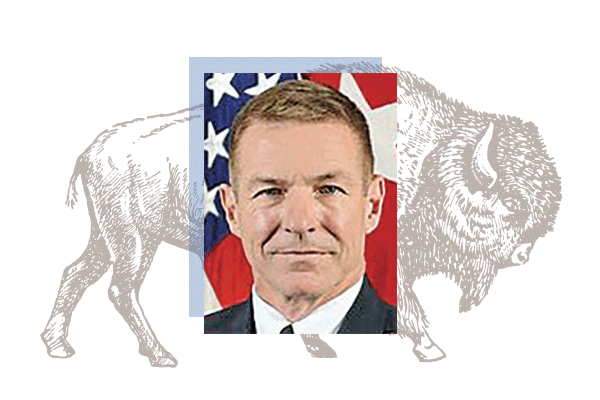
If it receives the “green light,” the United States military can withdraw from Afghanistan relatively quickly and safely, Gen. James C. McConville, the U.S. Army Chief of Staff, said Monday.
During a 30-minute interview that was live-streamed on the internet, author and Washington Post columnist David Ignatius asked the four-star general whether it is possible to “get them out quickly” along with their equipment after a war that has dragged on for almost 20 years.
The U.S. military has been considering a withdrawal for some time and, “The plans are available now,” McConville said.
Army Gen. Austin Scott Miller, commander of NATO’s Resolute Support Mission and of U.S. Forces-Afghanistan, advised that U.S. troops “will have proper defense mechanisms” should the Taliban choose to attack during the pullout from Afghanistan, McConville said.
A May 1 withdrawal deadline was a key element of a deal that former President Donald Trump made with the Taliban. President Joe Biden vowed that the U.S. will pull its troops out of Afghanistan but said it would be “hard” to do before that date.
U.S. Secretary of State Antony Blinken, in an interview with ABC on March 26, said, “We [NATO] went in together, we’ve adapted to circumstances together, and we’ll come out together when the circumstances are right... Everyone recognizes that there’s no military solution in Afghanistan. It has to be some kind of political settlement.”
About 2,500 U.S. troops remain in Afghanistan to train and support Afghan security forces, in addition to approximately 7,500 troops from other NATO allies. The U.S. military presence in Afghanistan peaked at approximately 100,000 troops in 2011, a decade after the terrorist attacks of Sept. 11, 2001, orchestrated by Osama bin Laden.
“We knew who did it, we knew where they were, and we held them accountable,” McConville said.
President Trump claimed last September that the Pentagon brass engage in wars to keep defense contractors “happy.”
McConville refused to comment specifically to that comment, but did tell Defense One news/commentary site, “I’ve talked with generals, I’ve talked with admirals, I’ve talked with [sergeants major] ... many of these leaders have sons and daughters who have gone to combat or may be in combat right now. So I can assure the American people that senior leaders would only recommend sending troops to combat when it’s required in national security or as a last resort.”
McConville has two sons and a daughter, and all three served in Afghanistan.
The mob of Trump supporters who stormed the U.S. Capitol earlier this year included several former and current members of the U.S. military. Millions of Americans have served in the armed forces, and, “There’s no role for anyone trying to overthrow the government,” McConville said Monday.
For the past three months military leaders have been making an effort to root out extremists in the service ranks. “Their numbers are not very big ... but one is too many,” the general said. “We don’t want in our Army, and won’t allow in our Army, harmful behaviors” such as sexual assault and extremism.
Active-duty personnel, reservists and National Guard troops were stationed at the Capitol as part of an integrated security detail on the presidential Inauguration Day, Jan. 20. “Most people would agree the military should be used in law enforcement only as a last resort,” McConville said.
‘WE WANT TO WIN THE NEXT FIGHT’
Ignatius also asked McConville about efforts to modernize the military.
Although a common belief is that generals want to fight the last war, “We want to win the next fight,” McConville said. “We need a new warfighting concept.” America needs “strong allies and partners” and must preserve “peace through strength”.
Ignatius mentioned inter-service rivalries, pointing to the comments of the U.S. Air Force general in charge of managing the service’s bomber inventory who belittled the Army’s new plan to base long-range missiles in the Pacific. During a podcast recorded March 31, Gen. Timothy Ray, who heads Air Force Global Strike Command, said the idea is expensive, duplicative and “stupid.”
The Army’s modernization priorities include long-range precision fires, next-generation combat vehicles, future vertical lift, the network, air-and-missile defense, and soldier lethality, which needs to be measured “in seconds rather than minutes,” McConville said.
All of the chiefs of U.S. military services “have talked about this,” he said. “What we look at are providing options,” he said, “giving field commanders multiple options.”
The United States has various “legacy” weapons such as tanks and aircraft carriers but, “We must transform the Army — we must modernize it,” the general said.
For example, the Army is seeking a “next-generation combat vehicle to replace the Bradley Infantry Fighting Vehicle,” McConville noted. The Army also has been focusing on artificial intelligence technologies in areas such as targeting systems and supply, he said.
McConville is working to transform the service with the speed, range and convergence of cutting-edge technologies needed for future decision dominance and overmatch required to win the next fight. As the U.S. develops its strategy to withdraw troops from Afghanistan, the Army is also redefining its role in deterring aggression around the world in this era of great power competition.
General McConville assumed his role as the 40th chief of staff of the U.S. Army on Aug. 9, 2019.
The Quincy, Mass., native is a graduate of the U.S. Military Academy at West Point, New York. He holds a Master of Science in Aerospace Engineering from Georgia Institute of Technology and was a National Security Fellow at Harvard University in 2002.
He previously was commanding general of the 101st Airborne Division (Air Assault), where he also served as the commanding general of Combined Joint Task Force-101, Operation Enduring Freedom.
McConville is a senior Army aviator qualified in the AH-64D Longbow Apache, OH-58 Kiowa Warrior, AH-6, AH-1 Cobra and other aircraft.