

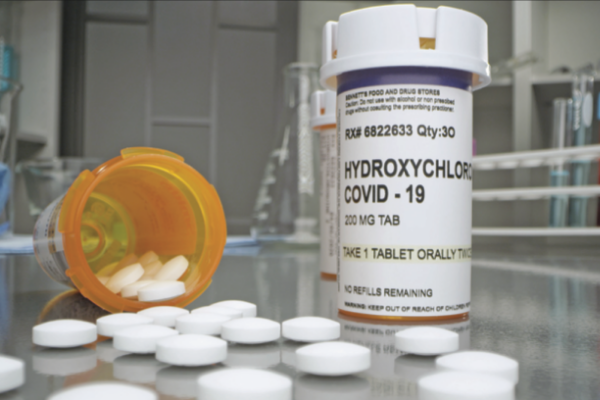
OKLAHOMA CITY – The stockpile of hydroxychloroquine the State Health Department purchased last year at the behest of Gov. Kevin Stitt as a treatment for the coronavirus will be returned to its supplier for a refund.
State Attorney General Mike Hunter announced he reached an agreement with FFF Enterprises of Temecula, Calif., to return the product in exchange for a refund. FFF is a private wholesaler of critical-care biopharmaceuticals, plasma products and vaccines.
Former President Donald Trump praised the drug as a “game changer” with “very, very encouraging early results” on March 19, 2020. The U.S. Food and Drug Administration (FDA) issued an emergency use authorization for hydroxychloroquine sulfate and a related drug, chloroquine phosphate, on March 28, 2020, based on anecdotal evidence rather than clinical data.
In April 2020 FFF Enterprises, at the request of the State of Oklahoma, procured 1.2 million 200 milligram hydroxychloroquine sulfate tablets from Rising Pharma, the U.S. direct importer of record for the products, at a price of $202.32 per bottle. In turn, FFF sold those bottles to the Oklahoma State Department of Health through a third-party intermediary, Beggs Pharmacy, for $218.50 per bottle.
The OSDH purchased 12,000 bottles of hydroxychloroquine for $2,622,000 “pursuant to Executive Orders issued by the Governor” at the onset of the coronavirus pandemic.
However, hydroxychloroquine was quickly determined to be ineffective against the coronavirus.
On June 15 the FDA revoked the emergency use authorization (EUA) that allowed for chloroquine phosphate and hydroxychloroquine sulfate to be used to treat certain hospitalized patients with COVID-19. Based on its ongoing analysis of the EUA and emerging scientific data, the FDA determined that chloroquine and hydroxychloroquine are unlikely to be effective in treating COVID-19. In addition, there was evidence of potential serious side effects.
“The overwhelming prevailing clinical trials that have looked at the efficacy of hydroxychloroquine have indicated that it is not effective in [treating the] coronavirus disease,” said Dr. Anthony Fauci, director of the National Institute of Allergy and Infectious Diseases.
And during an interview on MSNBC, Fauci said, “The scientific data, the cumulative data, on clinical trials that were valid, all of those show consistently that hydroxychloroquine is not effective in the treatment of coronavirus disease.”
Stitt defended the state’s purchase of the product, saying the drug was showing some promise. Subsequently he said, “Now there’s some evidence the chloroquine may not be as effective, but I was being proactive to try and protect Oklahomans.”
Then-State Secretary of Health and Mental Health Jerome Loughridge said several physicians, including some in Oklahoma, were previously optimistic about the drug’s promise in treating COVID-19. “When we were battling sort of the fog of war at that point, we certainly acquired it on the potential that it would have utility,” Loughridge said.
Based on “the unique circumstances encountered” by the Oklahoma Department of Health, FFF Enterprises “has agreed to return to the Department of Health the full purchase price paid for the medication,” Hunter’s office reported.
The State Health Department asked the attorney general to get involved after the FDA revoked the emergency use authorization.
The Associated Press reported that at least 22 states, including Texas, along with Washington, D.C., secured shipments of hydroxychloroquine; most received free shipments from drug companies or the U.S. government. Oklahoma paid more than any other state for the drug.
“The State of Oklahoma alleges that the purchase price paid” for the hydroxychloroquine “may have been excessive,” but FFF “denies any and all allegations related to the pricing,” the mutual settlement agreement reads.
“I commend the leadership at FFF Enterprises who worked with us to return the state’s supply of hydroxychloroquine while giving the state a refund,” Hunter said. “They recognized we were in competition with every other state in the nation to get whatever we could to protect Oklahomans. When it was determined the drug wasn’t effective in combatting the virus, they did the right thing by refunding our money.”
FFF will refund to the state the full purchase price for every bottle of the pills determined to have been “properly stored at a licensed location in conformity with manufacturer specifications and which remain within the Product’s ‘use by’ or ‘best by’ date.” The state will not be reimbursed for any pills that have not been properly stored, transferred, maintained and not in good condition.
The payments will be spread across five quarters, apparently starting later this month.