

OKLAHOMA CITY – An appellate court has upheld the $450,000 verdict a jury awarded in favor of a rural Caddo County couple whose property was polluted by leaks from an oil/gas operator’s pipelines.
Cemoil Inc. appealed the verdict to the state Supreme Court, which lateraled the case to the Oklahoma Court of Civil Appeals.
The appeals court affirmed the judgment earlier this month, noting that Cemoil appealed “without including in the record the trial transcript” nor any evidence or “requisite legal authority” in support of its argument. “When an appellate record lacks any evidence, a presumption arises that the judgment was responsive to the proof” offered during the trial, the judges wrote in affirming the jury verdict.
Kenneth Mark Myers and his wife, Carolyn, filed their suit in Caddo County District Court in March 2019.
Cemoil owns and/or operates oilfield equipment on about 160 acres the Myers- es own approximately eight miles south of Anadarko, and in particular the couple singled out Cemoil’s Northwest Cement Permian Sand Unit. That unit overlies the Myers’s property and apparently includes several wells, a tank battery and “numerous” pipelines on their acreage.
The couple claimed that on several occasions Cemoil “discharged and released oil, gas, saltwater and/or other deleterious substances from its wells, pipelines, and/ or other oilfield equipment” onto their property. The discharges and releases polluted the vegetation, soil, surface and subsurface waters on the Myers’s property.
They alleged that Cemoil failed to “properly and adequately remediate the pollution...” They also claimed that Cemoil owns “a number of pipelines and/or abandoned pipelines” that lay on the surface of their property, and Cemoil has “neglected to bury these pipelines in accordance with the terms of its oil and gas leases or to remove them” from the Myers’s property.
Consequently, the couple sued Cemoil on the grounds of nuisance, trespass and negligence.
The Myerses said they “expended money and labor” to improve their land by clearing trees “to make room for grass for cattle,” leveling and smoothing the terrain, spraying for weeds, fertilizing, and by repairing and adding fences.
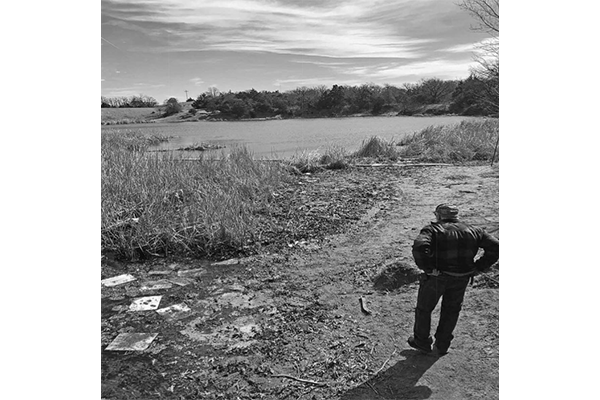
The property has a large body of water, and when they bought the acreage “there was no problem with the lake or the streams feeding it,” the couple said. In fact, they held fishing tournaments for bass and crappie, they said. The lake also was a year-round source of freshwater for their cattle “and did not dry up during times of drought.”
CRACKED PIPE LEAKS CRUDE OIL
Mr. Myers testified that in early March 2018 he dis- covered a leak from a Cemoil pipeline situated approximately 10 to 12 feet above the inlet channel to the lake. He promptly notified Cemoil and the Oklahoma Corporation Commission (OCC). Apparently, the breach resulted from a cedar tree that grew up around the line. “The tree would sway in the wind and eventually cracked the line,” the jury was told.
An estimated six to eight barrels (252 to 336 gallons) of crude oil spewed from the cracked pipe and flowed downhill into the Myers’s lake. “The oil floated ... all around and across the lake, including to the opposite side where the spillway is located.”
The raw crude emitted a “strong odor of petroleum,” created a sheen on the water, and stuck to whatever it touched, including cattails and other vegetation as well as the banks of the lake, “where it created a ‘bathtub ring’ effect” around the reservoir,” jurors were told.
Mr. Myers advised Cemoil that he wanted his property “cleaned up like it was before the leak.”
Instead, Cemoil “simply had contractors come out with weedeaters to cut off the tops of the cattails, bag them and haul them off.” During that operation they “stomped the oil deeper into the soils at the edge of the lake.”
Cemoil also scraped off some of the dirt “but did not go very deep and so did not get the oil and saltwater that had seeped into the ground.” Consequently, the area of the flow path “is all still dead and there are salt crystals on the surface of the ground,” the Myerses complained.
The couple retained an environmental consultant, who determined that “the presence of oil sheens and free oil in the water is significant,” posing a hazard to cattle and recreational use of the lake. Laboratory results of analyses of samples of water from the lake “showed the presence of high levels of petroleum hydrocarbons in the water.”
The Myerses received a letter from the Corporation Commission in June 2018, stating that the incident was resolved and that “the area has been remediated” and no further action was required.
But in September 2018 Mark Myers collected several samples along the creek that empties into the lake; the first sample was soil collected at the area where the pipeline leak occurred. Laboratory analysis of that sample “confirmed the levels of salt in the soil were over 40 times normal and were high enough to affect even salt-tolerant crops,” jurors were informed.
The jury also was shown photos of a poly pipeline associated with a Cemoil well; the end of the pipeline “was laying down in a creek on the Myers property and was open.” Nothing was growing in the soil around the open pipeline, and salt crystals and oil covered the surface.
SALT LEVELS IN SOIL, LAKE ABOVE NORMAL
“The problem with these high levels of salt is that you cannot use the water for drinking or cattle, and it is harmful to plants,” the environmental consultant testified. The cumulative result of the oil and saltwater discharges was that “the Myers’s lake was polluted to the extent that it could no longer be used to water cattle or for fishing.”
Cemoil’s witnesses “agreed that they did not try to do anything to address the salt impacts to the Myers’s property,” the court was told. The consultant who led Ce- moil’s remediation efforts “acknowledged that any salt impacts were not considered or evaluated as part of any cleanup or remediation activity related to this incident.”
OCC field tests were performed above and below the location of the pipeline release “and determined that levels of sodium chloride were higher upstream” before the spill. The OCC “also stated that they believed the higher sodium chloride levels were related to past operations or historic activity.” Therefore, sodium chloride was not considered to be part of the clean-up since, in the commission’s opinion, the Cemoil incident “did not cause those salt levels.”
Cemoil’s consultant testified that the goal of remediation “was not to restore the property” to its original condition. Instead, their goal was “to meet the Corporation Commission’s minimal standards, which were (1) no visible sheen and (2) no floating free product oil.”
Consequently, “no one from Cemoil got near the water or in the water or disturbed it to see what would happen,” the jury was told.
The Corporation Commission’s inspector admitted that during final inspection of the site “he did not get in or disturb the water.” He and the jury were shown photographs of the sheen and free oil that floated to the surface when the cattails were disturbed.
When asked about the salt, the commission inspector admitted that he had not taken any samples from the creek “and that he was not a hydrologist.”
The OCC inspector testified that when he closed the incident report, the area where the leak occurred “was green and everything was growing.” However, photos taken just before the trial started “showed that the area was still denuded, and nothing would grow there.”
The OCC inspector also “had difficulty explaining why no fine or other sanction was ever levied against Cemoil despite the fact that it had admitted violating the commission’s rules,” the appellate court was informed.
The Myerses testified that they worry their property will never be remediated in their lifetimes.
At the conclusion of a four-day trial in December 2019, the Caddo County jury returned a unanimous verdict in favor of the Myerses. The jury awarded the couple $450,000 in actual damages but declined to award any punitive damages; the court awarded the couple $38,526 in costs and attorney’s fees. Cemoil appealed to the Oklahoma Supreme Court, but the Supreme Court transferred the case to the Court of Civil Appeals last month, on May 26.
The Myerses were represented by attorney Wes Johnston of Oklahoma City, while Cemoil was defended by Edmond attorney Niles Eugene Stuck.
Cemoil was founded in October 2000 and its registered agent is Thomas L. Harris of Chickasha, according to records on file in the Oklahoma Secretary of State’s office. A website indicates Cemoil operates oil/gas wells in Grady County; several in Caddo County south of Anadarko and in the vicinity of Cement; and one in Comanche County, east of Medicine Park.