

The standard joke is that the term “military justice” is an oxymoron. Yet as a news reporter I covered three courts-martial: one at Fort Sill (a drill sergeant made a habitual screwup stand on his head in a trash barrel while his unit performed calisthenics) and two at Tinker AFB. In all three instances justice was served and the panels rendered the correct verdicts, in my opinion.
Chris Bray, a former U.S. Army infantry sergeant who earned a Ph.D. in history from UCLA, concedes that courts-martial have been “far more procedurally casual through much of our past,” and until after World War I a court-martial was “usually made up of a group of officers who had no legal training.” However, he continues, “If you attended a court-martial today, it would look a lot like a trial in your local courthouse.”
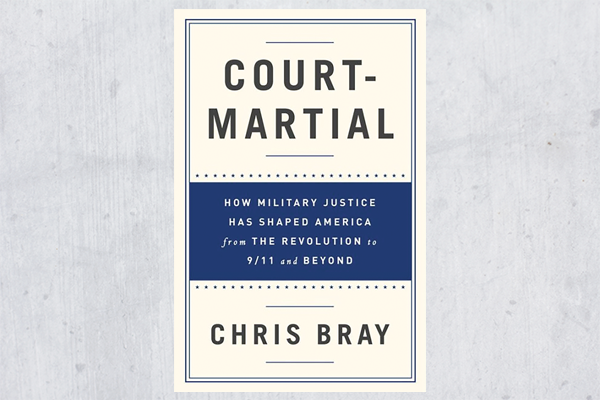
Bray reviews the evolution of the U.S. military’s administration of justice in “Court-Martial: How Military Justice has Shaped America from The Revolution to 9/11 and Beyond” (W.W. Norton & Co., 398 pages, ©2016).
Military justice is “separate from civilian justice but not separate from American society,” notes Bray.
For example, courts-martial “have taken up deeply political questions at precisely the moments that related controversies have torn at the fabric of the larger American society.”
As an illustration, more than a decade before Rosa Parks was arrested in 1955 for refusing to move to the back of a city bus in Montgomery, Ala., Lt. Jack Robinson took a similar stand at Camp Hood, Texas, three years before the UCLA alumnus broke the color barrier in Major League baseball.
A recent order had officially desegregated Army transportation, and in 1944 Robinson refused to move to the back of a bus traveling on the post as demanded by the bus driver. The military police were summoned, and a white MP who was a private addressed Robinson with a racial slur.
The case against Robinson was narrowly circumscribed; the list of charges against him was whittled from five to two, neither of which related to the events on the bus. Nevertheless, Robinson was acquitted when it became obvious that the Black officer had indeed been insulted and had a legitimate grievance.
Several courts-martial have been high-profile affairs, such as that of Col. Billy Mitchell in 1925.
Mitchell publicly condemned the “incompetency, criminal negligence and almost treasonable administration of the national defense by the Navy and War Departments.” Mitchell insisted that aircraft would become central to waging war and demonstrated that battleships could be destroyed by aerial bombing; he also claimed that U.S. naval facilities at Pearl Harbor were vulnerable to attack from the air.
Mitchell was convicted by a court composed entirely of general officers, including then-Maj. Gen. Douglas MacArthur. Mitchell, disgusted, resigned his commission.
MacArthur, in contrast, was not court-martialed even though he neglected to place his command on a full war footing after being informed about the 7 December 1941 Japanese attack on Pearl Harbor – which, incidentally, vindicated Mitchell. Nine hours after the raid in Hawaii the Japanese launched an attack on the Philippines that decimated MacArthur’s Far Eastern air force.
Bray recounts cases arising from the Army’s transition from a voluntary militia to a professional military, and the advancement of naval justice, which “became so haphazard that it looked like a ‘blind lottery’” and frequently involved brutal floggings for transgressions. Marines, meanwhile, were subject to navy laws while at sea and to army laws while on shore in a land campaign.
Contradiction was not uncommon in the U.S. military. During the U.S.-Mexico War (1846-48), Sgt. James Bannon and Pvt. George Miller were both accused of verbally threatening, but not striking, officers, and were tried by the same court-martial. Miller, a native-born American, received 50 lashes. Bannon, an Irish immigrant, was executed.
The most widely known military execution was the court-martial of Private Eddie Slovik. He was the only deserter executed by the American military during the 20th century.
At least 40,000 American soldiers in Europe “walked away from their fellow soldiers on the battlefield,” Bray said. More than 2,860 of those deserters were convicted, but capital punishment was assessed against only one of them: Slovik.
That might be because Slovik told anybody who’d listen, including several officers, that if given the chance he’d desert again. Also, no one before him had been executed.
The members of the court-martial “didn’t reach their decision casually,” the author emphasizes. The panel took three ballots and was unanimous every time: death. The sentence was approved by his division commander, Maj. Gen. Norman Cota (who stood alongside the troops on Omaha Beach and in the Normandy hedgerows). Slovik was shot by a military firing squad on 31 January 1945.
Bray also mentions the court-martial of Pvt. Louis Till, an African American who was hanged by the Army in 1945 for robbery, rape and murder while in Italy. In a tragic irony, Till’s son, Emmett, was lynched 10 years later in Mississippi, at the age of 14, after he was falsely accused of whistling at a white woman.
The author covers the unconscionable court-martial of Capt. Charles McVay, commander of the cruiser Indianapolis that was torpedoed and sunk by the Japanese in 1945. Approximately one-fourth of its crew of 1,196 men went down with the ship. The survivors floated in the water for five days, attacked repeatedly by sharks, while no one searched for them; rescuers saved just 317 of the sailors.
Bray also reviews the prosecution in 1970-71 of 2nd Lt. William Calley for the My Lai massacre in 1968 during the Vietnam War.
The author discusses the Tailhook scandal of 1991 and claims that for a century and a half cases arising from sexual issues were virtually ignored because military commanders and the courts they convened “didn’t want to hear about this stuff.”
Even before World War II ended the Army and Navy began to examine “the effectiveness and fairness” of wartime military justice. A War Department clemency board reviewed thousands of courts-martial and remitted or reduced 85% of the convictions and sentences; a similar Navy study reviewed 2,115 wartime trials and found that almost half involved “flagrant miscarriages of justice.”
Faced with “clear signs of a problem,” Congress and the military began a years-long effort to revise the nation’s military law and eventually developed the Uniform Code of Military Justice (UCMJ).
The military court martial has gradually but steadily progressed toward due process. However, the author acknowledges, courts-martial are “still very much instruments of command authority…” An egregious illustration is the case of Lt. Col. James Wilkerson who was convicted of an aggravated sexual assault on a civilian contractor that occurred in 2012. Air Force Lt. Gen. Craig Franklin overturned the conviction and reassigned the fighter pilot, triggering a national uproar.
Despite the shortcomings of the military justice system, “There are no American soldiers, sailors, airmen or marines who have to worry that they’ll be shot by a firing squad in the aftermath of a hurried court-martial conducted in the field,” Bray points out.