

After state crackdown, a quick decline in licenses
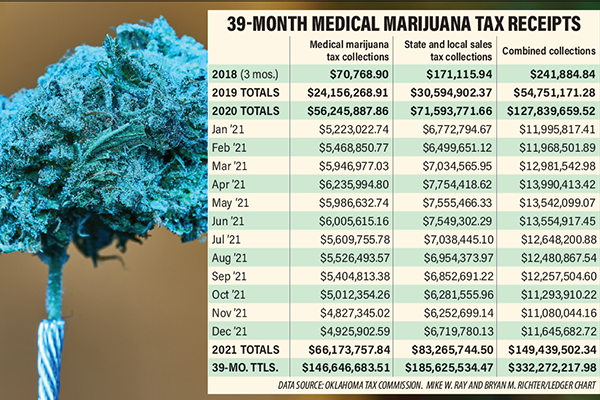
OKLAHOMA CITY — Oklahomans spent nearly a billion dollars on medical marijuana products last year, Oklahoma Tax Commission ledgers show.
Although MMJ tax receipts in November ($4.82 million) and December ($4.92 million) were the two lowest months last year, 2021 nevertheless was the third consecutive year in which the state collected record sums from the excise tax on medical marijuana products.
That 7% tax generated $66.17 million in 2021 – representing MMJ sales of $945.34 million during the year. The number of patients licensed by the state Health Department to buy and consume marijuana products has soared to 386,561 – almost one of every ten residents of this state.
Astonishing growth in the medical marijuana industry in Oklahoma in a little over three years since voters approved medical marijuana in 2018 has produced growing pains, and the state has started to react.
With more funding approved by the Legislature, the Oklahoma Medical Marijuana Authority has begun a hiring spree and now has more than 170 employees.
House Bill 2904 enacted last year directed the State Health Department to hire at least 70 employees for the Medical Marijuana Authority, including 62 compliance and enforcement officers, four investigative officers, and four employees to perform planning and logistics duties.
The OMMA plans to hire up to 100 compliance officers, Director Adria Berry indicated.
Because of unrestricted growth and an influx of “outsiders” and “foreigners” into the marijuana industry, state lawmakers have begun to tighten the reins.
Last year the Legislature passed, and Governor Stitt signed, House Bill 2272 by Rep. Josh West, R-Grove.
That law requires current medical marijuana business licensees and applicants seeking licensure to confirm or deny – under penalty of perjury – the existence of any foreign financial interests in their medical marijuana business operations; if there is any, the identity of that ownership must be disclosed.
As a direct consequence, the OMMA has taken steps to revoke the licenses of 650 marijuana businesses that did not file the requisite foreign involvement document, and more revocations are anticipated.
The number of licensed growers in Oklahoma fell by 1,096 in just one month: from 9,402 on Dec. 3, 2021, to 8,306 on Jan. 6, 2022, a decline of 11.65%, OMMA records reflect. During that same 34-day period the number of licensed dispensaries declined by 281, to 2,238, and the number of licensed marijuana processors shrunk by 201, to 1,512.
Additional restrictive measures await consideration when the Second Regular Session of the 58th Oklahoma Legislature convenes at noon Feb. 7.
House Bill 2987 by Rep. Jim Olsen, R-Roland, would allow municipalities and counties to enact an ordinance or resolution to limit the number of new medical marijuana farms or dispensaries within their confines.
If a city or county declined to enact such an ordinance or resolution, the Medical Marijuana Authority would be authorized to issue no more than one new medical marijuana dispensary license and one additional grow facility license within the geographic boundaries of that city or county each calendar year. For a county whose population exceeds 100,000, the OMMA could issue two new MMJ dispensary licenses and two additional grow facility licenses per year.
House Bill 2989 by Rep. Todd Russ, R-Cordell, would require any new application for a commercial marijuana grower’s license to be submitted to a vote of the residents of the county in which the operation would be located.
All applications for approval of a commercial grow license by the county would have to be submitted not later than June 30 each year. The commissioners of the county in which the marijuana farm would be located would refer the application to the voters of that county. The question for approval of the license could be submitted for a vote only at the General Election held in each even-numbered year.
Any marijuana farmer whose application was rejected by a county’s voters would be barred from resubmitting an application in that county for five years, HB 2989 decrees.
The agricultural sales tax exemption for marijuana operations would be repealed if Senate Bill 1101 by Sen. George Burns, R-Pollard, is enacted.
How MMJ taxes are allocated
A law the Legislature passed, and the Governor signed last May, Senate Bill 229, spells out how receipts from the 7% MMJ tax will be disbursed.
59.23% of the first $65 million in revenue (or $38,499,500) will be apportioned to the State Public Common School Building Equalization Fund, which is also known as the Redbud School Funding Program for disadvantaged public and charter schools.
34.62% of the first $65 million (or $22,503,000) will be earmarked to underwrite operations of the Oklahoma Medical Marijuana Authority. The agency’s budget for the fiscal year that ended June 30, 2021, was $25,472,344, legislative records reflect.
6.15% of the first $65 million (or $3,997,500) will be allocated to the State Health Department for drug and alcohol rehabilitation programs.
Any MMJ tax collections above $65 million will be deposited in the state’s General Revenue Fund. The 7% MMJ tax produced $66.17 million during Calendar Year 2021, an average of $5.51 million monthly.
A related measure the Legislature passed, Senate Bill 1033, authorizes the Oklahoma Tax Commission to keep 1.5% of the proceeds from the MMJ tax as a handling fee for collecting the tax and enforcing the law.