

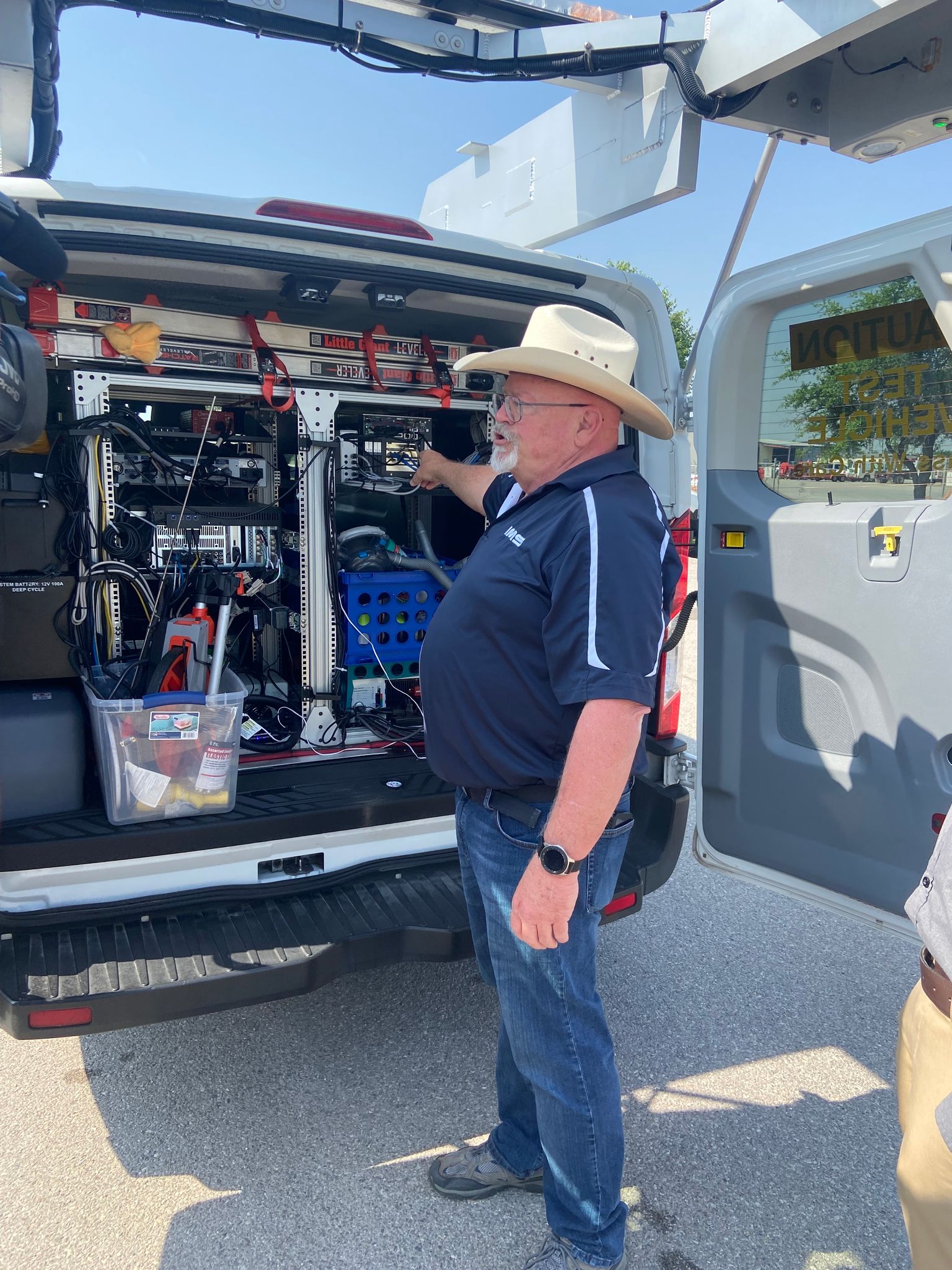
LAWTON – Armed with modern technology, an Arizona-based company is gearing up for a study of Lawton’s streets.
Infrastructure Management Services plans to examine every street in town, which will help officials decide which streets should be repaired first. Using lasers, cameras and other equipment, IMS will look at cracking, roughness and rutting on each street.
The results will help the Lawton’s Public Works Department develop a long-term plan for street repairs, Public Works Director Larry Wolcott said Tuesday.
“Once we get through with our analyzation of all these roads, we’ll put together a five-year project list,” he said during a media day at the department. “And that will give us a way to budget those roadways and get the primary streets fixed first.”
Wolcott said IMS uses two methods to survey roads: Laser crack surveying and deflection, a method in which surveyors press down on a road and test the base and pavement. He said those two methods rely on technology, rather than someone’s opinion, to determine the condition of each road.
The company recently completed a structural test of Lawton streets, which involved pressing down on pavement surfaces and measuring its response. The second phase, which will use IMS’ laser crack measurement system, will begin shortly and should be finished by early fall.
Funding for the $450,000 analysis comes from the city’s 2020 capital improvement plan, also known as Propel, which included $18 million for street repairs.
When the analysis is completed, the Public Works Department will assign a score known as the Pavement Condition Index to each street. The Public Works Department will use PCI scores to rate the streets and develop a priority list for repairs.
The city used to rely on visual inspections, which include the opinion of the inspector, to determine the condition of each road, Wolcott said. He said it’s difficult to compare roads accurately without looking at minute details, which is possible with laser crack surveying.
The upcoming analysis is a major achievement for both the Public Works Department and the city, Wolcott said.
“It’s something that we’ve been trying to accomplish for the last two decades, at least,” he said.
In addition to PCI scores, which are based on pavement conditions, the Public Works Department is collecting data about street attributes – such as stop signs, traffic signals and pavement markings – and rights of way. That information will give the Public Works Department a way to track its assets and budget for maintaining or replacing them.
Studying streets
IMS’ laser crack measurement system provides a continuous, downward scan of pavement surfaces, allowing the company to identify different types of cracking, said IMS President Kurt Keifer.
“The type of cracking indicates what is actually going wrong with the pavement, whether it’s a foundation issue, whether it’s an overloading issue, whether or not it’s just thermal fatigue cycling,” he said. “All sorts of different types of damage are possible to a pavement, but this technology helps us more objectively quantify that damage.”
IMS uses the American Society for Testing Materials’ standard scale for ranking roads, which was developed in the late 1970s by the U.S. Army Corps of Engineers and adopted in 1998. The scale assigns each road a ranking from zero to 100, with zero indicating a failed pavement and 100 denoting a pavement in excellent condition.
Once IMS has finished its analysis, the company will review the information and work with city officials to develop recommendations for fixing and upgrading roads, based on local unit costs for road maintenance.