

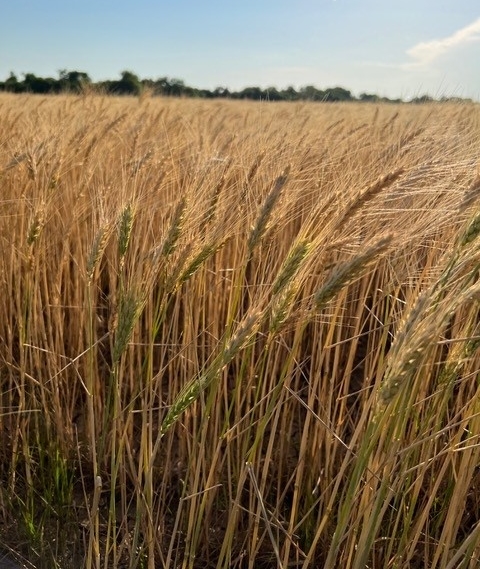
OKLAHOMA CITY – Despite rains in the Plains, the wheat crop is on the wane.
Rain earlier this month arrived too late to help much of the winter wheat in Oklahoma, the No. 2 U.S. producer of the grain, said Mike Schulte, executive director of the Oklahoma Wheat Commission.
Oklahoma farmers will soon begin harvesting their smallest crop in eight years, records reflect.
A crop shortfall in Oklahoma adds to a dire global wheat supply picture, after Russia’s invasion of Ukraine shut down ports, Reuters news service noted. Russia and Ukraine were the world’s first and fifth biggest exporters of wheat last year, accounting for 28% of the world market, The Economist reported.
The Wheat Commission projected Oklahoma’s winter wheat crop at a little more than 57 million bushels, about half the size of last year’s crop and the smallest since 2014. The commission forecast an average winter wheat yield of 23.5 bushels per acre, also the state’s lowest since 2014.
Approximately two-thirds of the U.S. crop was in an area experiencing drought as of May 3, including most major wheat areas of Oklahoma and top producer Kansas, according to the U.S. Department of Agriculture.
Nearly half of Oklahoma is under severe, extreme or exceptional drought, the U.S. Drought Monitor showed Saturday.
Drought shriveled Oklahoma’s wheat during March and April, the crop’s key growth period, leaving sparse-looking plants, especially in southwest Oklahoma and the Panhandle, Schulte said. A few areas in south- and north-central Oklahoma are in decent shape, he said.
“With high commodity prices, I think there’s a misconception that our wheat producers are going to be doing extremely well this year,” Schulte said. “Right now, wheat prices are at their all-time highs, but it doesn’t do producers any good with high prices if they don’t have anything to take to market,” he told FOX Weather.
Looking at the state of some Oklahoma wheat fields, it’s easy to think the problem is just the drought, but brown wheat mites could also be to blame, one specialist said.
Tom Royer, an Oklahoma State University extension entomologist for small grains and row crops, told NPR the outbreak is something that has not happened in years.
Since the mites are about the size of a period in newsprint, they are difficult to spot and can be mistaken for other issues such as drought or nitrogen deficiency.
The easiest way for producers to inspect for brown wheat mites, Royer said, is to take a sheet of white paper and shake a couple of wheat plants against it. This dislodges the pests if they are in the crop and makes them easier to see.
He said the mites are a common problem almost everywhere, especially in western Oklahoma. These mites typically follow dry environments and can be seen statewide, but they are more common in the western half of the state and the Panhandle.
“Every field that I’ve been to shows signs of mite injury, the stippling that we would typically associate with that,” Royer said. “And I’ve been in fields in Chickasha and the Altus area or over by Lawton all the way up to Cherokee.”
He said some producers already collected insurance on their crop, and the best wheat yield estimate he has seen is a 50% crop.