

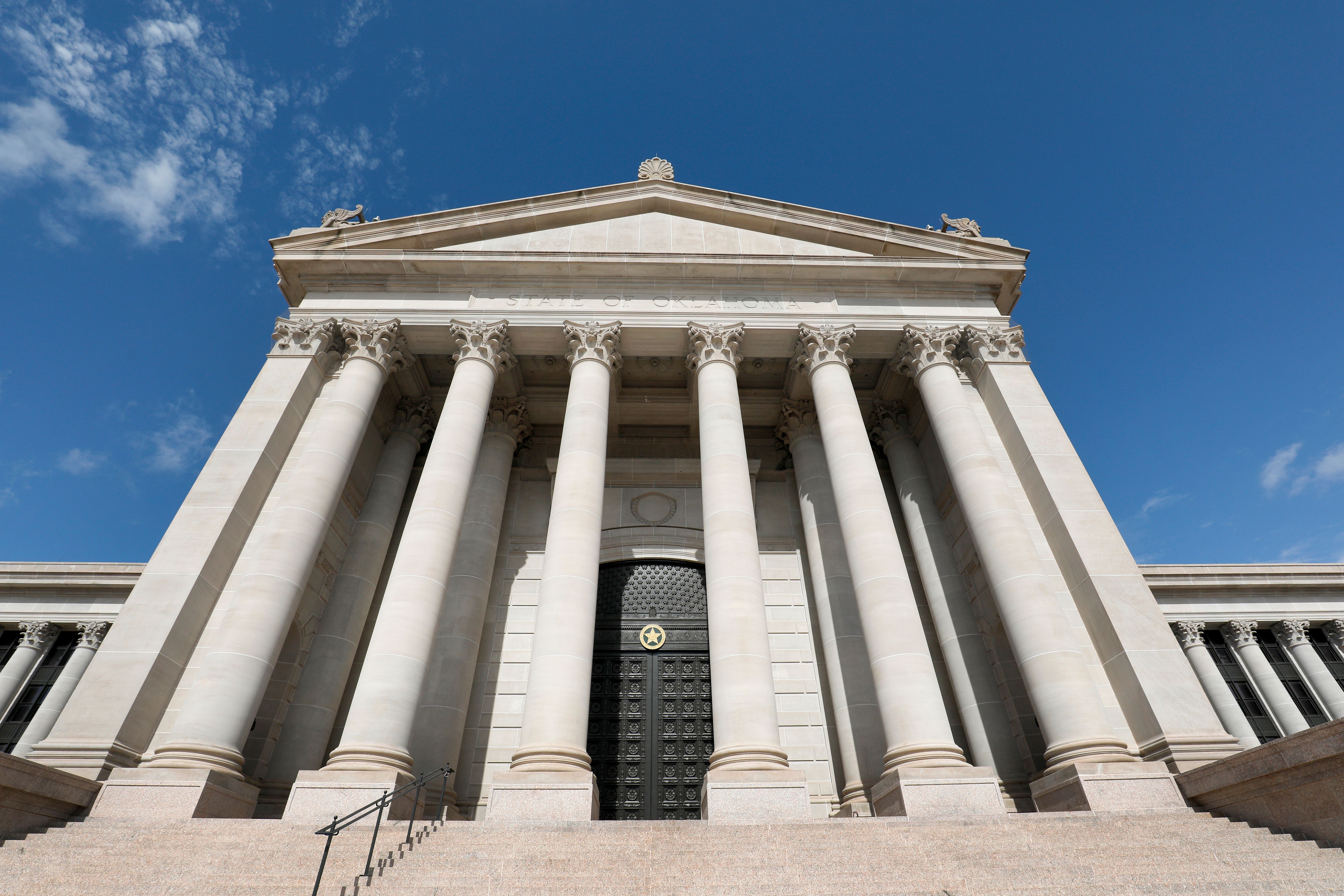
OKLAHOMA CITY – The Bible, it seems, won’t become Oklahoma’s official state book.
At least not this year.
While the Second Session of the 58th Oklahoma Legislature saw the creation of a $9.8 billion budget, pay increases for many state employees and millions of dollars allocated to reduce the backlog of people waiting for developmental disability services it did not designate an official state book.
That bill, House Bill 3890, never made it to the House floor.
Authored by state Rep. Tammy Townley, an Ardmore Republican and former owner of a Christian Bible bookstore, the measure would have designated the Bible as the state book.
Touting her proposal, Townley said Oklahomans were people of great faith, adding that the Bible was an integral part of numerous faiths and important to many.
“Even when we don’t always agree with each other, we always know that we have a foundation higher than politics that we can rely on to remain unshakeable when times are tough,” she said in a media statement.
Critics of the proposal objected, calling the bill an unconstitutional move to inject religion into state government. An action alert from the group, Freedom from Religion, said the measure would “almost certainly result in a preventable lawsuit that would cost state taxpayers dearly.”
Yet, in Oklahoma, residents say religion and faith are important. Data from the Pew Center shows that of the state’s 2.39 million adults, about 70% – 1.89 million – consider themselves Christian.
And while records shows the Bible remains a popular book in both Oklahoma and the rest of the country, a report from the American Bible Society notes that “the purchases of printed Bibles and other Christian books have experienced a marked downturn” since 2019.
“In the first two months of 2020, print Bible sales kept pace with the same period of 2019,” the report said. “However, the period from March 1 through May of 2020 saw a 39.5 percent drop in the category.”
Though Bible sales rebounded some, the report said sales still lag behind 2019 by almost 18%. The same report also indicated that fewer Americans are reading their Bible. According to the ABS, about 25% who responded to the group’s survey said they never used the Bible on their own. In 2020, that number had grown to 34%.
Still, even with the large number of Oklahomans who say they are Christian or have a religious affiliation, one state political scientist says the effort to make the Bible the state book is part of a bigger, more menacing trend: hyper-nationalism.
This trend “at the national level has been compounded at the state level where it is often far easier to push through initiatives meant to exalt one group of people over others, this has been used more recently to enshrine “American-ness,” said Rose State College Professor Emily Stacey.
Stacey, the author of the book, Global Politics, Political Participation and the Rise of Nationalism, said that hyper-nationalism has translated into defining characteristics such as the effort to make Christianity and the Protestant Bible dominate over other religions. It’s also part of an election year effort to rile up the base of conservative voters, she said.
“This wave of incredibly antagonistic legislation has been largely successful, particularly in states like Oklahoma and Florida, which feature extremely critical U.S. Senate races,” she said.
At the same time lawmakers shot down the effort to enshrine the Bible as Oklahoma’s official book, they were successful in restricting access to books that discussed human sexuality, LGBT issues and race relations.
This year state lawmakers passed House Bill 3092 which requires school libraries to have “age-appropriate materials” that follow community standards.
That bill, written by House Speaker Pro Tempore Kyle Hilbert and Sen. James Leewright, both Republicans from Bristow, was signed by Gov. Kevin Stitt in early May. Art that time, Hilbert told reporters the bill was written to empower local school boards to make decisions “that are best for their local school district.”
That bill is a watered-down version of legislation filed by state Sen. Rob Standridge, a Republican from Norman.
Standridge’s bill, Senate Bill 1142, would prohibit public school districts, public charter schools, and public school libraries from “having or promoting books that address the study of sex, sexual preferences, sexual activity, sexual perversion, sex-based classifications, sexual identity, gender identity, or books that contain content of a sexual nature that a reasonable parent or legal guardian would want to know about or approve of before their child was exposed to it.”
Standridge’s bill included a provision allowing parents to collect a fine of up to $10,000 per day for every day the questioned material remains on a school library’s shelf, after the material has been challenged.
But both measures were probably unnecessary.
Cherity Pennington, the head of the Oklahoma Library Association, said the state has had policies in place for decades that encourage parental involvement in selecting school library materials.
“We have had selection policies in place for years,” Pennington said in February.
Rilla Askew, an associate professor of English at the University of Oklahoma whose books have touched on issues such as the Tulsa Race Massacre, settlers in Oklahoma, and the Holocaust, said efforts to reduce access to books and the move to enshrine the Bible as the official state book were problematic.
“The truth of who we are and where we have been needs to be known,” she said.
Lawmakers who bring up legislation that would prevent young people from understanding who they are are suppressing the knowledge of the truth and of compassion to maintain a power base that is afraid of losing power, Askew said.
Askew, a nationally known award-winning novelist and scholar, said she was concerned by the rhetoric from many Oklahoma lawmakers.
“I was raised Southern Baptist,” she said. “My dad was a deacon in the church. My grandfather was. I was raised in the same culture that many of our state legislators purport to come from and yet, their values, what they are pushing are nothing like the values I was raised with.”
When she was a child, Askew said the church pushed to remain separate from government. “They insisted on it,” she said.
Today, she said, bills such as attempts to make the Bible the state book are examples of how the religious community’s faith has been held hostage by a political power. “White Christian nationalists are afraid of losing their power,” she said.