

NORMAN — Patrick Huval drove nine hours from his home in Louisiana just to be there. Huval, a self-confessed geek, is a game developer. He didn’t come to Norman for the football. Instead, for three days last week Patrick Huval was at ground zero for all things geek in Oklahoma.
Patrick Huval came to SoonerCon.
The jokes are well known. The nicknames overused. The folks at SoonerCon have heard them all: Geekville, Nerdfest. Dorktime. Nerdistan. There’s also the ever-popular Geek Valhalla and several other monikers that can’t be printed in a family newspaper.
The names don’t matter, though, because what isn’t widely known is the fact that SoonerCon has been around for a while. Let’s just say it has serious staying power. And it’s not just the nerds and the geeks that buy tickets.
Years ago, SoonerCon began life as Star OKC, a science fiction and fantasy club launched in 1971.
During those first years, Star OKC hosted some of the first Star Trek conventions in Oklahoma. For a handful of lucky ones that meant having your photo taken with the likes of James Doohan, the man who played Scotty on the original Star Trek, or Walter Koenig, the guy who played Chekov.
Star OKC grew in popularity and somewhere around 2006 evolved into SoonerCon.
Sure, even now there is still a room full of Star Trek fans, but SoonerCon has changed into an event that, today, is an all-inclusive pop culture-geek-nerd-cosplay-gaming-comic-art-film-program-festival thingy.
Headquartered in Norman, SoonerCon describes itself as a collaborative, volunteer-based nonprofit organization that brings together fans, creative and academic professionals, artists, authors, musicians, small and large businesses, and community members together each year at its annual convention.
It’s also popular.
What began with a few dozen fans in 1971 now draws more than 3,000 people to Norman for three days during the summer. Stephanie Brickman, communications manager for Visit Norman, said hotel attendance at this year’s event was estimated at about 3,400 with 440 room nights.
Direct economic impact from the conference was $123,775, she said, with a total economic impact estimated at about $190,000.
Money raised from the event is donated. This year, SoonerCon officials said they would donate money raised by the event to Bridges, a Norman-based charity that assists high school students by providing food, clothing, shelter, and assisting with medical needs so those students can graduate.
The nerds and geeks, it seems, bring money to spend.
•
The game room is huge. It’s wedged between the Exhibitor Hall and an area cleverly entitled the Main Programing Venue. The vast majority of the room is filled with tables for old-school board and role-playing games.
At the far end, opposite the door, occupying one corner is the land of video games. There, state-of-the-art computer screens shower the room in a bright palette of color and sound. In front of them, gamers of all ages blast, run and jump and kick their way to the next levels.
All around, tribes of other gamers have gathered, rolling dice and collectively going on quests, storming castles and fighting evil creatures.
Unless you go near the back.
There, Thomas Burke and Aaron McNeil are playing Monopoly. “I was looking for something to play and found this,” Burke said. McNeil, who only met Burke just before playing, thought a round of Monopoly looked fun.
At the same time McNeil was working to purchase Boardwalk, behind him, a dwarf was working to extract himself from by a slimy snake-like creature and an evil wizard.
Patrick Huval is here, too.
He’s set up in roughly the center of the room, at the end of a table designed to hold about eight people.
But Huval didn’t really come to play. You won’t find him at the video games. Instead, he came to do research.
A game developer, Huval and his two brothers have spent the past decade developing game called Pulp Hero, a sort of pop culture role-playing game. Think Dungeons and Dragons with movie quotes, television and pop music all mixed together. And, instead of dice, the game uses cards. Huval is set up and has the information and rules in each player’s spot. By replacing dice with cards, he said, players have more control over their characters.
His goal is simple: find some SoonerCon’s best gamers and let them take a whirl through his game, then tell him what they like and what they don’t. Eventually he and his brothers want to crowdfund a startup and launch the game.
“I’ve been testing and retesting and modifying and changing it,” he said. “I’ve been doing this for a while.”
Right now, Huval’s table is empty.
But he’s not worried. Gamers come in and out of the room like hungry teenagers at a taco truck. And the morning is still young.
•
The little boy stands quietly in his Iron Man costume. His father is just behind him, a few feet away, smiling. Dad has foregone his costume; he’s playing more of a supervisory role. That is, Tiny Iron Man’s older, wiser wingman.
The little boy doesn’t notice. Instead, he’s looking at a person directly in front of him.
Just across the hall, someone is wearing what looks like an authentic StarWars Mandalorian soldier’s costume. The Mandalorian pauses and looks down at the little superhero. Tiny Iron Man looks at the Mandalorian then quickly back at his father.
Dad smiles and nods.
Tiny Iron Man walks over and, timidly, shakes the Mandalorian’s hand. In the meantime, Dad grabs his phone and captures several images of greeting for posterity.
It’s that small moment, SoonerCon’s Programing Chair Aislinn Burrows said, that shows just what SoonerCon is all about.
“We’ve worked hard to create a space for people to have fun,” she said. “And kids are a big part of that. Cosplay has lots of appeal to the younger generation.”
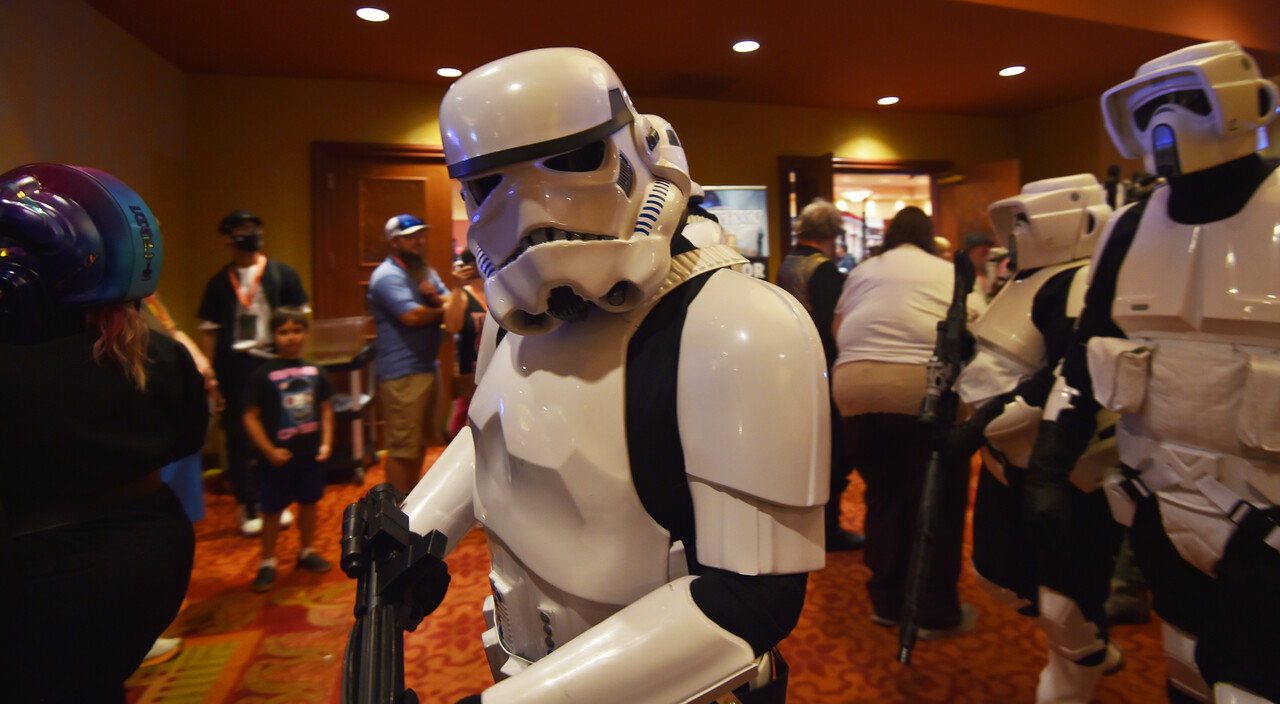
And a large portion of those who attend SoonerCon are all about costumes. In addition to Tiny Iron Man and the Mandalorian, SoonerCon had its share of people dressed as anime characters, superheroes, mythological beings, droids, aliens, a handful of zombies, mutants, Stormtroopers, a weird, blended ghost-like thingy that only the designer can explain, something that is truly dark and a little disturbing, and a lone Ghostbuster – complete with regulation proton pack.
“I think this year was so popular because people missed their convention family,” Burrows said. “It’s all about fandom and this fandom belongs to the community. And man, they love their costumes.”
Not far from Tiny Iron Man and his new Mandalorian friend, SoonerCon’s Ghostbuster strikes up a deep conversation with Wonder Woman.
Just behind the pair, in the Exhibitor Hall, Madison Pierce is excitedly registering voters – about the closest SoonerCon comes to politics. Pierce’s energetic smile is catchy. She’s focused on the kids who just turned 18 but haven’t registered yet. By noon she’d already signed up 21 new voters.
“We want to nerd the vote,” she said.
•
If SoonerCon is known for its efforts to embrace gaming and graphic novels and television shows such as Star Trek, it’s also big on movies.
Yes, the big budget science fiction and monster movies have swarms of fans who are vocal and energetic have their place, but SoonerCon also embraces what can only be called Hollywood’s younger and stranger side – the low budget “B” movie.
“There are a lot of ‘B’ movies that are better than ‘A’ movies said Buck Berlin, a panelist at SoonerCon said. “They run the gamut from the sacred to the profane.”
With discussions ranging from the best and worst movies of director Roger Corman to the film, Bubba Ho-Tep, a comedy-horror film by Bruce Campbell, or how low budget films can often make profound political statements, SoonerCon’s film panels go well beyond likes and dislikes and often become an academic discussion of styles, techniques and early efforts by well-known actors.
Getting into the weeds, Burrows said, on an issue is half the fun.
•
Michael Cross is a journalist. Monday through Friday, he anchors the newscast of KOSU, Oklahoma State University’s public radio station. A former capitol bureau reporter, Cross has been with KOSU since 2008, and has anchored the station’s newscast since 2014.
Cross is well known across Oklahoma and considered a topflight broadcast journalist with numerous awards and deep stories behind him.
But that’s just his day job.
When Cross isn’t doing all things journalism at KOSU radio, he’s gaming or producing podcasts about gaming. A longtime dungeon master, he’s also the host of Red Dirt DnD, a long-running podcast that takes the DnD world and places it on the frontier.
Call it Dungeons and Dragons meets the Oklahoma Panhandle – with sound effects.
Cross has been coming to SoonerCon since 2009.
“Because of the pandemic we all haven’t been together for three years,” he said. “That’s why this year is the Hero’s Homecoming. We’ve seen friends we haven’t seen in a long time, but it feels like it was just yesterday.”
The beauty of SoonerCon, he said, is that it isn’t limited to just one family.
“A lot of times when you go to a convention they are just focused on anime or they are focused on Star Trek or they are focused on Star Wars,” he said. “This (SoonerCon) is a true overall pop culture convention that deals with literature, comics, Dungeons and Dragons, pop culture, things like Star Trek and Star Wars. It’s whatever a person is into.”
That broad-brush approach, he said, is why SoonerCon remains popular. “When we were kids, this stuff was taboo. You weren’t cool if you embraced it. Now, it is. But today, you have a young people who have no idea that at any time before it wasn’t cool.”
Along with its ‘something for everyone’ approach, Cross said SoonerCon also reaches a segment of society that gets left behind: those who have been marginalized for their beliefs or their sexuality.
“It’s not just about fandom but who they are,” he said. “Their need to be different. Their need to be unique. Even though pop culture is popular there are people you will find at this convention who are here because they are still marginalized in society. But here, they can be free to be themselves. I think that’s the big thing going on. No matter what your quirk is, you’re going to be embraced here as a human being.”
•
The day passes quickly. Still, the cosplayers – even the ones if full-body masks and costumes – remain active and engaged. Yes, it may be 102 degrees outside by the Stormtrooper won’t be taking off his helmet, thank you very much.
Of course, they could have also attended the panel discussion: Wear Five Layers in 100 Degree Weather Without Dying.
Now it’s 2 p.m., time for the Star Wars parade.
Just down the hall, Tiny Iron Man, holds a juice box in one hand and his dad’s hand in the other. He’s waiting patiently, occasionally leaning far out in hall to see if the parade has started.
Eventually, the speaker crackles with the news.
Tiny Iron Man jumps up and down and leans sideways again. He spies the twin Darth Varders first.
And from that point, at least for the next 30 minutes or so, Tiny Iron Man is in his own world. With each passing costume, his smile grows bigger, and he stretches farther into the hallway. This is his world and each time one of the costumed players in the parade waved at him, Tiny Iron Man giggled and laughed and tugged on his dad’s hand.
For him, SoonerCon was simple, pure fun.
Not too far away, back in the game room, Patrick Huval is still waiting. He’s talked to a few people and answered some stray questions but he’s still waiting on a big group of players.
Huval isn’t worried, though.
Even if the players don’t come, he’ll consider his trip a success.
“I can aways attend the seminars and the panel discussions,” he said. “There is lots to do here and I’m fine. So far, everything has been good. We’ll get there.”
For others such as Michael Cross and Aislinn Burrows, SoonerCon 2022 has been a major success. Record attendance and lots of positive feedback; a chance to remind people just how much fun it can be to wear a costume; a chance to reconnect with friends; a chance to have that deep, meaningful discussion about a favorite monster movie.
Or, as panelist Joshua Cook said, it’s a chance to engage the brain.
“Sometimes the theater of the mind,” he said, “is the best way to do things.”