

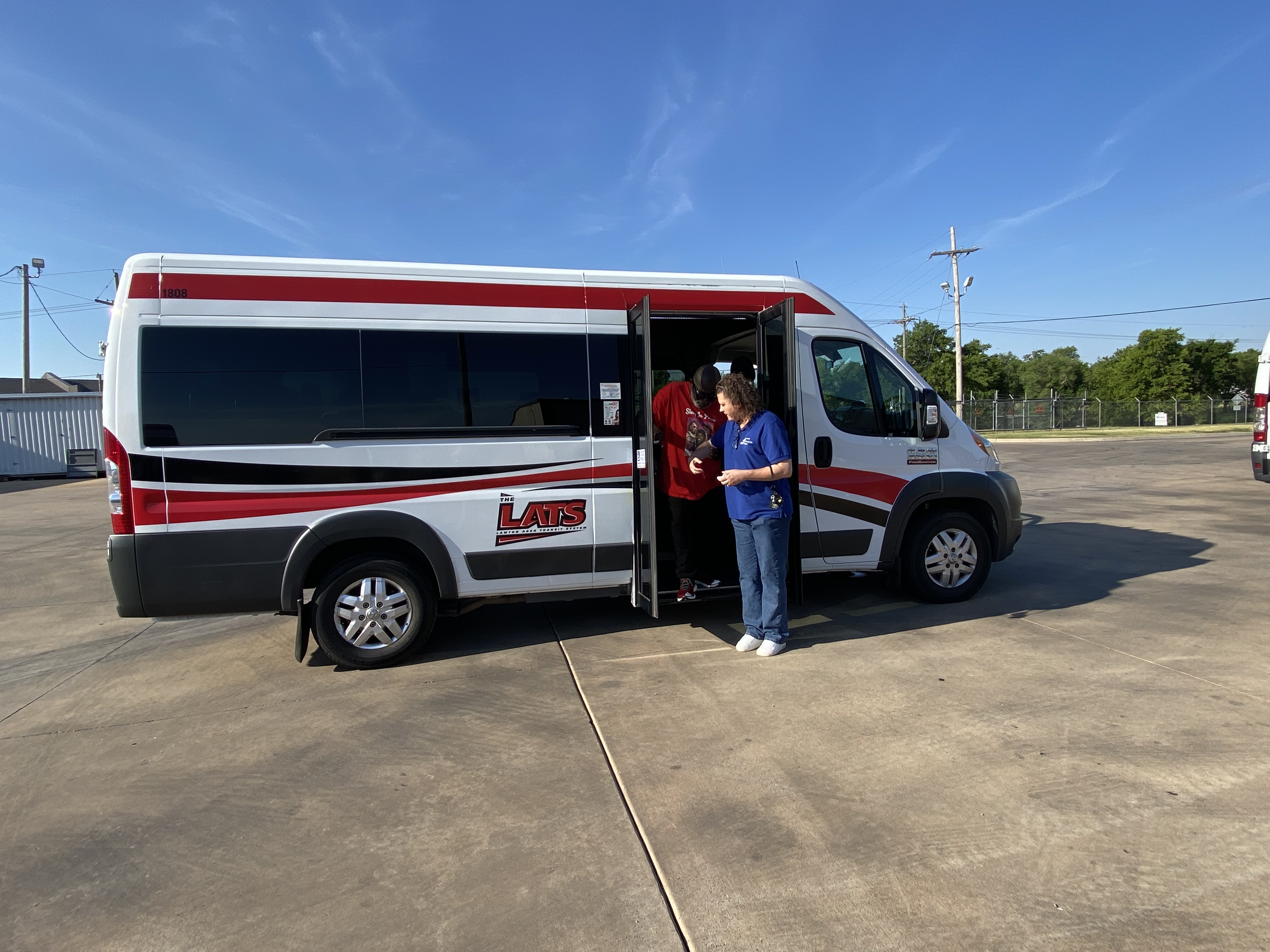
LAWTON — Lawton Area Transit System officials are moving ahead with a training program designed to accommodate all of their riders.
“People with disabilities are people just like you and me,” said Tony Hansley, LATS assistant general manager and safety coordinator, “so we treat them in such a way, but we also accommodate their disabilities.”
Members of Lawton Council of the Blind met with LATS personnel at the transit company’s Bishop Road facility on July 16 to build upon the disability training the two organizations began prior to the onset of the COVID-19 pandemic. The last in-person training session between LATS and LCB took place three years ago in July 2019, LCB member Rocco Bonacci stated.
Rae FitzPatrick, current LCB president, said she was excited to continue the partnership with the transit service.
FitzPatrick, who has optic atrophy – a condition which causes colorblindness, said she rarely gets behind the wheel these days, mostly because many traffic signals present challenges to those who are colorblind. Her plans include utilizing the public transit service more and more. She reminded everyone that blindness can affect people at any stage in life. She also commended LATS drivers for providing additional assistance to passengers with special needs.
Kay Love, president of the Oklahoma Council of the Blind, highlighted many challenges persons with visual impairments face each day while utilizing public transportation. Love, who is former president of LCB, underscored the importance of communicating with visually impaired passengers.
“One of the very first things we need to understand is that people who are visually impaired may look pretty normal, she said. “You can see us, but we cannot see you. So, the communication that you offer to us is critical.”
While people who are visually impaired may hear the bus pull to a stop, they may not be able to see the bus or its doors, she added. She recommended that drivers step out of the bus and help guide the would-be passengers onto the bus.
Love’s husband Tom added that persons with limited or no eyesight may have no idea whether there are other passengers nearby.
“What’s the first thing you do when you get on the bus?” he asked the audience. “You look around at other people and where you want to sit.
“In this case, you’ve got people who are visually impaired, and you’ve got to put them in the seat. Do you tell them, ‘Hey, there’s a person right next to you or if there’s a person, where they are?’”
In addition to communicating with passengers to overcome some of the challenges presented to persons who are blind, LATS drivers participated in several staged scenarios in the facility’s parking lot.
Drivers tried to navigate walking a 10-yard path using a cane, and boarded and disembarked transit vans while blindfolded or wearing distortion goggles, which encouraged transit drivers to be mindful in explaining details such as curb placement and height, path width and approximate step height and landing measurements. The goggles demonstrate different types and degrees of severity of visual impairments, including retinitis pigmentosa, detached retinas and macular degeneration.
According to the National Eye Institute, signs of retinitis pigmentosa are loss of vision at night and peripheral vision. Those with detached retinas report floaters or small dark spots with squiggly lines affecting vision, and persons with macular degeneration may experience loss of central vision or blurry/wavy lines in one’s central vision, the NEI states.
LATS has several transit vans for passengers with special needs, the organization’s website states. Clients with disabilities – such as those who are visually impaired or who have mobility issues – may ride free of charge, Hansley said.
He said understanding and meeting customers’ needs is paramount to the program’s success and that LATS welcomes the training and input from those with special needs.
“What we’re doing today is so important,” Hansley said. “We have a large ADA (Americans With Disabilities Act) clientele. So it helps us know how to empathize with our customers and look out for their needs.”
Hansley, who began with LATS shortly before the onset of the COVID-19 pandemic, added that since 2019 LATS has had several new drivers join their team.
“COVID shut everything down and we lost quite a bit of drivers,” he said. “We almost lost half our workforce. So it was pretty rough, but now things have cleared up somewhat.”
Looking ahead, LATS plans to continue to embrace the needs of all passengers and build on the training for those who require additional assistance.
“We’re going to start doing this on a quarterly basis,” he said of the training. “We’d like to have them (LCB) back in the fall to do this again. We need that refresher. We need that training even for our fixed-route service, where our drivers are a little less hands-on. They also deal with ADA clients.”
As for LCB’s mission to educate and promote inclusion in the community, Bonacci said, “It gives us reassurance that we are helping the community. What better way to do that than to teach people how to better understand people who have disabilities. Any way we can help, that’s why we’re here.”
For information on Lawton Area Transit Service’s paratransit program, call (580) 248-5252 ext. 103 or TTY (580) 248-3940 (for hearing impaired).
For more details on Lawton Council of the Blind, call (580) 536-1650.