

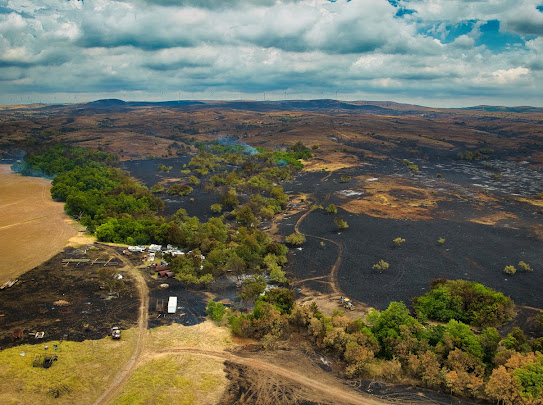
LAWTON — A spate of wildfires in Comanche County and elsewhere in Oklahoma has scorched thousands of acres of pastures; structures, vehicles and fire equipment have been damaged and destroyed; property owners and firefighters have sustained injuries from smoke inhalation and heat exhaustion; and one volunteer firefighter, April Partridge of Apache, who died March 20 while battling a grassfire near Edgewater Park, north of Lawton.
Scores of firefighters have been engaged virtually nonstop in Comanche County since July 28. Fires at Wolf Road and state Highway 115/Quanah Road “joined to become one large fire, said Amy Hawkins, emergency management specialist and Comanche County’s public information officer.
Four active fires were being fought simultaneously in Comanche County. Evacuation of homeowners in the area was initially envisioned, but that plan was cancelled after crews “contained enough of the fires to allow residents to return to their homes,” she said.
Fire crews “have been inserting control lines around the perimeter via graders and bulldozers or conducting back-burn operations for the last two days,” Hawkins said Sunday afternoon. “We are currently at 75% containment. Crews continue to work hot spots.”
Recent rainfall “has helped some, but the fires keep popping back up in some areas,” said state Sen. John Michael Montgomery of Lawton.
The goal of firefighters is to achieve 90% containment “by the end of the day,” Hawkins said Sunday.
Approximately 6,882 acres have been scorched, she estimated, and one unoccupied hunting structure was damaged.
“This is our fourth day working this fire,” Hawkins noted.
To date 46 fire departments and agencies have been engaged in the operation. “We have had crews from Comanche, Tillman, Grady, Kiowa and Caddo counties, including Fort Sill Fire and the Lawton FireDepartment, Comanche County’s Western Barn, the Forestry Services Division of the Oklahoma Department of Agriculture, and the Wichita Mountains Wildlife Refuge Fire Department.” The Southwest Incident Support Team has been on scene assisting with command operations, Hawkins said.
During the fire near Meers, “Josh Powers and I made a run to Walmart that first night to get some food for the firefighters,” Montgomery recalled on Sunday. Powers is the newly elected commissioner for Comanche County District 1. In addition, the Hilliary family and others donated hot dogs for the firefighters.
Elsewhere, a fire in Sterling at 240th and Cline Road consumed approximately 80 acres and was fought by an estimated 27 personnel from four departments, a task force from Grady County, the Comanche County Eastern Barn and the Central High Volunteer Fire Department, Hawkins said.
And a fire at Baseline and Red Elk covered approximately 30 acres and required three fire departments to contain it, she said.
Comanche County has 20 volunteer fire departments, and virtually every one has been summoned to help suppress a fire somewhere in recent months. And the Lawton Fire Department was quick to lend assistance to area volunteers recently, Montgomery noted. “This has become almost a regional effort.”
Area firefighters expressed their thanks to the many organizations that donated food, water, Gatorade, ice and snacks during their firefighting operations. “And a great ‘thank you’ to GW Aerial Cinematography of Elgin for coming out and helping us get eyes in the sky,” Hawkins said.
High temperatures a catalyst for fires
A massive fire in Blaine County in July seared an estimated 10,000 acres and was fought by 120 fire departments, including one from Lipscomb County, Texas, said state Rep. Mike Dobrinski of Okeene. The Oklahoma National Guard provided aerial support, he added.
When the Legislature reconvenes next February, additional funding for rural fire departments “will be at the top of my priorities,” Dobrinski said.
“These volunteers need all the help we can give them,” echoed Montgomery.
“The intense heat alone is helping those fires start, and helps keep them going,” said Rick Smith, warning coordination meteorologist with the National Weather Center in Norman. Temperature records across the state were set on July 19, and two dozen Mesonet sites in Oklahoma “broke all-time record highs” on July 24, Smith told the Oklahoma News Report.
Adverse effects on ag industry
Heat, drought and fires are having a long-term,adverse, cascading effect on the agriculture industry.
“They’re taking a terrible toll on crops,” said Scott Blubaugh, president of Oklahoma Farmers and Ranchers.
“I see a lot of crops that will never be harvested this summer; they’ll be plowed under,” Blubaugh told ONR recently. He said he farms 600 acres of soybeans in Kay County “and I doubt I’ll harvest any of those acres, because the drought and temperatures have stressed them so bad.”
The beef cattle industry faces similar issues.
Many farmers and ranchers, whose profit margins are already thin, face the difficult decision of whether to sell their livestock at below-market prices since they don’t have enough grass or hay to feed their cattle.
“I’ve still got some cows, but I’m not in great shape,” cattleman Don Armes of Faxon told Southwest Ledgeron Saturday.
“All of this land that’s burned off will be great next year, when it greens up from the spring rains,” he said.But because of the drought and the fires, “It’s not providing much right now.”
Compounding the problem is a dearth of hay. “I have a neighbor who found some hay for sale in Nebraska,” Armes said. “But it’d cost $6 a mile to drive 200 or 300 miles up there to get it.” Diesel fuel prices in Lawton and Elgin topped $4 per gallon on Saturday.
Because of the drought and the searing heat, Oklahoma ranchers have been able to “put up only about 20% of their normal hay crop, so they won’t have enough to get through the winter,” Blubaugh told ONR recently. “Even now they’re having trouble feeding their animals because the grass has dried up.”
Farmers and ranchers who sell their cows and calves before they’re ready are reducing the herd, leaving little with which to start next year.
“Typically we sell our calves in February or March, after we get them up to about 800 pounds,” Armes said. “But some folks may not have that opportunity because of limited availability of grass, and they may not be able to find any hay, at least at an affordable price. They might have to take whatever the market offers.”
Armes also said, “I need to get that calf off that cow, to prevent her from producing milk. I need to maintain her condition during this drought,” he explained.
High temperatures fatal to livestock
Livestock owners need to be extra vigilant during this heat wave, said Alicia Gorczyca-Southerland, assistant state veterinarian with the Oklahoma Department of Agriculture, Food and Forestry.
“It doesn’t take long for livestock to deteriorate from heat, and they can die from excessive heat,” she said during an interview with ONR.
The brutal temperatures that have had Oklahoma sweltering of late killed several hundred head of cattle, perhaps as many as 2,000, that were confined in feedlots around Liberal, Ulysses and Garden City in southwest Kansas, just north of the Oklahoma Panhandle, the weekend of June 11-12.
As temperatures soared to 108 degrees in some areas of Kansas, the cattle succumbed to extreme heat, lack of wind and high humidity, agriculture officials reported.
The mostly Angus cattle absorbed the heat faster than other lighter-colored livestock. Adding to the conditions were the weight of the feeders, many of which were nearly ready to be trucked to slaughtering plants.
Producers “need to make sure their water systems are working, try to provide fans and some kind of ventilation for their animals, and offer as much shade as possible,” Gorczyca-Southerland advised.
Current conditions “aren’t good in any direction you look,” Armes said. “We need rain, but there’s nothing in the outlook right now. This will be a long-term problem,” he added.
Consumers should brace for higher prices at the grocery store “for months to come, as producers recover from this heat wave,” said ONR’s Jason Doyle.