

OKLAHOMA CITY — Attorneys general from almost half of the states have urged majority and minority leaders in both houses of Congress to pass “meaningful legislation … to allow states to jam contraband cell phones.”
Smuggled mobile telephones are being used in prisons across the nation to commit narcotics trafficking and even to order murders. Prison officials have “no way to block the devices” and they pose “an active threat to public safety,” the states’ chief law enforcement officers wrote in a letter dated Jan. 25.
The document was signed by 22 attorneys general, including Gentner Drummond of Oklahoma, Ken Paxton of Texas and Tim Griffin of Arkansas.
“This is a significant problem across the country, not isolated to one state,” the attorneys general noted in their letter, pointing to incidents in Oklahoma, South Carolina, Tennessee, Georgia and Indiana.
“We need Congress to pass legislation giving states the authority to implement a cell phone jamming system to protect inmates, guards, and the public at large,” the AGs wrote.
The Federal Communications Commission has balked at the idea, expressing concern that jamming cell phones in prison could interfere with public safety communications.
U.S. Sen. Tom Cotton, R-Ark., introduced a measure last year that would have allowed a state or federal correctional facility to operate a jamming system “to interfere with cellphone signals within inmate housing facilities.” Cotton’s proposal was co-authored by six colleagues, including Sens. James Lankford, R-Okla., and Lindsey Graham, R-S.C., but never received a hearing before the 117th Congress expired last year.
Over the past five years, South Carolina has had four major drug trafficking cases where the operations were administered “behind prison walls through the use of contraband cell phones, with the most recent operation being directly related to a Mexican drug cartel,” South Carolina Attorney General Alan Wilson wrote.
Additionally, gang-affiliated inmates in a maximum-security South Carolina prison used cell phones to organize and coordinate “a brutal attack that killed seven inmates and injured many more,” in 2018, Wilson wrote.
In Tennessee, a Memphis inmate used a contraband cell phone to “orchestrate drug conspiracy deals” by sending a FedEx package full of methamphetamine to his girlfriend, Attorney General Jonathan Skrmetti said.
Prison inmates in Georgia used contraband cell phones to make scam calls and demand payment, and even texted photos of bloodied inmates to the victims’ relatives, demanding cash.
According to the Indiana Department of Corrections, last year a gang’s enforcer incarcerated behind prison walls ordered a double homicide hit using a contraband mobile telephone.
275 convictions in four investigations of prison drug rings
In Oklahoma, federal, state and local investigators and prosecutors “concluded their fourth unrelated long-term investigation and prosecution of separate drug-trafficking networks directed from inside state prisons, using contraband cell phones,” Western District U.S. Attorney Robert J. Troester announced last month.
Collectively, the multi-year investigations yielded the following results:
• 275 defendants were convicted, including several who either ordered or participated in acts of violence such as witness retaliation, witness tampering, shootings, kidnappings and death threats against prosecutors as part of their conspiracies.
Those convicted included 60 Southside Locos gang members and their associates, 69 members of the Universal Aryan Brotherhood and their associates, 125 members and associates of the Irish Mob gang and 21 other assorted criminals.
• 30 of those defendants were incarcerated in Oklahoma Department of Corrections facilities while directing their often-violent drug trafficking networks through use of unauthorized cell phones smuggled in by visitors or bribed correctional officers.
• Four corrections workers at the state and county levels were prosecuted for crimes that included conspiring to distribute drugs inside correctional facilities, possessing methamphetamine with intent to distribute and conspiring to launder drug money.
• 1,061 pounds of methamphetamine, heroin, and cocaine – half a ton of narcotics were removed from the streets.
• 393 firearms were confiscated.
• $1.335 million in cash was seized by law enforcement.
“Being behind bars did not stop state inmates in four separate criminal organizations from accessing contraband cell phones to continue directing their drug trafficking and violent networks through associates outside prison walls,” Troester said.
Smuggled phones used by convict to peddle drugs in Tulsa area
While Troester and other law enforcement officials were making their announcement in Oklahoma City, U.S. Attorney Clint Johnson in Tulsa was reporting a similar case there.
Richard Dale Deeter Jr., 45, and five co-conspirators pleaded guilty in Tulsa’s Northern District federal court to narcotics trafficking crimes.
Deeter, who has a lengthy record of state drug crimes and other offenses, used contraband cell phones to direct a methamphetamine distribution operation while imprisoned for a state drug trafficking conviction, Johnson announced.
According to court documents, Deeter directed the purchase and receipt of bulk quantities of methamphetamine from Oklahoma City for the purpose of redistributing the drug within the Northern District of Oklahoma. Deeter and his co-conspirators utilized Facebook Messenger, video calls, text messaging, encrypted instant messaging and other methods to conduct their illicit operations.
Contraband phones ‘our #1 security threat’
“Contraband cellphones are our Number 1 security threat,” said Scott Crow, former interim director of the Oklahoma Department of Corrections.
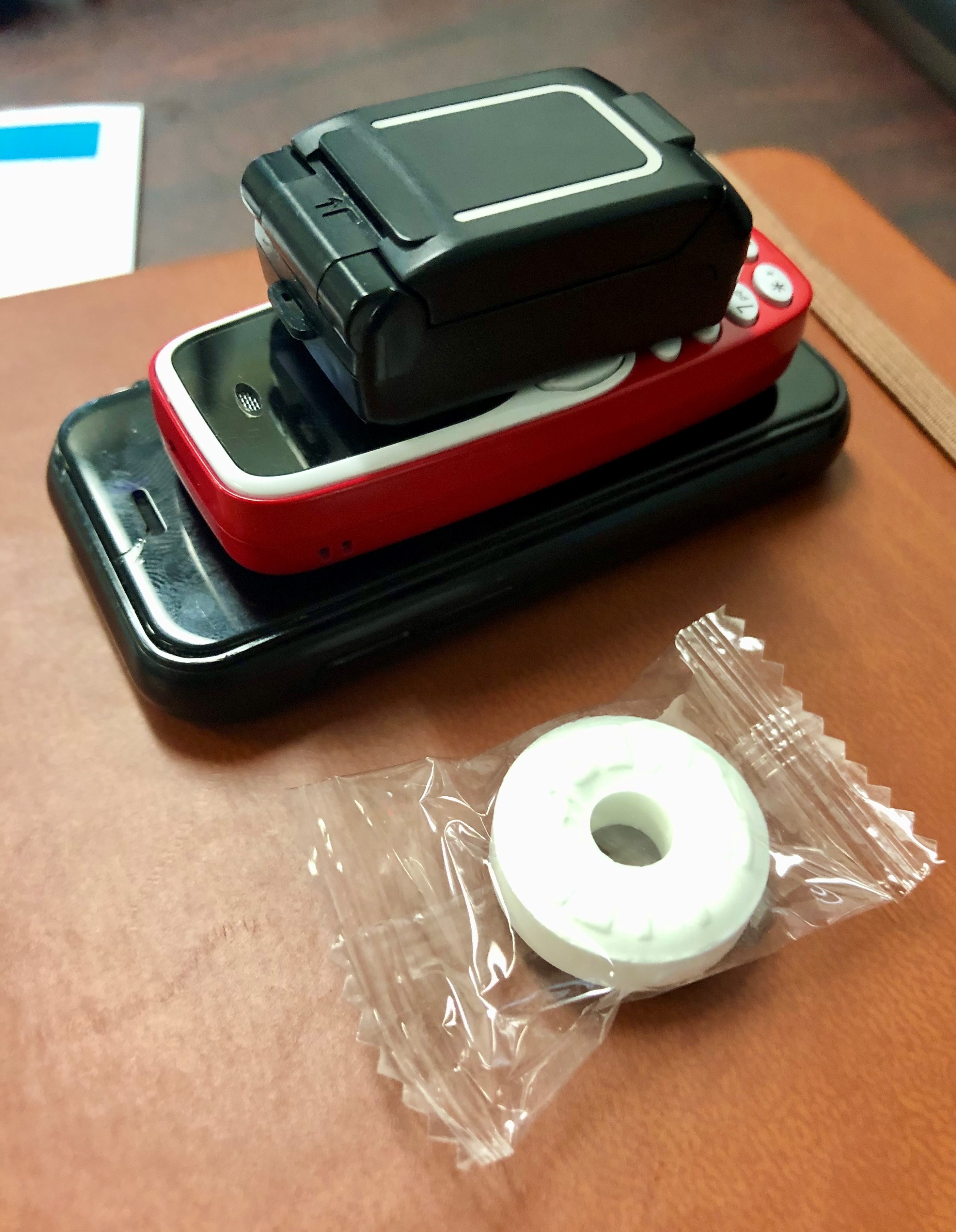
“We find a lot of cell phones” in the state prison system, a Corrections Department spokesman told the Southwest Ledger in 2020. “Some are barely bigger than a finger and can be easily concealed.”
Mobile phones prized by convicts are specialty devices that aren’t sold in stores, the spokesman said.
“They don’t need ‘smart phone’ technology,” he said. “All they’re needed for is to dial out” from prison to an accomplice on the outside.
More than 33,400 contraband cell phones have been confiscated in Oklahoma’s state and private prisons in the past six years, an average of 5,572 per year, Corrections Department records reflect.
Gov. Kevin Stitt issued an executive order in 2019 that directed the secretary of public safety, the secretary of digital transformation and administration, and the Oklahoma Department of Corrections to research and implement technology solutions to eliminate the public safety threat of contraband cellphones in Oklahoma prisons and correctional facilities.
“Contraband cellphones in our state prisons have become a serious public safety concern in Oklahoma,” Stitt said.
“This is a technology issue that must be answered with a technology solution in order to efficiently and effectively improve safety for our inmates, Department of Correction employees and citizens of Oklahoma,” the governor said. “We are working to address the contraband cellphone crisis in order to minimize criminal activity in and out of our prisons.”